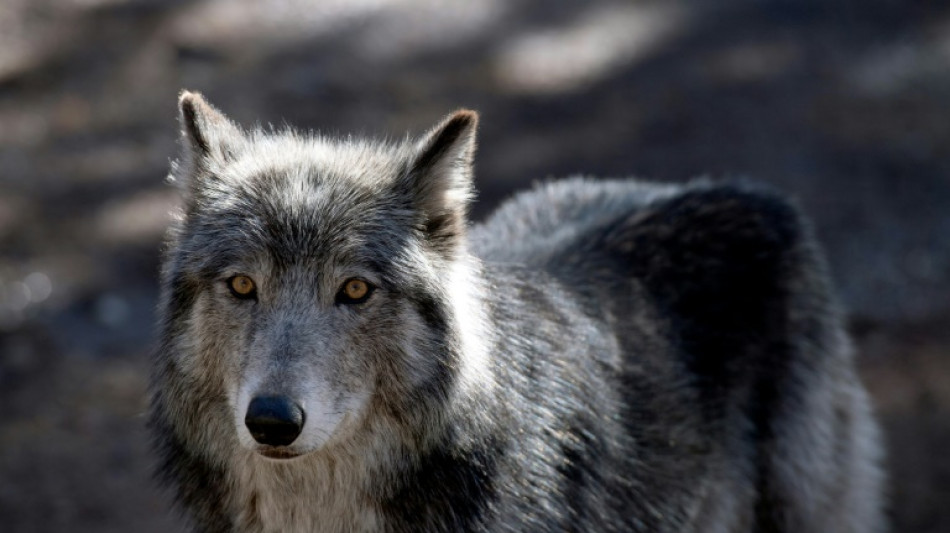
Like dogs, wolves recognize familiar human voices / Photo: Jason Connolly - AFP/File

 Drones hit Moscow as Russians go to the polls

 New England boss Fleming says 'wrong' to ask Stokes to end retirement

 Germans vote in elections threatening fresh blow to Merz

 US fears rapid escalation in Mideast after Houthis attack Riyadh

 Japan triathlete Hojo wins first gold of Asian Games

 IOC president impressed by 'beautiful' Asian Games wooden huts

 First Asian Games gold goes to Japan as China's 13-year-old Yu lights up pool

 Data centre command hub keeps AI up and running

 Pope Leo in France: the issues on the table

 Packing for a pope: behind the scenes on foreign trips

 Republicans find transgender issues a powerful political weapon in midterm campaigning

 German state elections threaten new shock waves for Merz

 Chile's Bachelet quits race to be next UN chief

 Raphinha treble fires perfect Barca to win at Sevilla

 Thiam makes winning heptathlon return at Decastar meet

 Czechs beat USA to qualify for Davis Cup finals

 Dortmund sink Stuttgart to climb to Bundesliga summit

 Trump says will not tolerate attempts to slow AI growth

 'It has to stop': runners protest women's murders in S.Africa district

 Fire erupts near Riyadh airport as Houthis claim strikes

 Cuba works to restore power after another blackout

 England thrash Sri Lanka again to return to top of T20 rankings

 Arsenal thrashed by Brighton, sorry Spurs lose again

 South Korea, Austria qualify for Davis Cup finals

 Seare shocks Ingebrigtsen to win world 5km gold

Here, wolfie, wolfie, wolfie!
Like dogs, wolves recognize and respond to the voices of familiar humans more than strangers, according to a study that has implications both for the story of canine domestication and our broader understanding of the natural world.
Holly Root‑Gutteridge of the University of Lincoln, a co-author of the paper that appeared in Animal Cognition this week, told AFP a longstanding theory held that dogs' ability to distinguish human voices was a consequence of generations of selective breeding.
"So we wanted to look at wolves, because obviously nobody has been selecting so that wolves can recognize human voices," she said.
Root‑Gutteridge and colleagues carried out experiments across five zoos and wildlife parks in Spain, involving a total of 24 gray wolves, both male and female, aged between one and 13.
The team set up speakers and first played the animals the voice of a number of strangers that they would "habituate" to, in other words, get bored of, because they decided it was not salient to them.
Then, they played the wolves the voice of their keeper who would say familiar things to them in Spanish, such as "Hey, what's up wolves?" or "Hello little ones, good morning, how's it going?"
In gestures that would be instantly recognizable to any dog owner, the wolves raised their heads, pricked their ears up, and turned towards the speaker.
To test the effect wasn't random, the researchers went back to playing the wolves recordings of strangers, and found they once more lost interest.
Finally, to make sure the wolves genuinely knew their keepers' voices, rather than just knowing words that the familiar humans would normally say to them, the team mixed things up and had the keepers utter a stream of unfamiliar phrases.
Once more the results held up.
- 'Listening to us' -
The fact that the wolves engaged with disembodied voices played through speakers echoes what's been seen in dogs from the era of gramophones -- as captured in a famous painting entitled "His Master's Voice" -- to today's video doorbells, though it's not yet known whether our pooches enjoy this or it frustrates them.
In terms of implications, Root‑Gutteridge said it was significant that wolves possessed the ability to distinguish between humans despite the fact that our species went our separate evolutionary ways tens of millions of years ago.
Before this, there had been limited study on the topic of how animals differentiate between the vocalizations of other species. Research had shown our close cousins, gorillas listen to people, but that was expected.
Big-brained elephants have also been found to distinguish the gender, age, and ethnicity of humans by their voices, assigning less threat value, for example, to women and children, in addition to being more fearful of the elephant-spearing Maasai than the agrarian Kamba.
Given the new finding, "chances are, lots of species are listening to us and getting to know us as individuals," Root‑Gutteridge said.
And it's not all about us, she said. Dogs could be listening to the neighbors' cats and understanding the difference between one meow or the other, for example.
"If the abilities are that general, it means that animals might be having a lot more cross species interactions than we had thought about before."
R.Garcia--AT



