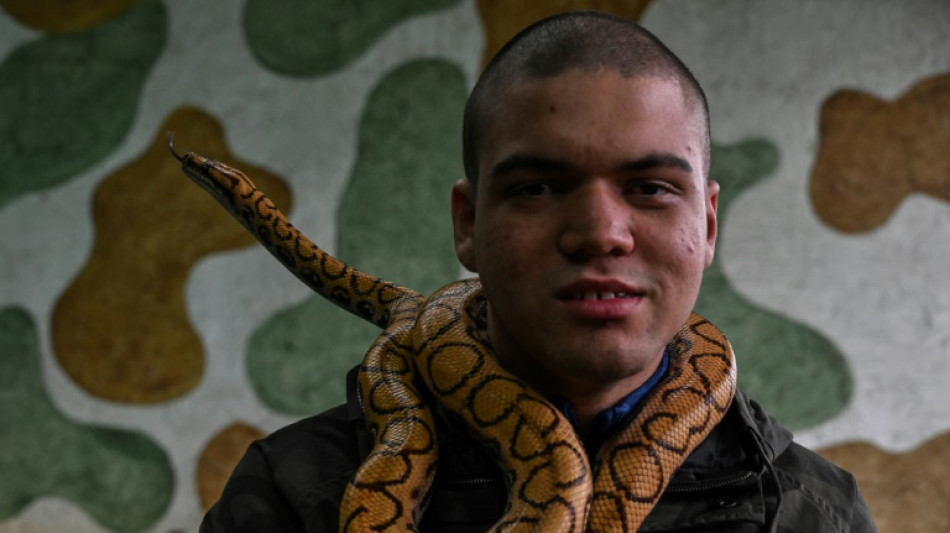
Snakes as therapy animals: reptiles help heal in Brazil / Photo: Nelson ALMEIDA - AFP

 Drones hit Moscow as Russians go to the polls

 New England boss Fleming says 'wrong' to ask Stokes to end retirement

 Germans vote in elections threatening fresh blow to Merz

 US fears rapid escalation in Mideast after Houthis attack Riyadh

 Japan triathlete Hojo wins first gold of Asian Games

 IOC president impressed by 'beautiful' Asian Games wooden huts

 First Asian Games gold goes to Japan as China's 13-year-old Yu lights up pool

 Data centre command hub keeps AI up and running
 Pope Leo in France: the issues on the table

 Packing for a pope: behind the scenes on foreign trips

 Republicans find transgender issues a powerful political weapon in midterm campaigning

 German state elections threaten new shock waves for Merz

 Chile's Bachelet quits race to be next UN chief

 Raphinha treble fires perfect Barca to win at Sevilla

 Thiam makes winning heptathlon return at Decastar meet

 Czechs beat USA to qualify for Davis Cup finals

 Dortmund sink Stuttgart to climb to Bundesliga summit

 Trump says will not tolerate attempts to slow AI growth

 'It has to stop': runners protest women's murders in S.Africa district

 Fire erupts near Riyadh airport as Houthis claim strikes

 Cuba works to restore power after another blackout

 England thrash Sri Lanka again to return to top of T20 rankings

 Arsenal thrashed by Brighton, sorry Spurs lose again

 South Korea, Austria qualify for Davis Cup finals

 Seare shocks Ingebrigtsen to win world 5km gold

A yellow-and-brown boa constrictor wraps itself around David de Oliveira Gomes's neck like a scarf, but the 15-year-old Brazilian with autism is fascinated, not afraid.
For him, this is therapy.
"His name is Gold. He's cold. He eats mice," Gomes tells his therapist at a treatment center in Sao Paulo, gently holding the large snake as it slithers around him.
That is exactly the kind of sentence his therapist, Andrea Ribeiro, is trying to elicit.
She specializes in treating people with disabilities, autism or anxiety, using an unusual method: reptile therapy, which she says helps patients relax and improve their communication, motor skills and other abilities.
"He's working on speech and memory formation," the 51-year-old language-speech therapist says of Gomes, sitting at a table with him and the large snake.
Ribeiro has pioneered this method over the past decade at the treatment center, which features an open-air space where patients interact with lizards, turtles and a "jacare" -- a kind of alligator native to Latin America that is common in Brazil, including in the Amazon rainforest.
The treatment is not scientifically proven.
But "it's been medically demonstrated that when people come in contact with animals, it releases neurotransmitters such as serotonin and beta-endorphins that give a sense of pleasure and well-being," says Ribeiro.
"That makes (patients) feel good and want to learn."
The reptiles "enable us to achieve better, faster results," she told AFP.
- Step aside, dogs -
Ribeiro used to use dogs in her treatment sessions.
But she found their constant attempts to play and interact made some patients uneasy, especially those with autism.
So she turned to reptiles.
It's a class of animals that makes many people squirm.
But people with autism tend to approach them "without prejudice," she says: The animals spark their curiosity without making them uncomfortable.
The reptiles, for their part, "are indifferent," she says.
"They don't seek attention the way some mammals do."
Ten-year-old Gabriel Pinheiro is petting a small alligator, trying to imitate Ribeiro's syllables by opening his mouth wide three times: "Ja-ca-re."
"It's wet," he says, his eyes fixated on the creature from behind his glasses.
The alligator's scales are "hard," its belly "soft," he says, as the therapist helps him work on opposites.
He and Ribeiro then sing a song about the jacare to practice auditory memory skills.
Pinheiro's mother, Cristina, credits four years of this therapy with helping improve his listening, communication and motor skills.
"He's always happy when we come," she says.
- Reptilian massage -
Another patient, 34-year-old Paulo Palacio Santos, suffered severe brain damage in an accident that left him paralyzed and speechless.
Ribeiro wraps his face with a thick snake, whose weight and cold temperature help reactivate Santos's swallowing reflex, she says.
She then uses a smaller boa constrictor to work the muscles around his mouth.
The handling of these species is regulated by Brazil's environmental authority, IBAMA.
Ribeiro works side-by-side with biologist Beatriz Araujo, whose job is to monitor the animals' stress levels and ensure patients remain safe.
There has never been an accident in 10 years of treatment, the center says.
The reptiles, which are raised on site, are accustomed to human contact. No poisonous snakes are used.
"I'm always here, just in case (an animal) reacts unexpectedly," says Araujo.
"The dangers are the same as for close contact with any animal."
E.Rodriguez--AT