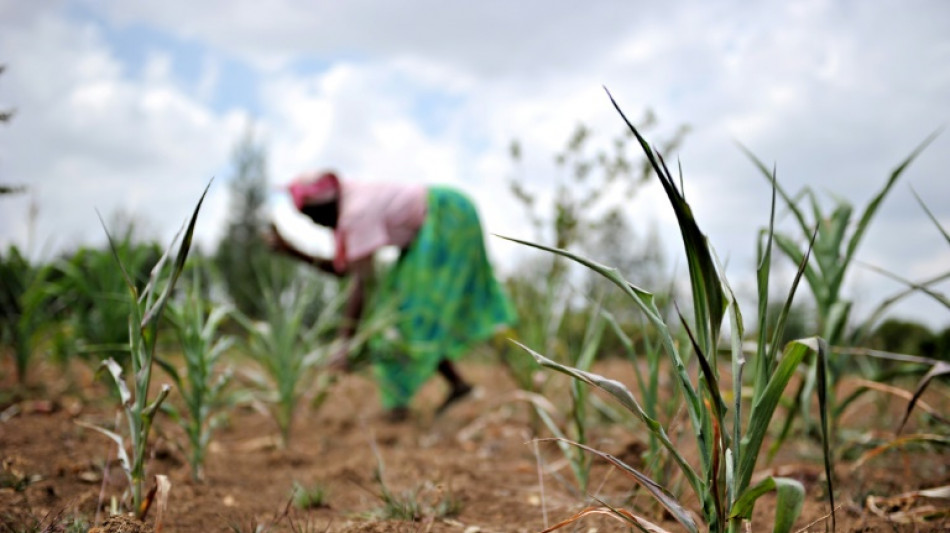
Disinformation soils Kenya's GMO debate / Photo: Tony KARUMBA - AFP/File

 Germans vote in elections threatening fresh blow to Merz

 US fears rapid escalation in Mideast after Houthis attack Riyadh

 Japan triathlete Hojo wins first gold of Asian Games

 IOC president impressed by 'beautiful' Asian Games wooden huts

 First Asian Games gold goes to Japan as China's 13-year-old Yu lights up pool

 Data centre command hub keeps AI up and running
 Pope Leo in France: the issues on the table

 Packing for a pope: behind the scenes on foreign trips

 Republicans find transgender issues a powerful political weapon in midterm campaigning

 German state elections threaten new shock waves for Merz

 Chile's Bachelet quits race to be next UN chief

 Raphinha treble fires perfect Barca to win at Sevilla

 Thiam makes winning heptathlon return at Decastar meet

 Czechs beat USA to qualify for Davis Cup finals
 Dortmund sink Stuttgart to climb to Bundesliga summit

 Trump says will not tolerate attempts to slow AI growth

 'It has to stop': runners protest women's murders in S.Africa district

 Fire erupts near Riyadh airport as Houthis claim strikes

 Cuba works to restore power after another blackout

 England thrash Sri Lanka again to return to top of T20 rankings

 Arsenal thrashed by Brighton, sorry Spurs lose again

 South Korea, Austria qualify for Davis Cup finals

 Seare shocks Ingebrigtsen to win world 5km gold

 Brigitte Bardot widower slams sale of star's belongings

 Aston Villa compound Tottenham's misery despite late rally

A Kenyan government decision to allow imports of genetically modified maize to help combat its food crisis has sparked disinformation, with leading politicians spreading unsubstantiated claims about the health risks of the crops.
In October last year, the East African nation lifted a decade-long ban on the cultivation and importation of GM crops, partly in response to the worst drought to ravage the Horn of Africa region in 40 years which has left millions hungry.
A Nairobi high court later blocked the decision, pending a ruling on a lawsuit brought by a farmers' lobby group which argues that the government move was unlawful.
But the lifting of the ban has triggered a wave of disinformation off- and online.
This included veteran opposition leader Raila Odinga falsely claiming that GM crops caused mutations in humans and President William Ruto making misleading assertions about their use in other countries.
"Both sides of the debate, those who are pro (genetically modified organisms) and those who are against GMOs, have been to some extent propagating that kind of misinformation," Anne Maina, national coordinator at the Biodiversity and Biosafety Association of Kenya, told AFP.
A 2023 study by the Alliance for Science, a project funded by the Bill & Melinda Gates Foundation, warned that Kenyans were "subjected to the world's worst misinformation" on GM crops.
According to the research, false or misleading claims "primarily originated in the form of quotes from prominent Kenyan politicians", which were then repeated in media reports.
- 'Not supported by evidence' -
Odinga has alleged that eating food made from GM crops would cause men to grow breasts and women to develop testicles. A video of his remarks at a public address on May 7 went viral on Facebook, with one post garnering more than 17,000 views.
Experts say there is no scientific proof of GM crops causing sex changes in humans.
"Claims of gender mutation are not supported by scientific evidence," the European Food Safety Authority (EFSA) said in an email to AFP.
The World Health Organization (WHO) says GM foods available on the market have passed safety assessments and are unlikely to be harmful.
About a decade ago, Odinga backed GMOs while serving as prime minister. However, he now says his stance was based on "limited information" and has since come to believe GM crops cause human mutations.
This puts him at odds with Kenyan President William Ruto, a GMO supporter who also faces opposition from other politicians.
- Politicised issue -
Ekuru Aukot, who ran in Kenya's 2017 presidential election race, told his 350,000 Twitter followers last year that lifting the ban was akin to "feeding people poison in the pretext of saving their lives".
Meanwhile, 2022 presidential candidate George Wajackoyah asserted that Mexico banned GM crops after cases of men developing breasts and women growing beards.
There is no evidence to back up this claim. In 2020, Mexico ordered the elimination of GM corn by next year, with its leader saying his country would "not accept transgenic corn for human consumption".
But the government rowed back in February following pressure from the US –- its main trading partner and the leading producer of GM crops -– announcing it would allow GM corn for animal feed and industrial food production.
In Kenya, Ruto also contributed to the spread of disinformation when he misleadingly said in a TV interview in January that South Africa and the United States were "100 percent GMO".
South Africa has so far approved the cultivation of only three GM crops while US supermarkets sell organic produce alongside GM products clearly labelled as such.
- Herbicide safety concern -
Many countries allow the import but not the cultivation of GM crops.
In Kenya, the GMO debate is "based on people and not fact", according to Joel Ochieng, the lead agricultural biotechnology researcher at the University of Nairobi.
"We have politicians in Kenya whose main business is to fight each other. Because the current president has said it is safe, the game (of the opposition) is normally to oppose," he told AFP.
Ochieng added that the main safety concern was not linked to the development of GM crops but glyphosate, a herbicide commonly used in tandem with them and which poses potential risks.
The WHO has classified glyphosate as "probably carcinogenic in humans" and several countries around the world have already banned the weedkiller.
However other agencies including the European Chemicals Agency (ECHA) have said that scientific evidence does not justify classifying glyphosate as a carcinogen.
Agriculture is the biggest single contributor to Kenya's economy, generating more than 21 percent of gross domestic product (GDP) last year, according to government figures.
Festus Kavita, a farmer in Machakos, about 65 kilometres (40 miles) southeast of Kenya's capital Nairobi, said he was worried that the political mud-slinging was standing in the way of addressing the country's real problems.
For him, using GMOs for animal feed would allow farmers to grow more organic crops for human consumption.
"It's a lose-lose debate in my opinion because it misses out on actual solutions," he told AFP.
A.Taylor--AT



