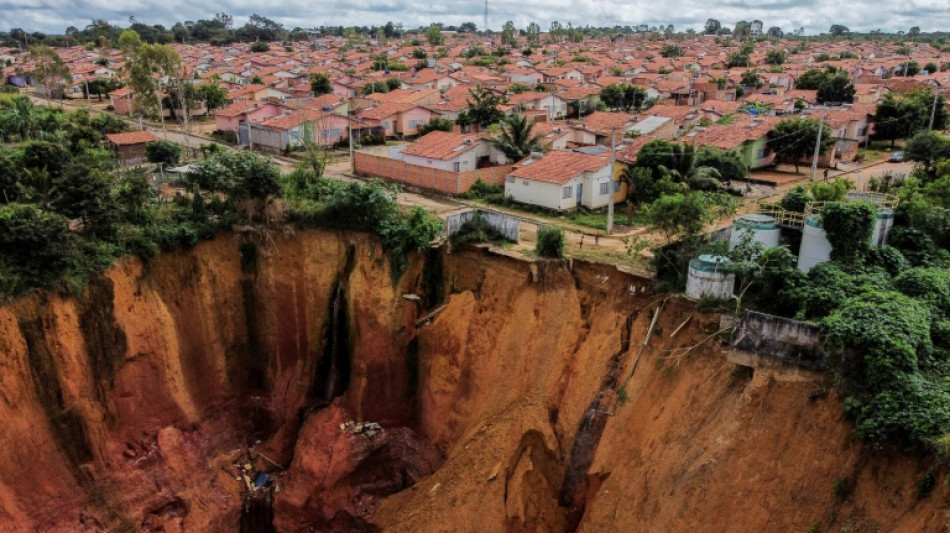
In Brazil, a damaged city lives on edge of abyss / Photo: NELSON ALMEIDA - AFP

 Germans vote in elections threatening fresh blow to Merz

 US fears rapid escalation in Mideast after Houthis attack Riyadh

 Japan triathlete Hojo wins first gold of Asian Games

 IOC president impressed by 'beautiful' Asian Games wooden huts

 First Asian Games gold goes to Japan as China's 13-year-old Yu lights up pool

 Data centre command hub keeps AI up and running

 Pope Leo in France: the issues on the table

 Packing for a pope: behind the scenes on foreign trips

 Republicans find transgender issues a powerful political weapon in midterm campaigning

 German state elections threaten new shock waves for Merz

 Chile's Bachelet quits race to be next UN chief

 Raphinha treble fires perfect Barca to win at Sevilla

 Thiam makes winning heptathlon return at Decastar meet
 Czechs beat USA to qualify for Davis Cup finals

 Dortmund sink Stuttgart to climb to Bundesliga summit

 Trump says will not tolerate attempts to slow AI growth

 'It has to stop': runners protest women's murders in S.Africa district

 Fire erupts near Riyadh airport as Houthis claim strikes

 Cuba works to restore power after another blackout

 England thrash Sri Lanka again to return to top of T20 rankings
 Arsenal thrashed by Brighton, sorry Spurs lose again

 South Korea, Austria qualify for Davis Cup finals

 Seare shocks Ingebrigtsen to win world 5km gold

 Brigitte Bardot widower slams sale of star's belongings

 Aston Villa compound Tottenham's misery despite late rally

A few steps from a cliff-edge, Deusimar Batista is hanging clothes to dry in her yard. Near it, a neighbor's house used to stand on a residential street, but they have all collapsed into the abyss.
Batista is from the city of Buriticupu, in northeastern Brazil, where residents are living a nightmare: the earth beneath them is literally breaking open into enormous craters, which have swallowed streets, houses and even killed people.
"It used to be really nice here," said Batista, a slight 54-year-old who works as a seamstress.
"But now it's like this -- all destroyed," she told AFP, motioning to the gorge that now marks the edge of her yard, empty except for some trash at the bottom.
Experts say the rare phenomenon is caused by deforestation and a lack of urban planning in the city of 70,000 people, located in the impoverished state of Maranhao.
Buriticupu, which sits at the edge of the Amazon rainforest, expanded quickly in the 1970s as the site of a housing program for rural workers.
Rampant logging has decimated the region's trees, and with them the soil's ability to absorb rainwater, according to scientists.
That, coupled with a lack of adequate drainage systems, has caused erosion that looks like something out of a horror film.
Locals call the giant craters "vocorocas," which means "torn earth" in the Indigenous Tupi–Guarani language.
- Gaping craters -
They start as small cracks in the ground, but tend to expand with heavy rain, growing into gaping craters.
Seen from the sky, they look like big red- and orange-hued canyons swallowing pieces of the city as they advance.
The mayor's office says seven people have died falling into the craters since they began to form two decades ago.
Around 50 houses have collapsed into them, and more than 300 others are risk, it says.
The city declared a state of emergency last month, seeking funds from the state and federal governments for infrastructure projects to fight the erosion.
In all, there are 26 craters in the city, the deepest of which reaches 70 meters (230 feet), according to authorities.
Rainy nights have become a source of terror for Batista.
"I can't sleep when it rains. I stay awake all night," she said.
"I'm afraid of going to sleep and dying if there's a collapse."
- 'It's come to this' -
Erosion happens in every city, said Augusto Carvalho Campos, a geographer at Maranhao Federal University.
But in Buriticupu, the issue is "much bigger," due to "rapid urban growth without the necessary planning, a lack of sanitation and drainage infrastructure, and deforestation," he said.
Deforestation has surged in the region over the past several decades, driven by the logging industry, with devastating impact on the soil, he said.
The problem has been exacerbated by the fact that many "vocorocas" are de facto drainage or sewage channels, causing further erosion.
"The city needs major engineering projects to contain the erosion process, and also reforestation at the edges of the 'vocorocas,'" said Carvalho Campos.
But "first and foremost," he said, the city should resettle families living near the craters.
Mayor Joao Carlos Teixeira is promising major drainage and soil-treatment projects.
"The federal government has made clear it is committed to making this area safe," he said.
But local residents are doubtful.
"The authorities have never bothered to do anything about the problem, and now it's come to this," said Isaias Neres, president of a local residents' association.
- 'Just like thunder' -
Standing at the edge of a 60-meter abyss, Maria dos Santos says she is afraid of being inside her own home.
"There was no crater here before. It started recently, less than three years ago," said Dos Santos, 45, standing on a patch of cracked road that has partly collapsed into the gorge.
There is no protective barrier around the crater, one of the biggest in the city, even though children often play nearby.
Dos Santos's meager, mud-walled house is among those at risk of collapsing into the chasm.
Rainstorms make her panic, too, she said.
"We're afraid of dying here... When the collapses happen, it sounds just like thunder," she said.
But she and her family have nowhere else to go, she said.
"We're in God's hands."
M.White--AT



