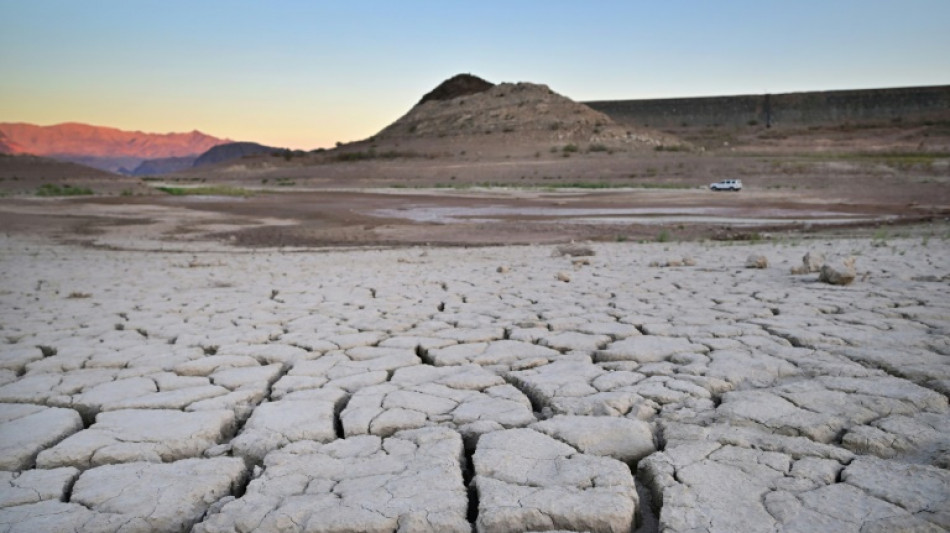
US mulling forced cuts of Colorado River use as water dwindles / Photo: Frederic J. BROWN - AFP

 Russians vote on last day of parliamentary elections

 Hong Kong pays final respects to former city leader Tung

 Typhoon put people off Asian Games opening ceremony, official says
 China's 13-year-old Yu cruises as Asian Games swimming begins

 AI 'warning shots' focus Beijing on national security risks

 Philippine tribe in limbo over US-led tech hub

 Leo XIV, first US pope transcends his restrained style

 Singer Ed Sheeran says Gaza situation 'unjustifiable' following controversy

 In 'Tenzing', a Sherpa mountaineer gets his due

 Ed Sheeran set to return to stage after Palestinian controversy

 Toulouse edge Vannes, Lyon beat Pau to take Top 14 summit

 Germans arrested for Louvre stunt in Mona Lisa hall

 Saudi-led coalition says Houthis fired ballistic missile at Riyadh

 France's debt climbs to highest since 1978: ministry

 McIlroy two shots off the lead at Wentworth after eagle on 18
 Martinez brace saves Inter in Serie A top-two clash with Roma

 Rosenior abused but guides Paris FC past old club Strasbourg

 Seven-try Lyon beat Pau, climb to Top 14 summit

 Brighton defeat a 'big lesson' against complacency for Arsenal, says Arteta

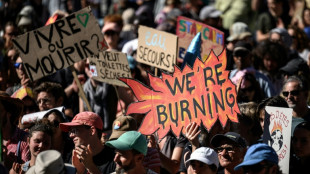 Thousands protest inaction over climate crisis in Switzerland

 Carapaz out of cycling world championships

 'Fragile' Tottenham beaten by Aston Villa despite late rally

 Mourinho hails Real Madrid grit before Atletico derby clash

 Martin wins Austrian MotoGP sprint after Acosta crash

 Japan edge Fiji to win Pacific Nations Cup

The US government announced Tuesday that it is considering imposing across-the-board cuts in usage of the dwindling Colorado River, after squabbling states failed to agree on how to deal with a decades-old problem.
Almost a quarter of a century of drought worsened by human-caused climate change, coupled with entrenched overuse, has left the once-mighty river severely depleted, with reservoirs at historic lows and hydropower generation threatened.
The river supplies water to around 40 million people in seven US states and Mexico, and irrigates millions of acres of fertile farmland that helps feed America.
But despite numerous deadlines, the states have been unable to agree on how to reduce their usage to prevent deadpool -- the point where intake pipes at the Hoover Dam will sit above the waterline and the river will effectively cease to flow.
The Bureau of Reclamation, the federal government department that manages water resources, said Tuesday it could impose mandatory cuts that would see users below Lake Mead -- California, Nevada and Arizona -- hit with a uniform percentage reduction.
That would upend a more than century-old method of divvying up the water which is based on a system of senior rights -- basically, who got there first -- with California's farmers near the front of the queue.
"Everybody understands the significance of the crisis," Deputy Interior Secretary Tommy Beaudreau said, according to the Los Angeles Times.
He noted that a wetter-than-average winter in the West was a boon for the river and would ease pressure this year, but was not a permanent fix.
"I think everybody understands that, as fortunate and thankful we are for the precipitation, that nobody’s off the hook, and that there needs to continue to be unity in trying to develop solutions," Beaudreau said.
- Mob murder victim -
The Bureau of Reclamation's proposal lays out two other options for the river: doing nothing, or cutting usage in line with the system of seniority.
Under the latter option, California's farmers would be almost entirely exempted while users that came to the table later would bear the brunt of the cuts.
That would hit Nevada and Arizona particularly hard, and could cut the drinking water available to the fast-growing city of Phoenix to almost nothing.
"Those are consequences that we would not allow to happen," Beaudreau told The New York Times.
But over-riding the so-called law of the river, and imposing a percentage cut on all users is likely to invite lawsuits from California's farmers, who for generations have enjoyed water plentiful enough to turn an otherwise arid near-desert into profitable farmland.
Last year water levels in Lake Mead dropped to their lowest since the Hoover Dam was built, exposing hillsides that have not been seen since the 1930s, and even uncovering the corpse of a suspected murder victim of the Las Vegas mob.
The Bureau of Reclamation's proposals, which will be finessed later this year, came after the states involved were unable to reach a decision.
Last year the federal government told Colorado, Arizona, New Mexico, California, Nevada, Utah and Wyoming to agree on how to reduce their usage by up to 40 percent of the river's flow.
A plan by six states, not including California, proposed that the bulk of cuts come from America's most populous state.
California countered with a suggestion that most of the cuts come from further upstream.
N.Walker--AT