Why are animal-to-human diseases on the rise? / Photo: John SAEKI - AFP

 Russians vote on last day of parliamentary elections

 Hong Kong pays final respects to former city leader Tung

 Typhoon put people off Asian Games opening ceremony, official says

 China's 13-year-old Yu cruises as Asian Games swimming begins

 AI 'warning shots' focus Beijing on national security risks

 Philippine tribe in limbo over US-led tech hub

 Leo XIV, first US pope transcends his restrained style

 Singer Ed Sheeran says Gaza situation 'unjustifiable' following controversy

 In 'Tenzing', a Sherpa mountaineer gets his due

 Ed Sheeran set to return to stage after Palestinian controversy

 Toulouse edge Vannes, Lyon beat Pau to take Top 14 summit

 Germans arrested for Louvre stunt in Mona Lisa hall

 Saudi-led coalition says Houthis fired ballistic missile at Riyadh

 France's debt climbs to highest since 1978: ministry

 McIlroy two shots off the lead at Wentworth after eagle on 18

 Martinez brace saves Inter in Serie A top-two clash with Roma

 Rosenior abused but guides Paris FC past old club Strasbourg

 Seven-try Lyon beat Pau, climb to Top 14 summit

 Brighton defeat a 'big lesson' against complacency for Arsenal, says Arteta

 Thousands protest inaction over climate crisis in Switzerland

 Carapaz out of cycling world championships

 'Fragile' Tottenham beaten by Aston Villa despite late rally

 Mourinho hails Real Madrid grit before Atletico derby clash

 Martin wins Austrian MotoGP sprint after Acosta crash

 Japan edge Fiji to win Pacific Nations Cup

From Covid-19 to monkey pox, Mers, Ebola, avian flu, Zika and HIV, diseases transmitted from animals to humans have multiplied in recent years, raising fears of new pandemics.
- What's a zoonosis? -
A zoonosis (plural zoonoses) is a disease or infection transmitted from vertebrate animals to people, and vice versa. The pathogens involved can be bacteria, viruses or parasites.
These diseases are transmitted either directly during contact between an animal and a human, or indirectly through food or through a vector such as an insect, spider or mite.
Some diseases end up becoming specifically human, like Covid-19.
According to the World Organisation for Animal Health, 60 percent of human infectious diseases are zoonotic.
- What types of diseases are involved? -
The term "zoonoses" includes a wide variety of diseases.
Some affect the digestive system, such as salmonellosis, others the respiratory system, such as avian and swine flu as well as Covid, or the nervous system in the case of rabies.
The severity of these diseases in humans varies greatly depending on the disease and the pathogen's virulence, but also on the infected person, who may have a particular sensitivity to the pathogen.
- What animals are involved? -
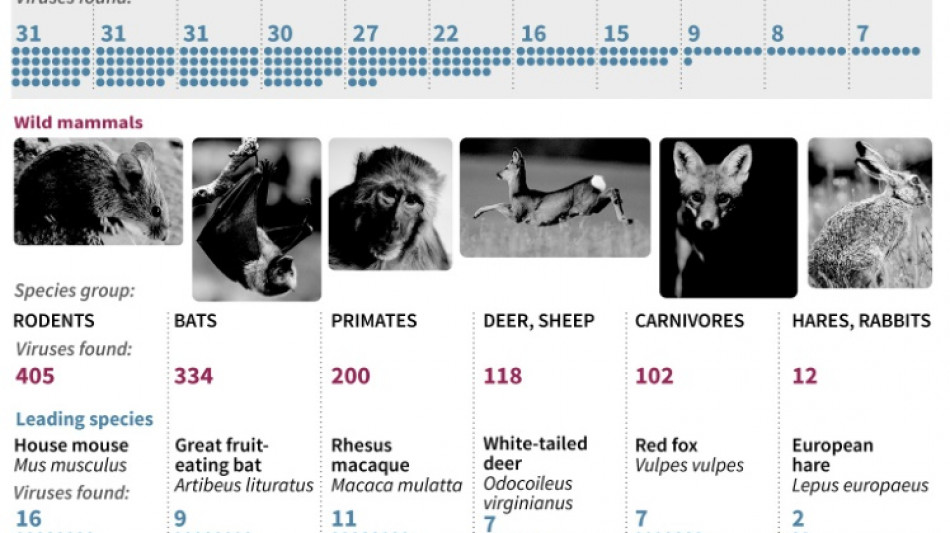
Bats act as a reservoir for many viruses that affect humans.
Some have been known for a long time, such as the rabies virus, but many have emerged in recent decades, such as Ebola, the SARS coronavirus, Sars-CoV-2 (which causes Covid-19) or the Nipah virus, which appeared in Asia in 1998.
Badgers, ferrets, mink and weasels are often implicated in viral zoonoses, and in particular those caused by coronaviruses.
Other mammals, such as cattle, pigs, dogs, foxes, camels and rodents, also often play the role of intermediate host.
All the viruses responsible for major influenza pandemics had an avian origin, either direct or indirect.
Finally, insects such as ticks are vectors of many viral diseases that affect humans.
- Why has the frequency of zoonoses increased?
Having appeared thousands of years ago, zoonoses have multiplied over the past 20 or 30 years.
The growth of international travel has allowed them to spread more quickly.
By occupying increasingly large areas of the planet, humans also contribute to disrupting the ecosystem and promoting the transmission of viruses.
Industrial farming increases the risk of pathogens spreading between animals.
Trade in wild animals also increases human exposure to the microbes they may carry.
Deforestation increases the risk of contact between wildlife, domestic animals and human populations.
- Should we fear another pandemic? -
Climate change will push many animals to flee their ecosystems for more livable lands, a study published by the scientific journal Nature warned in 2022.
By mixing more, species will transmit their viruses more, which will promote the emergence of new diseases potentially transmissible to humans.
"Without preventative strategies, pandemics will emerge more often, spread more rapidly, kill more people, and affect the global economy with more devastating impact than ever before," the UN Biodiversity Expert Group warned in October 2020.
According to estimates published in the journal Science in 2018, there are 1.7 million unknown viruses in mammals and birds, 540,000 to 850,000 of them with the capacity to infect humans.
But above all, the expansion of human activities and increased interactions with wildlife increase the risk that viruses capable of infecting humans will "find" their host.
S.Jackson--AT



