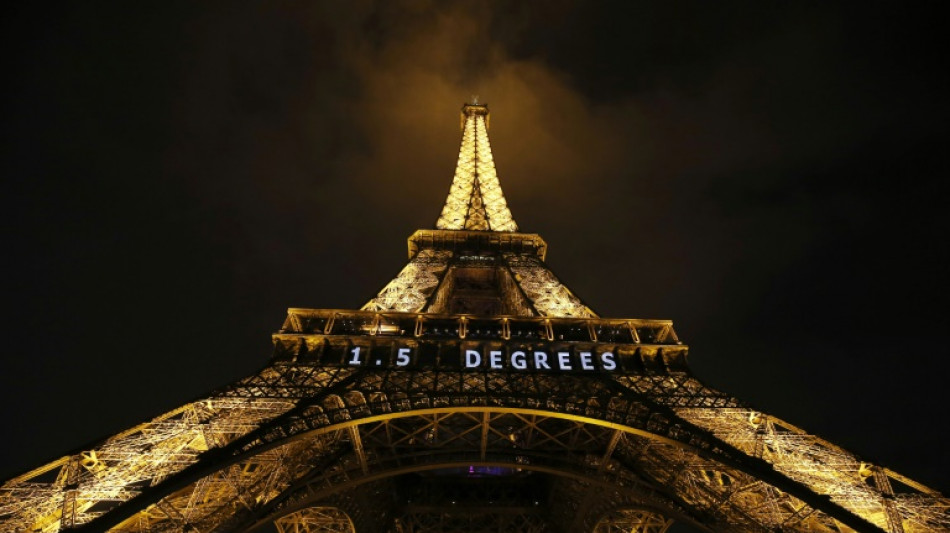
Dreaming the impossible dream: the 1.5C climate target / Photo: PATRICK KOVARIK - AFP/File

 Russians vote on last day of parliamentary elections

 Hong Kong pays final respects to former city leader Tung

 Typhoon put people off Asian Games opening ceremony, official says

 China's 13-year-old Yu cruises as Asian Games swimming begins

 AI 'warning shots' focus Beijing on national security risks

 Philippine tribe in limbo over US-led tech hub

 Leo XIV, first US pope transcends his restrained style

 Singer Ed Sheeran says Gaza situation 'unjustifiable' following controversy

 In 'Tenzing', a Sherpa mountaineer gets his due

 Ed Sheeran set to return to stage after Palestinian controversy
 Toulouse edge Vannes, Lyon beat Pau to take Top 14 summit
 Germans arrested for Louvre stunt in Mona Lisa hall
 Saudi-led coalition says Houthis fired ballistic missile at Riyadh

 France's debt climbs to highest since 1978: ministry
 McIlroy two shots off the lead at Wentworth after eagle on 18
 Martinez brace saves Inter in Serie A top-two clash with Roma

 Rosenior abused but guides Paris FC past old club Strasbourg

 Seven-try Lyon beat Pau, climb to Top 14 summit

 Brighton defeat a 'big lesson' against complacency for Arsenal, says Arteta

 Thousands protest inaction over climate crisis in Switzerland

 Carapaz out of cycling world championships

 'Fragile' Tottenham beaten by Aston Villa despite late rally

 Mourinho hails Real Madrid grit before Atletico derby clash

 Martin wins Austrian MotoGP sprint after Acosta crash

 Japan edge Fiji to win Pacific Nations Cup

In the realm of climate diplomacy, it's the little engine that could, the 80-to-1-odds Kentucky Derby winner, the low-budget multiverse fantasy that came out of nowhere to sweep the Oscars.
We are talking, of course, about the Paris Agreement goal of capping Earth's average surface temperature at 1.5 degrees Celsius above levels in the late 19th century, when burning fossil fuels began to seriously heat up the planet.
At barely 1.2C above that threshold, the world today has already seen a crescendo of deadly and destructive extreme weather.
Fifteen years ago, a 1.5C limit on global warming -- championed by small island nations worried about sea level rise -- was rejected by most scientists as unrealistic and by most countries as unnecessary.
A 2C "guardrail" was assumed to be safe enough.
Today, the 1.5C target is enshrined in everything, everywhere, all at once. While technically no more than an "aspirational" goal, it has become the de facto North Star for UN climate talks, national climate plans and the business world.
From Apple and Facebook to Big Pharma and even Big Oil, multinationals have unveiled promises and plans to be "1.5C-aligned", even if most of those plans don't hold up very well under scrutiny.
You can draw a straight line from 1.5C to the science-base imperative to nearly halve global emissions by 2030 and achieve net zero around mid-century, meaning any residual carbon pollution must be offset by removals.
Both of these targets are set to be affirmed in a report summarising six years of climate science, released Monday by the UN's Intergovernmental Panel on Climate Change (IPCC).
- 2C not good enough -
This raises a perplexing question, according to Beatrice Cointe, a sociologist at France's National Centre for Scientific Research and co-author of a recent study on the history of the 1.5C target.
"How did an almost impossible target become the point of reference for climate action?" she asked.
And what will happen when the world experiences its first full year at or above 1.5C, which the IPCC says could easily happen within a decade, even under aggressive emissions reduction scenarios?
"The target appears increasingly unattainable," Cointe and co-author Helene Guillemot, a historian of science at the Centre Alexandre-Koyre, wrote in the journal WIREs Climate Change.
"And yet calls to 'Keep 1.5C Alive' have been growing louder."
The backstory of the 1.5C goal reveals an interplay of science and politics, with one driving and shaping the other.
Going into the 2015 climate negotiations that yielded the breakthrough Paris treaty, it seemed unlikely that 195 nations would significantly improve on the 2C target already set in stone.
But a scientific evaluation by a UN technical body delivered ahead of the December summit sounded an alarm about the dangers of a +2C world and suggested greater ambition might be wise.
"While science on the 1.5C limit is less robust, efforts should be made to push the defence line as low as possible," it concluded.
A growing coalition of developing nations, meanwhile, had gathered behind the 1.5C goal, eventually joined by the European Union and the United States.
Emerging giants and oil exporters baulked, fearful of the constraints on their fossil-fuel dependent economies.
"China was against it, India was against it, Saudi Arabia fought us tooth-and-nail to the very end," recalled Saleemul Huq, director of the International Centre for Climate Change and Development in Dhaka.
Even today, these nations remain lukewarm on the idea.
But in the end, nearly 200 nations committed to cap warming at "well below 2C", while "pursuing effort to limit the temperature increase to 1.5C."
- 'A moral target' -
It was a stunning diplomatic coup. Many scientists, however, were less than thrilled.
"It will be very hard -- if not impossible -- to keep warming below 1.5 C during the entire 21st century," Joeri Rogelj, a climate modeller currently at Imperial College London who played a key role in the technical report, told AFP at the time.
But because the target was part of the Paris Agreement, nations called on the IPCC -- which exists to brief policymakers on climate science -- for a "special report".
The resulting bombshell, delivered in October 2018, left no doubt as to the difference a half-a-degree makes: a 1.5C world will see deep change but remain liveable; a 2C world could tip the climate system into overdrive, outstripping our capacity to adapt, it warned.
Today, the IPCC -- including Rogelj, a lead author of the 2018 report -- insists that the 1.5C goal is technically feasible.
But that conclusion hangs by the thinnest of threads.
There is no scenario that avoids "overshooting" the target, and bringing temperatures back under the wire will require extracting billions of tonnes of CO2 from thin air, something we can't do yet at scale.
But whether the 1.5C target is feasible may be missing the point, say others.
"Getting 1.5 C into the agreement was a moral target," Huq told AFP not long after the Paris pact was inked.
"It's our leverage, the whip we will use to hit everybody on the back so they can go faster," he added.
"Whether we achieve it or not is going down a dark track. From now on, it's about raising ambition."
Piers Forster, director of the University of Leeds Priestley International Centre for Climate and a coordinating lead author for the IPCC, describes the 1.5C objective as a "huge, but not impossible, task".
"Hopefully the IPCC report can push the urgency," he told AFP. "If it's ignored, we would have to give up on 1.5C."
O.Gutierrez--AT



