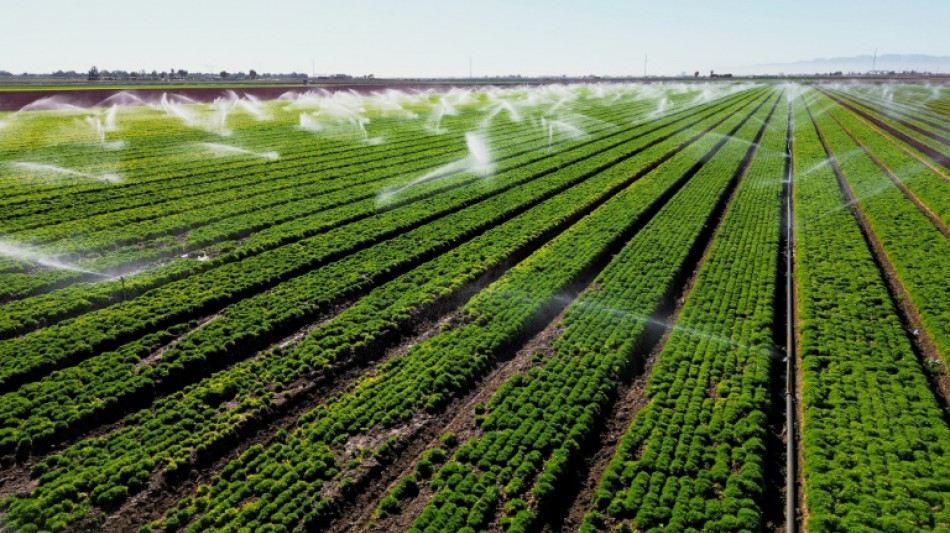
California's desert farmers defend their river rights / Photo: SANDY HUFFAKER - AFP

 Russians vote on last day of parliamentary elections

 Hong Kong pays final respects to former city leader Tung

 Typhoon put people off Asian Games opening ceremony, official says

 China's 13-year-old Yu cruises as Asian Games swimming begins

 AI 'warning shots' focus Beijing on national security risks

 Philippine tribe in limbo over US-led tech hub

 Leo XIV, first US pope transcends his restrained style

 Singer Ed Sheeran says Gaza situation 'unjustifiable' following controversy

 In 'Tenzing', a Sherpa mountaineer gets his due

 Ed Sheeran set to return to stage after Palestinian controversy

 Toulouse edge Vannes, Lyon beat Pau to take Top 14 summit

 Germans arrested for Louvre stunt in Mona Lisa hall

 Saudi-led coalition says Houthis fired ballistic missile at Riyadh

 France's debt climbs to highest since 1978: ministry

 McIlroy two shots off the lead at Wentworth after eagle on 18

 Martinez brace saves Inter in Serie A top-two clash with Roma

 Rosenior abused but guides Paris FC past old club Strasbourg
 Seven-try Lyon beat Pau, climb to Top 14 summit

 Brighton defeat a 'big lesson' against complacency for Arsenal, says Arteta

 Thousands protest inaction over climate crisis in Switzerland

 Carapaz out of cycling world championships

 'Fragile' Tottenham beaten by Aston Villa despite late rally

 Mourinho hails Real Madrid grit before Atletico derby clash

 Martin wins Austrian MotoGP sprint after Acosta crash

 Japan edge Fiji to win Pacific Nations Cup

A blanket of crops covers the floor of the Imperial Valley in southern California, a patchwork of vibrant greens given life by the Colorado River in a landscape bleached by the desert sun.
But as a decades-long drought desiccates the US West and the once-mighty river dwindles, questions are being asked about why a handful of farmers are allowed to take as much water as all of Nevada and Arizona combined.
"We average less than two inches (five centimeters) of rainfall per year," fourth generation farmer Andrew Leimgruber told AFP.
"So without the supply of Colorado River water coming here, there would be no one living here, there'd be nothing being grown here, this would be a desert."
The valley, along with Yuma in Arizona, is a vital part of America's huge agricultural sector, producing most of the vegetables the United States eats over winter, in a business that generates around $2 billion a year.
Farmers here also grow alfalfa, a forage crop supplied to beef and dairy ranchers.
- Ancient agreement -
The land here has always been fertile, but it's always been dry.
The pioneers who forged the West realized that with its permanent sunshine, Imperial Valley could produce crops year-round to feed a growing population, as long as they could keep the fields watered.
Their solution was to build an 80-mile (130-kilometer) canal from the Colorado River, positioning themselves at the head of the queue for the rights to that river.
An agreement hashed out over a century ago allows Imperial Valley farmers to use 3.1 million acre-feet of water every year -- about 70 percent of all the water California is allowed to take.
An acre-foot refers to an acre covered in water a foot deep, which equals some 326,000 gallons (1.23 million liters) or about half an Olympic-size swimming pool.
But as human-caused climate change worsens a drought that has now lasted more than two decades, the river is struggling to keep up with demand.
The 40 million people in the West who rely on it, including in some of America's biggest cities, are being told they need to cut back.
Residents of Los Angeles last year faced fines for watering their gardens too often, and are urged to take only short showers instead of baths.
The predicament has pitted suburban homeowners surveying their brown lawns against nearby farmers.
"As the largest water user on the river, we become a target because it becomes an easy solution," says Tina Shields of the Imperial County Irrigation District.
"We're not going to sacrifice our community for urban sprawl and urban development and other areas."
In any case, says Shields, many of the people who complain about farmers using water are happy to fill their refrigerators with the food they produce.
"We grow a half million acres a year of crops that feed our nation and other nations as well. So it's critical to our community and our economy in particular."
- 'No lack of work' -
Despite its water wealth, Imperial County is one of the poorest in California and would struggle to survive without agriculture.
Rural workers, mostly Latinos, come from a wide area, including across the Mexican border several dozen miles away, to earn money in the fields.
"There has been no lack of work here," says Ramon Cardenas, who has toiled for three decades under summer temperatures that regularly top 100 degrees Fahrenheit (38 degrees Celsius).
Some farmers have cut deals with power generation companies, signing long-term leases that see crops replaced by solar panels.
They might not be using water anymore, but neither are they offering work.
Cardenas hopes the trend won't spread.
"We depend on this," he says gesturing to the crew picking lettuce.
- Productive land -
Despite a very wet California winter, Imperial Valley hasn't gotten much rain this year.
As Leimgruber's sprinklers spray hundreds of liters (gallons) of water onto a field, he insists it is well used.
Even thirsty alfalfa -- around 15 percent of which he says is exported -- is vital for a country that consumes so much meat and dairy, he says.
"California is the top dairy-producing state in the country, and that's because of the Imperial Valley's ability to plant alfalfa," he says.
"A lot of Americans don't think it's possible to see empty shelves, and it's areas like this that ensure the country is fed and I think that has to be protected."
And, he insists, if Imperial Valley didn't produce the alfalfa, other suppliers would simply step in and fill the void.
Why, he questions, should he and his fellow farmers miss out on that?
"People don't understand how productive this land is," he says.
A.Williams--AT



