'More important than rainforests': UK pioneers peat partnership / Photo: OLI SCARFF - AFP

 IOC president impressed by 'beautiful' Asian Games wooden huts

 First Asian Games gold goes to Japan as China's 13-year-old Yu lights up pool

 Data centre command hub keeps AI up and running

 Pope Leo in France: the issues on the table

 Packing for a pope: behind the scenes on foreign trips

 Republicans find transgender issues a powerful political weapon in midterm campaigning

 German state elections threaten new shock waves for Merz

 Chile's Bachelet quits race to be next UN chief

 Raphinha treble fires perfect Barca to win at Sevilla

 Thiam makes winning heptathlon return at Decastar meet

 Czechs beat USA to qualify for Davis Cup finals

 Dortmund sink Stuttgart to climb to Bundesliga summit

 Trump says will not tolerate attempts to slow AI growth

 'It has to stop': runners protest women's murders in S.Africa district

 Fire erupts near Riyadh airport as Houthis claim strikes

 Cuba works to restore power after another blackout

 England thrash Sri Lanka again to return to top of T20 rankings

 Arsenal thrashed by Brighton, sorry Spurs lose again

 South Korea, Austria qualify for Davis Cup finals

 Seare shocks Ingebrigtsen to win world 5km gold

 Brigitte Bardot widower slams sale of star's belongings

 Aston Villa compound Tottenham's misery despite late rally

 Asian Games offer 'deepest apologies' for South Korea anthem blunder

 Inter Milan and Italy icon Mazzola dies aged 83

 Saudi capital issues first air raid alert since renewed fighting in Yemen

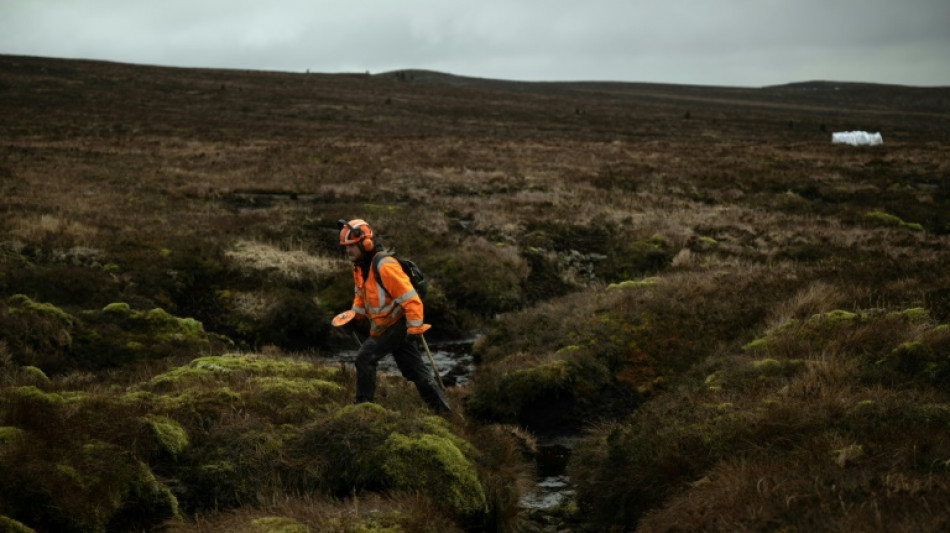
On a windswept hillside in a remote corner of northern England, a peatland restoration plan pooling public and private money is underway which proponents claim provides a model for climate change mitigation.
Deploying a tank-like vehicle, helicopter, digger and a dozen-strong team building dams and other defences, the "Ridge Graham" project will return the site to its original waterlogged state, locking in carbon dioxide (CO2).
Currently, the 450 hectares (1,112 acres) of peatland by draining -- the size of 840 football fields -- and others like it in Britain and beyond are releasing greenhouse gases (GHGs), hindering efforts to go net-zero within decades.
The venture will use nascent carbon markets but is groundbreaking in England because it is the first time a company, rather than an NGO or charity, has also received public funds to restore privately-owned peatland.
"Peatland restoration is incredibly expensive and so... you need to find something that makes it economically viable," explained Betsy Glasgow-Vasey of Ridge Carbon Capture (RCC).
The Oxfordshire-based "nature-based solutions" developer is delivering the scheme -- with the help of an £813,000 ($975,000) grant from government agency Natural England -- and has a dozen other peatland projects in the pipeline.
The UK has "woken up to what something like this can do," she added.
- 'Icing a cake' -
Trampling up the hillside in Cumbria, 28-year-old Glasgow-Vasey -- branded "bog woman" by friends due to her frequent peatland visits -- points out works completed since September.
As well as creating hundreds of small brick dams and, on higher ground, barriers made from rolls of coir coconut fibre to saturate the land, contractors have been covering exposed soil.
"When peatland is exposed to the air, that's when it starts to release all the emissions from the decomposing vegetation," she explained.
Using transplanted heather, workers undertake the gruelling task wherever gaps exist on the vast terrain.
"(It's) like when you're icing a cake... if there's not enough icing, you've got to pull icing from elsewhere to cover the side of the cake -- and it's a big cake!" she added.
The site and neighbouring land have been owned for centuries by the Graham family, which hopes it will prove a "shining example" of peatland restoration.
The landowners will have a stake in eventual "carbon units" created, "turning something that could be a liability into an asset," Glasgow-Vasey noted.
- 'Crucial' -
Peatland moors and bogs are wetland ecosystems formed from partly decomposed carbon-rich organic matter.
They cover about three percent of the earth's surface and create its largest natural carbon store, holding more than any other type of vegetation.
But when sites deteriorate, typically after being drained by humans for purposes such as rearing livestock, they become sources of GHGs -- responsible for 10 percent of annual global emissions, according to the International Peatland Society.
The UK is home to seven million acres, around 10 percent of its surface, but four-fifths are in a poor state and emit 10 million tonnes of CO2 annually, the International Union for Conservation of Nature (IUCN) says.
"We need to restore our peatlands and we need to restore them now!" Renee Kerkvliet-Hermans, the IUCN's UK Peatland Code coordinator, told AFP.
A certification standard for projects like Ridge Graham, the code is helping overcome their "significant" financial barriers by generating and certifying carbon units.
The government, which wants to restore 35,000 hectares of English peatlands by 2025, backs the market while also providing grants.
Chris Kaighin, Natural England's Cumbria manager, called peatland restoration "crucial" to help meet climate targets.
Ridge Graham will hold "vast quantities of CO2, providing vital habitats for wildlife, purifying drinking water, and storing water to reduce flood risk," he added.
- Vineyard analogy -
RCC and the grant covers the project's costs, which will eventually be recouped through the carbon market.
Credits will be created based on emissions abated and bought by businesses as part of their offsetting efforts.
Under the Peatland Code, one credit equates to one tonne of so-called carbon equivalent abated.
Glasgow-Vasey noted government support is still crucial because the market price of that credit "currently just isn't high enough to make these projects make sense".
"As the carbon price goes up -- which everyone says they think it will -- more landowners will come on board," she added.
She compares the enterprise to a vineyard, with the credits issued in vintages corresponding to the project's early years and eventually sold and retired -- akin to a bottle of wine bought and later drunk.
It is uncertain exactly how long it will take the site to become a so-called carbon sink absorbing CO2, instead of emitting it.
Auditors from the government and IUCN will visit to assess progress over the coming years.
Stuart Evans, an experienced specialist contractor working on the project, heralded the "amazing" growing recognition of peatlands' importance.
Surveying the stunning views from atop the hillside, he added: "They're more important than rainforests and they're so degraded."
Ch.P.Lewis--AT