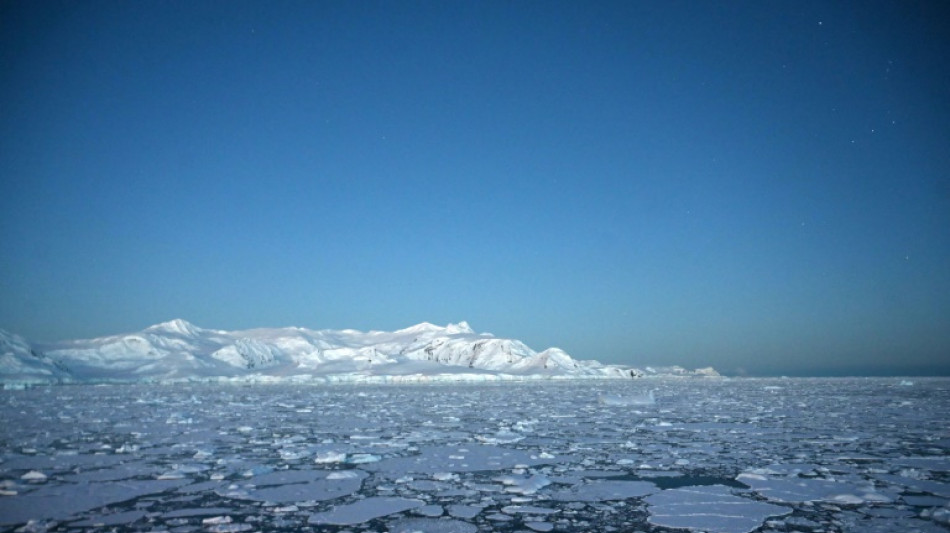
Antarctic sea ice cover at record low / Photo: Johan ORDONEZ - AFP/File

 IOC president impressed by 'beautiful' Asian Games wooden huts

 First Asian Games gold goes to Japan as China's 13-year-old Yu lights up pool

 Data centre command hub keeps AI up and running

 Pope Leo in France: the issues on the table

 Packing for a pope: behind the scenes on foreign trips

 Republicans find transgender issues a powerful political weapon in midterm campaigning

 German state elections threaten new shock waves for Merz

 Chile's Bachelet quits race to be next UN chief

 Raphinha treble fires perfect Barca to win at Sevilla

 Thiam makes winning heptathlon return at Decastar meet

 Czechs beat USA to qualify for Davis Cup finals

 Dortmund sink Stuttgart to climb to Bundesliga summit

 Trump says will not tolerate attempts to slow AI growth

 'It has to stop': runners protest women's murders in S.Africa district

 Fire erupts near Riyadh airport as Houthis claim strikes

 Cuba works to restore power after another blackout

 England thrash Sri Lanka again to return to top of T20 rankings

 Arsenal thrashed by Brighton, sorry Spurs lose again

 South Korea, Austria qualify for Davis Cup finals

 Seare shocks Ingebrigtsen to win world 5km gold

 Brigitte Bardot widower slams sale of star's belongings

 Aston Villa compound Tottenham's misery despite late rally

 Asian Games offer 'deepest apologies' for South Korea anthem blunder

 Inter Milan and Italy icon Mazzola dies aged 83

 Saudi capital issues first air raid alert since renewed fighting in Yemen

Sea ice in Antarctica shrank to the smallest area on record in February for the second year in a row, continuing a decade-long decline, the European Union's climate monitoring service said Tuesday.
On February 16, the ocean surface covered by ice around the frozen continent shrank to 2.09 million square kilometres (800,000 square miles), the lowest level since satellite records began, according to figures provided to AFP by the Copernicus Climate Change Service (C3S).
"Antarctic sea ice reached its lowest extent in the 45-year satellite data record," said Samantha Burgess, Deputy Director of C3S.
US government scientists have also confirmed a new record last month but indicated an even lower figure of 1.79 million sq km, a difference Copernicus attributed to "different sea ice retrieval algorithms".
Sea-ice concentrations during the southern hemisphere summer were well below average in all sectors of the Southern Ocean.
Startlingly, the record lows this year and in 2022 are about 30 percent below the 1981-2010 average.
"These low sea-ice conditions may have important implications for the stability of Antarctic ice shelves and ultimately for global sea level rise," said Burgess.
"Polar ice caps are a sensitive indicator of the climate crisis."
Melting sea ice has no discernible impact on sea levels because the ice is already in ocean water.
- A new trend -
But diminished ice cover is nonetheless a major concern because it helps accelerate global warming, including in the Arctic region.
About 90 percent of the Sun's energy that hits white sea ice is reflected back into space. But when sunlight hits dark, unfrozen ocean water, nearly the same amount of that energy is absorbed instead, contributing directly to a warming planet.
Both the North and South pole regions have warmed by roughly three degrees Celsius compared to late 19th-century levels, three times the global average.
But unlike sea ice in the Arctic, which has diminished by three percent a year since the late 1970s, sea ice in Antarctica has remained relatively constant over the same period, albeit with large annual variations.
Until recently -- over the last eight years -- minimum sea ice extent in the Southern Ocean has consistently been below the average for the 1991-2020 period.
Antarctica encountered its first recorded heatwave in 2020, with an unprecedented 9.2C above the mean maximum. In March last year, a research centre in eastern Antarctica saw temperatures soar 30 degrees above normal.
Recent ice cover during the austral summer has shrunk most around West Antarctica, which is more vulnerable to the impacts of global warming than the far larger East Antarctica.
The record minimum sea ice extent in the Arctic -- 3.4 million square kilometres -- occurred in 2012, with the second- and third-lowest ice-covered areas in 2020 and 2019, respectively.
In 2021, The UN's IPCC climate science advisory panel forecast with "high confidence" that the Arctic Ocean would become practically ice-free in September at least once by mid-century.
R.Lee--AT



