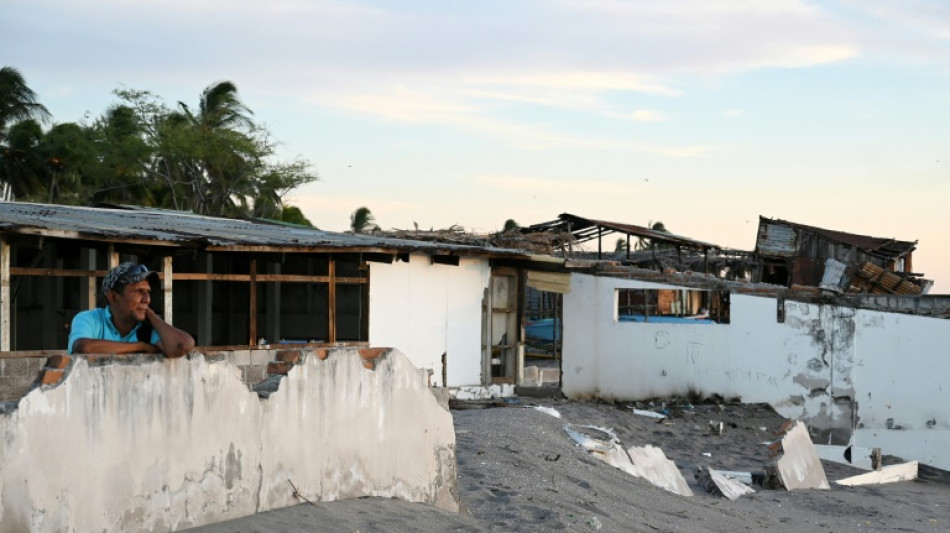
Rising seas eating away at Honduran fishing village / Photo: Orlando SIERRA - AFP

 IOC president impressed by 'beautiful' Asian Games wooden huts

 First Asian Games gold goes to Japan as China's 13-year-old Yu lights up pool

 Data centre command hub keeps AI up and running
 Pope Leo in France: the issues on the table

 Packing for a pope: behind the scenes on foreign trips

 Republicans find transgender issues a powerful political weapon in midterm campaigning

 German state elections threaten new shock waves for Merz

 Chile's Bachelet quits race to be next UN chief

 Raphinha treble fires perfect Barca to win at Sevilla

 Thiam makes winning heptathlon return at Decastar meet

 Czechs beat USA to qualify for Davis Cup finals

 Dortmund sink Stuttgart to climb to Bundesliga summit

 Trump says will not tolerate attempts to slow AI growth

 'It has to stop': runners protest women's murders in S.Africa district

 Fire erupts near Riyadh airport as Houthis claim strikes

 Cuba works to restore power after another blackout

 England thrash Sri Lanka again to return to top of T20 rankings

 Arsenal thrashed by Brighton, sorry Spurs lose again

 South Korea, Austria qualify for Davis Cup finals

 Seare shocks Ingebrigtsen to win world 5km gold

 Brigitte Bardot widower slams sale of star's belongings

 Aston Villa compound Tottenham's misery despite late rally

 Asian Games offer 'deepest apologies' for South Korea anthem blunder

 Inter Milan and Italy icon Mazzola dies aged 83

 Saudi capital issues first air raid alert since renewed fighting in Yemen

The coastline of Cedeno, a fishing village in southern Honduras, looks like it was hit by an earthquake. Houses, businesses and clubs stand in ruins. Forsaken.
But it was not a quake. Nor a tsunami. A much slower, but equally destructive force is at work in Cedeno and other villages on the Pacific Gulf of Fonseca: sea level rise.
The creeping ocean has claimed ever more of the protective mangrove forest off Cedeno's coast, and claws away at the land with increasingly violent sea surges.
Inhabitants of Cedeno and other fishing villages on the Gulf of Fonseca -- shared by Honduras, El Salvador and Nicaragua -- are at the forefront of one of the more visible symptoms of climate change: sea level rise caused by melting glaciers and ice sheets.
"The sea is advancing," said Telma Yadira Flores, a 40-year-old homemaker from Cedeno who lost her house in a storm surge last year and now lives in a rickety shack with her son and daughter-in-law. The sandy beach is their kitchen floor.
"If the sea comes again, we will have to move. We will have to see where," Flores told AFP.
According to the NGO Coddeffagolf (Committee for the Defense and Development of the Flora and Fauna of the Gulf of Fonseca), the sea has advanced 105 meters (344 feet) into Cedeno, a settlement of some 7,000 people, in 17 years.
Apart from numerous homes and small businesses, a marine laboratory, police headquarters and a park were also abandoned to the waves.
The Michel Hasbun primary school, which once served about 400 children, now stands empty.
"There was a soccer field, it was lost," Sergio Espinal, a 75-year-old fisherman, told AFP, pointing to where it once stood.
"There were good restaurants, good hotels..." But no more.
- 'Entire countries could disappear' -
The community has also had to contend with dwindling fish numbers.
The mangroves whose roots act as nurseries and hunting grounds for crustaceans, shellfish and many other species that in turn serve as food for bigger animals, are under attack from sea levels rising too fast for them to adapt.
"Before there were schools of dolphins, there were sharks, swordfish... and now everything has been lost," boat operator Luis Fernando Ortiz, 39, said as he pointed out the broken and abandoned mansion of a former president overlooking the idyllic turquoise waters.
The community's hopes now rest on a Coddeffagolf project, still in the planning phase, to improve coastal surge protections and reforest the battered mangrove.
Earlier this month, UN chief Antonio Guterres warned that global warming-induced sea level rise could force a mass exodus "on a biblical scale" as people flee low-lying communities.
"The danger is especially acute for nearly 900 million people who live in coastal zones at low elevations -- that's one out of 10 people on Earth," Guterres told the UN Security Council.
"Low-lying communities and entire countries could disappear forever," he said.
Honduras is already a mayor source of US-bound undocumented migrants.
The UN's Intergovernmental Panel on Climate Change (IPCC) says sea levels rose by 15-25 centimeters (6-10 inches) between 1900 and 2018.
And if the world warms by just two degrees Celsius (3.6 degrees Fahrenheit) compared to the pre-industrial era, those levels will rise again by 43 centimeters by the year 2100.
According to the IPCC, all mangrove forests could be lost in the next 100 years.
Mangroves not only sustain sea life but also help trap planet-warming carbon dioxide and protect coastlines from storms and surges.
Central America's Atlantic and Pacific coasts "are some of the most endangered on the planet with regard to mangroves, as approximately 40 percent of present species are threatened with extinction," according to the IPCC.
On Thursday and Friday this week, leaders of government, the private sector, civil society and academics will gather in Panama for the "Our Ocean" conference to discuss how to save under-pressure marine resources.
R.Lee--AT



