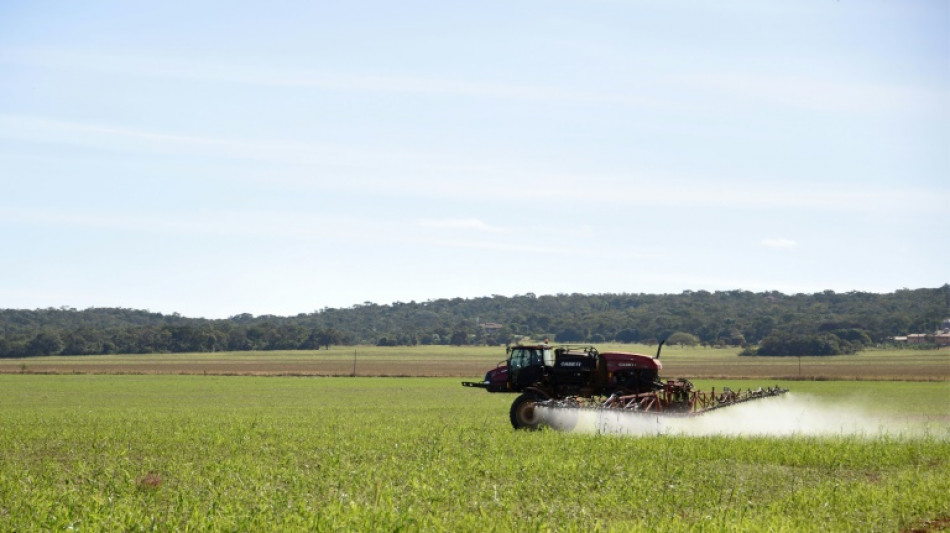
Emissions from fertilisers could be slashed by 2050: study / Photo: EVARISTO SA - AFP

 Singer Ed Sheeran says Gaza situation 'unjustifiable' following controversy

 In 'Tenzing', a Sherpa mountaineer gets his due

 Ed Sheeran set to return to stage after Palestinian controversy

 Toulouse edge Vannes, Lyon beat Pau to take Top 14 summit

 Germans arrested for Louvre stunt in Mona Lisa hall

 Saudi-led coalition says Houthis fired ballistic missile at Riyadh

 France's debt climbs to highest since 1978: ministry

 McIlroy two shots off the lead at Wentworth after eagle on 18

 Martinez brace saves Inter in Serie A top-two clash with Roma

 Rosenior abused but guides Paris FC past old club Strasbourg

 Seven-try Lyon beat Pau, climb to Top 14 summit

 Brighton defeat a 'big lesson' against complacency for Arsenal, says Arteta

 Thousands protest inaction over climate crisis in Switzerland

 Carapaz out of cycling world championships

 'Fragile' Tottenham beaten by Aston Villa despite late rally

 Mourinho hails Real Madrid grit before Atletico derby clash

 Martin wins Austrian MotoGP sprint after Acosta crash

 Japan edge Fiji to win Pacific Nations Cup

 Black smoke, flames rising near Riyadh airport: residents to AFP

 UK actor Naomi Watts honoured at Spain film festival

 Japan emperor declares Asian Games open after turbulent build-up

 Asian Games open with unity message after troubled build-up

 Denmark hails 'binding' Greenland deal with Trump

 We don't want Games host Japan losing money, says Asian Olympic official

 Ed Sheeran returns to stage after Palestinian controversy

The production and use of nitrogen fertilisers accounts for five percent of global greenhouse gas emissions, which can be massively reduced with a few available interventions, a new study said Thursday.
Nitrogen fertilisers -- produced and used across the world -- are crucial for global food security.
But their harmful emissions contributing to global warming exceed the aviation sector, and are on par with the iron and steel, cement and plastics industries.
Most existing research has focused on emissions associated with the production of fertilisers, but Thursday's study showed that the majority -- two thirds -- come from the use of the fertilisers in croplands.
"There is the perception that the petrochemical industry has been causing the emissions producing the fertilisers, but actually that doesn't seem to be the case. That was very surprising for us," co-author Andre Cabrera Serrenho from Cambridge University told AFP.
The findings are important because they show "where we should prioritise action to reduce emissions," he added.
Carbon emissions could be reduced by up to 80 percent by 2050 while still producing enough food to feed a growing global population, said the study published Thursday in the journal Nature Food.
"The interventions we propose in our study do not imply loss in crop productivity, and they consider the future growing demand for food to feed a growing global population," Serrenho confirmed.
- Boost efficiency, use less -
Emissions associated with production are mostly associated with ammonia, a key ingredient in most fertilisers.
Making ammonia not only uses a lot of energy, but also requires hydrogen production, which causes emissions.
Some factories in China, for example, use coal to make hydrogen. Hydrogen can be made from water using electricity generated by renewables, which would greatly reduce emissions, though it is often a lot more expensive.
And since many factories producing ammonia for fertilisers, especially in Asia, are relatively new, they are less likely to covert technologies to be more environmentally friendly.
Switching to renewable energy in factories is another way to help reduce that carbon footprint.
But Serrenho said the main way to reduce emissions linked to fertilisers is on the use side, by increasing their efficiency and thus reducing their use.
"We are currently really inefficient in the way we use fertilisers," he said. "We put much more fertilisers in croplands than the amount of nitrogen that actually crops need to grow."
The main emissions in the use phase come from the degradation of fertiliser by bacteria that exist in the soil and produce nitrous oxide, one of the most powerful greenhouse gases.
Carbon dioxide and methane are also emitted in the use phase, but simply using less fertiliser could help to slash those harmful emissions.
But convincing farmers to use fertilisers more efficiently -- for example, applying them daily in smaller quantities instead of spraying in large doses them once a season -- will require policy shifts.
"If we could have more economic incentives to farmers to change practices to reduce emissions, that seems to be the most obvious place to start," Serrenho said.
Ch.Campbell--AT



