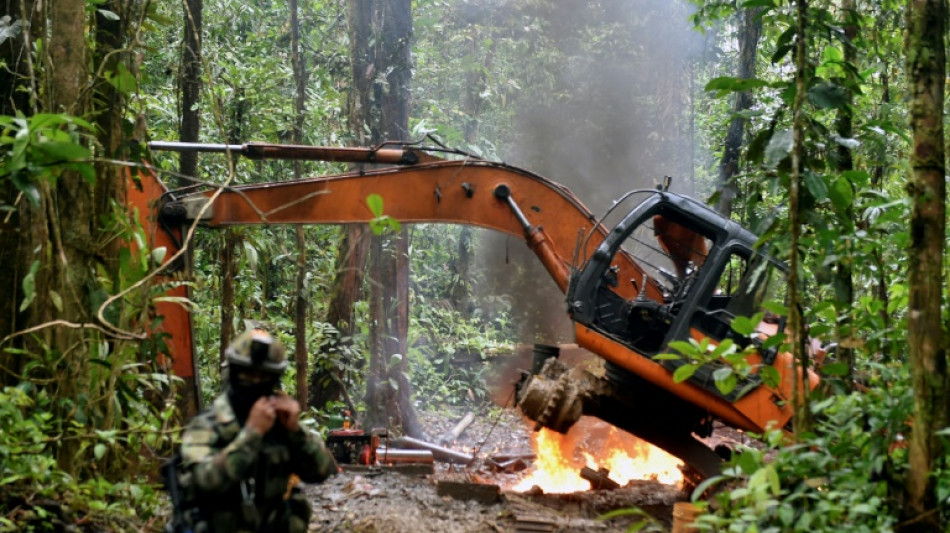
Colombia's war on illegal gold mines also hits outlaw armed groups / Photo: DANIEL MUNOZ - AFP

 Singer Ed Sheeran says Gaza situation 'unjustifiable' following controversy

 In 'Tenzing', a Sherpa mountaineer gets his due

 Ed Sheeran set to return to stage after Palestinian controversy

 Toulouse edge Vannes, Lyon beat Pau to take Top 14 summit

 Germans arrested for Louvre stunt in Mona Lisa hall

 Saudi-led coalition says Houthis fired ballistic missile at Riyadh

 France's debt climbs to highest since 1978: ministry

 McIlroy two shots off the lead at Wentworth after eagle on 18

 Martinez brace saves Inter in Serie A top-two clash with Roma

 Rosenior abused but guides Paris FC past old club Strasbourg

 Seven-try Lyon beat Pau, climb to Top 14 summit

 Brighton defeat a 'big lesson' against complacency for Arsenal, says Arteta

 Thousands protest inaction over climate crisis in Switzerland

 Carapaz out of cycling world championships

 'Fragile' Tottenham beaten by Aston Villa despite late rally

 Mourinho hails Real Madrid grit before Atletico derby clash

 Martin wins Austrian MotoGP sprint after Acosta crash

 Japan edge Fiji to win Pacific Nations Cup

 Black smoke, flames rising near Riyadh airport: residents to AFP

 UK actor Naomi Watts honoured at Spain film festival

 Japan emperor declares Asian Games open after turbulent build-up

 Asian Games open with unity message after troubled build-up
 Denmark hails 'binding' Greenland deal with Trump

 We don't want Games host Japan losing money, says Asian Olympic official

 Ed Sheeran returns to stage after Palestinian controversy

From the army helicopter circling overhead, Colombian security forces are able to spot several illegal gold mines in the jungle below.
The armed forces land suddenly to be confronted by angry workers, but they brush them off and destroy the machinery used to extract gold.
The operation is both a blow to illegal mining and a strike at armed groups that profit from illicit mines in this conflict-ridden country.
More than 100 soldiers, police and anti-riot officers arrive onboard four aircraft in the southeastern Triangulo del Telembi region.
Their mission is to destroy bulldozers to prevent villagers from mining for gold, an illegal activity that helps fund the National Liberation Army (ELN) rebels and dissidents of the now-defunct Revolutionary Armed Forces of Colombia (FARC) guerrillas who made peace with the state in 2016, laying down their arms to form a communist political party.
Illegal mining for gold does not just provide resources for armed groups, it is also responsible for environmental damage through the use of mercury, which pollutes water sources.
AFP was present to witness the spectacular operation in this region that borders Ecuador and where gold exploitation leads to mercury pollution of water sources.
Eight bulldozers, either hidden in the vegetation or sitting next to craters, are found and destroyed with explosives.
The heavy machinery was responsible for the destruction of at least five square kilometers of jungle.
According to a United Nations report in 2021, illegal mining directly led to the destruction of more than 640 square kilometers (about 250 square miles) of vegetation in Colombia.
"Illegal armed groups enrich themselves from this gold extraction," police special commando unit chief Hugo Nelson Gallego said.
Although they may not own the machinery themselves, these groups "impose a tax" on those using the bulldozers to extract gold.
- 'Predatory activity' -
Dozens of young people, mostly black, throw stones at the security forces in an attempt to protect the machinery. Some even tried to put out the flames.
Riot police respond with tear gas to avoid an armed "confrontation" with civilians, said Gallego.
Without the tear gas to clear a field, the civilians might prevent the helicopters from landing.
Impoverished families and children watch from their makeshift wooden homes.
Colombia began operations against such illegal mining in 2012. Since then, authorities say they have destroyed more than 800 pieces of machinery.
Leftist President Gustavo Petro, who assumed office in August, has vowed to continue the operations against illegal mining of gold, platinum, silver and other minerals as long as "the protagonists of this predatory activity continue to destroy the environment."
- Widespread mercury contamination -
From the air, brown patches among the green vegetation attest to the environmental damage left behind by illegal mining.
Extracting gold involves cutting down trees and removing the subsoil.
Turquoise pools reveal the use of mercury, a chemical element that pollutes water and is used to separate small golden nuggets from worthless sediment.
Miners "dump it into the river... and that contaminates the whole area," said general Javier Africano, the anti drug trafficking and transnational threats commander.
According to studies, mercury can cause genetic damage and provoke malformations in humans.
Authorities believe mercury is smuggled into Colombia from neighboring Brazil, Ecuador and Venezuela.
The production and use of mercury have been restricted since 2018, but Colombia is the country with the highest level of mercury pollution per capita in the world, according to official data.
"To extract one gram of gold they are using about five grams of mercury," said Gallego.
"That little amount pollutes 600,000 liters of water, which in turn take 30 years to recover."
- Gold hard to trace -
Illegal mining and drug trafficking are the two main sources of income for Colombia's armed groups that have waged a near-six-decade conflict against the security forces.
Authorities say gold is almost as profitable as drugs due to the difficulty in tracing its source.
Some 85 percent of gold exported by Colombia is illegally extracted, according to official calculations.
"It is probably going to the US and Europe," said Africano.
The army estimates that the Triangulo de Telembi operation will have cost rebels close to $800,000.
In 2022, such operations deprived criminal gangs of $14 million.
Colombia is the world's largest producer of cocaine and authorities work hard to try to seize the drug, "but gold is moved in a much easier way," said Carlos Romero, a soldier.
Gold can also be made into jewelry, making it harder for authorities to detect its illegal origin.
At airports, for example, a person can go with "their chains, their watch and pass through metal detectors without any problems because these are jewelry," Romero said.
T.Perez--AT