
Politics, cash, fame: what motivates climate change deniers / Photo: SAUL LOEB - AFP

 Singer Ed Sheeran says Gaza situation 'unjustifiable' following controversy

 In 'Tenzing', a Sherpa mountaineer gets his due

 Ed Sheeran set to return to stage after Palestinian controversy

 Toulouse edge Vannes, Lyon beat Pau to take Top 14 summit

 Germans arrested for Louvre stunt in Mona Lisa hall

 Saudi-led coalition says Houthis fired ballistic missile at Riyadh

 France's debt climbs to highest since 1978: ministry

 McIlroy two shots off the lead at Wentworth after eagle on 18

 Martinez brace saves Inter in Serie A top-two clash with Roma

 Rosenior abused but guides Paris FC past old club Strasbourg

 Seven-try Lyon beat Pau, climb to Top 14 summit

 Brighton defeat a 'big lesson' against complacency for Arsenal, says Arteta

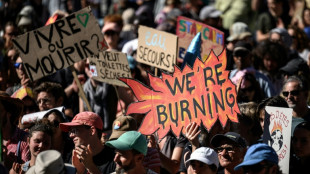 Thousands protest inaction over climate crisis in Switzerland

 Carapaz out of cycling world championships

 'Fragile' Tottenham beaten by Aston Villa despite late rally

 Mourinho hails Real Madrid grit before Atletico derby clash

 Martin wins Austrian MotoGP sprint after Acosta crash

 Japan edge Fiji to win Pacific Nations Cup

 Black smoke, flames rising near Riyadh airport: residents to AFP

 UK actor Naomi Watts honoured at Spain film festival

 Japan emperor declares Asian Games open after turbulent build-up

 Asian Games open with unity message after troubled build-up

 Denmark hails 'binding' Greenland deal with Trump

 We don't want Games host Japan losing money, says Asian Olympic official

 Ed Sheeran returns to stage after Palestinian controversy

Right-wing ideologues funded by fossil fuels, fame-seeking narcissists and doubt mongers monetising their content are pushing climate disinformation that undermines the fight against global warming, researchers say.
Experts interviewed by AFP outlined six key things that motivate people to deny climate change or seek to delay action.
- Oil money -
Studies have documented flows of cash from the fossil fuel industry to conservative US think tanks, signalled by researchers as publishers of misleading climate claims.
Greenpeace on the site exxonsecrets.org published documents from oil giant ExxonMobil revealing donations it made in the 1990s and 2000s to three such bodies: the Heartland Institute, the Competitive Enterprise Institute and the Cato Institute. Exxon has repeatedly denied working against climate science.
An analysis of tax documents and donor records by sociologist Robert Brulle of Brown University found that 91 climate-sceptic think tanks and lobby groups received income of $900 million in 2003-2010, largely from conservative foundations.
Since the mid-2000s, the funding has largely been channelled through philanthropic groups that conceal their donations.
"Fossil fuel companies have a long history of funding climate misinformation promulgated by conservative think tanks," Brulle told AFP.
"This misinformation has misled many Americans regarding the risks associated with climate change and has hindered actions to mitigate carbon emissions."
- Monetising -
Elsewhere there are individuals "who benefit from the outrage economy online and are exploiting the current business model of social media, which allows them to monetise climate denial and climate disinformation," said Jennie King, head of civic action at the Institute for Strategic Dialogue (ISD), a London-based digital research group.
"There is a large element of grift taking place in the online space. By cultivating a brand as these contrarian, intellectual Dark Web pundits, they gain increasing prominence on social media platforms," she said.
"That drives traffic to their websites and increases the likelihood of them developing brand relationships, sponsorship and paid talking appearances."
- Ideology -
For psychologists, climate disinformation is driven by free-market ideals that make people reject climate reforms.
"The number one driver of whether people accept climate science or reject it is their personal ideology," said Stephan Lewandowsky, a psychology professor at Bristol University who researches attitudes to climate change.
"People who are committed to unregulated free markets find it impossible to accept the science because the implications of the science are that we have to have regulations or a price on carbon," he told AFP.
- Politics -
Some of the most widely shared social media posts come from politicians –- such as US ex-president Donald Trump's repeated claims on Twitter that snowfall was evidence against global warming.
"People who vote conservative are more likely to be climate deniers," said John Cook, a researcher at Monash University in Melbourne and founder of the climate explainer site Skeptical Science.
"Not liking the solutions to climate change, they reject that there's a problem in the first place."
A November 2022 study in Nature by researchers at City, University of London revealed a rise in ideological polarisation around climate change during the COP26 climate summit in 2021, "driven by growing right-wing activity".
- Psychology -
A 2022 article co-authored by Lewandowsky and Matthew Hornsey of the University of Queensland pointed to other psychological aspects of climate claims, such as "motivated reasoning" –- people deciding what they believe and then seeking evidence that supports their view –- and "solution aversion" against reforms that imply painful sacrifice.
"On top of that, people are fearful of climate change," said Lewandowsky.
"Jumping into denial in the context of fear is not uncommon. The pandemic is another prime example."
- Fame -
Some climate contrarians have millions of followers on social media.
"I think that malignant narcissism probably is a big driver of the influencers," said Cook.
"These kind of mini-celebrities -- what makes them popular, famous, gets followers, gets blog readers, is their denial of the science."
Some prolific contrarians are former weather forecasters, such as Anthony Watts, founder of sceptic blog Watts Up With That -- or scientists themselves.
"I can think of individual instances of academics who had an extremely mediocre career at best and then climate change came along and they said, 'Oh, it's a hoax,' and claimed to have some expertise," said Lewandowsky.
"They were flooded with media requests. These guys are motivated by attention."
T.Sanchez--AT



