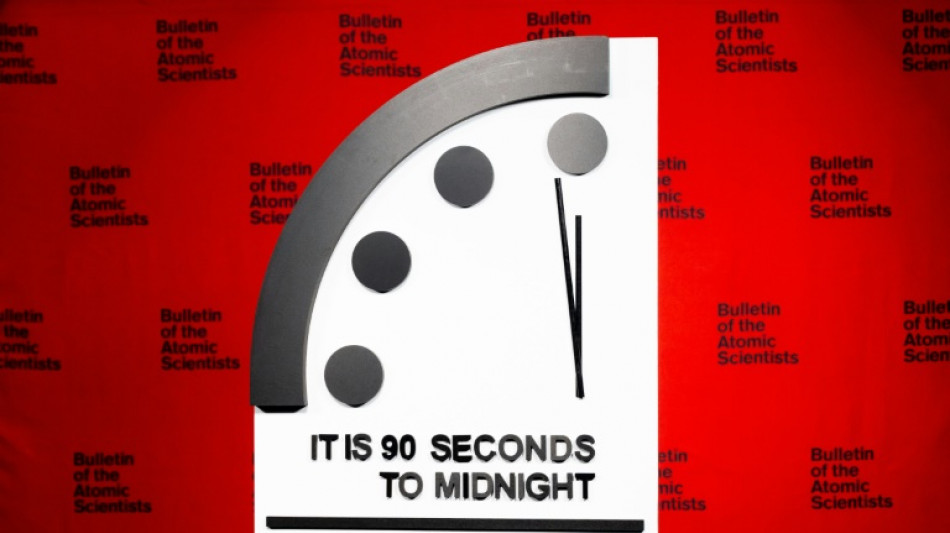
'Doomsday Clock' moves closest ever to midnight / Photo: Handout - Hastings Group Media/AFP

 Singer Ed Sheeran says Gaza situation 'unjustifiable' following controversy

 In 'Tenzing', a Sherpa mountaineer gets his due

 Ed Sheeran set to return to stage after Palestinian controversy

 Toulouse edge Vannes, Lyon beat Pau to take Top 14 summit

 Germans arrested for Louvre stunt in Mona Lisa hall

 Saudi-led coalition says Houthis fired ballistic missile at Riyadh

 France's debt climbs to highest since 1978: ministry

 McIlroy two shots off the lead at Wentworth after eagle on 18

 Martinez brace saves Inter in Serie A top-two clash with Roma

 Rosenior abused but guides Paris FC past old club Strasbourg

 Seven-try Lyon beat Pau, climb to Top 14 summit

 Brighton defeat a 'big lesson' against complacency for Arsenal, says Arteta

 Thousands protest inaction over climate crisis in Switzerland

 Carapaz out of cycling world championships

 'Fragile' Tottenham beaten by Aston Villa despite late rally

 Mourinho hails Real Madrid grit before Atletico derby clash

 Martin wins Austrian MotoGP sprint after Acosta crash

 Japan edge Fiji to win Pacific Nations Cup

 Black smoke, flames rising near Riyadh airport: residents to AFP

 UK actor Naomi Watts honoured at Spain film festival

 Japan emperor declares Asian Games open after turbulent build-up

 Asian Games open with unity message after troubled build-up

 Denmark hails 'binding' Greenland deal with Trump

 We don't want Games host Japan losing money, says Asian Olympic official

 Ed Sheeran returns to stage after Palestinian controversy

The "Doomsday Clock" symbolizing the perils to humanity moved Tuesday to its closest ever to midnight amid the Ukraine war, nuclear tensions and the climate crisis.
The Bulletin of the Atomic Scientists, which describes the clock as a "metaphor for how close humanity is to self-annihilation," edged its hands from 100 seconds to midnight to 90 seconds to midnight.
A decision to reset the hands of the symbolic timepiece is taken each year by the Bulletin's science and security board and its board of sponsors, which includes 10 Nobel laureates.
The hands of the clock moved to 100 seconds to midnight in January 2020 -- the closest to midnight it had been in its history -- and remained there for the next two years.
In a statement, the Bulletin said it was advancing the hands of the clock by 10 seconds this year "due largely but not exclusively to Russia's invasion of Ukraine and the increased risk of nuclear escalation."
"Russia's thinly veiled threats to use nuclear weapons remind the world that escalation of the conflict -- by accident, intention, or miscalculation -- is a terrible risk," it said. "The possibility that the conflict could spin out of anyone's control remains high."
The Bulletin said the new clock time "was also influenced by continuing threats posed by the climate crisis and the breakdown of global norms and institutions needed to mitigate risks associated with advancing technologies and biological threats such as Covid-19."
"We are living in a time of unprecedented danger, and the Doomsday Clock time reflects that reality," said Rachel Bronson, president and CEO of the Bulletin of the Atomic Scientists.
"90 seconds to midnight is the closest the clock has ever been set to midnight, and it's a decision our experts do not take lightly," Bronson said.
"The US government, its NATO allies and Ukraine have a multitude of channels for dialogue," she said. "We urge leaders to explore all of them to their fullest ability to turn back the clock."
Former UN secretary-general Ban Ki-moon also called for world leaders to take action in a world that has become more dangerous because of Covid-19, extreme weather events and "Russia's outrageous war on Ukraine."
"Leaders did not heed the Doomsday Clock’s warnings in 2020," Ban said. "We all continue to pay the price. In 2023 it is vital for all our sakes that they act."
The clock was originally set at seven minutes to midnight.
The furthest from midnight it has ever been is 17 minutes, following the end of the Cold War in 1991.
The Bulletin was founded in 1945 by Albert Einstein, J. Robert Oppenheimer and other scientists who worked on the Manhattan Project which produced the first nuclear weapons.
The idea of the clock symbolizing global vulnerability to catastrophe followed in 1947.
M.Robinson--AT



