Chile and Bolivia agree on river row, UN court says / Photo: AIZAR RALDES - AFP/File

 British PM says to make 'difficult decisions' as inflation rises

 TotalEnergies pumps up controversy in France with cut-price gas

 Global fuel price demos: a round-up

 Leverate Launches MCP for Traders to Connect AI Assistants With Trading Platforms

 MEXC Launches $1M "Discover Your Wall Street DNA" Campaign to Help Traders Find Their Market Fit
 Emporio Armani names Dario Vitale new creative director
 Maresca defends VAR officials after Man City benefit from error

 Courts jails LGBTQ activists as Turkey crackdown widens

 French court to hear Depardieu's appeal against rape trial order: sources

 The German state premier hoping to halt far-right surge

 Lebanon wants Israel security deal as prelude to peace: president to AFP

 England's Brook keen to learn from 'hero' Pietersen after stunning ton

 Saudi says Houthis target Mecca, warns of 'red line'

 Phillippines ex-leader Duterte makes first appearance at ICC
 Lebanon wants Israel security deal, Hezbollah disarmament without confrontation: president to AFP
 BASIS.pro Expands On-Chain Infrastructure with XDC Network Partnership and Zypher DAO as Auto Earn Goes Live
 Samson relishing battle with teen star Sooryavanshi for India spot
 Pickle-flavoured tart? AI inspires Japan's convenience stores
 Macau holds first closed-door national security trial
 Bank of Japan set to raise rates under pressure from inflation, US
 Zverev, Shelton back on court for Davis Cup qualifiers
 Peace is a 'dangerous' word in Russian city heading to polls

 Meta chief pushes back on AI slowdown calls

 'Resident Evil' film brings video game's ethos to the big screen
 Court orders N. Korea pay Seoul $32.5 mn for blowing up office
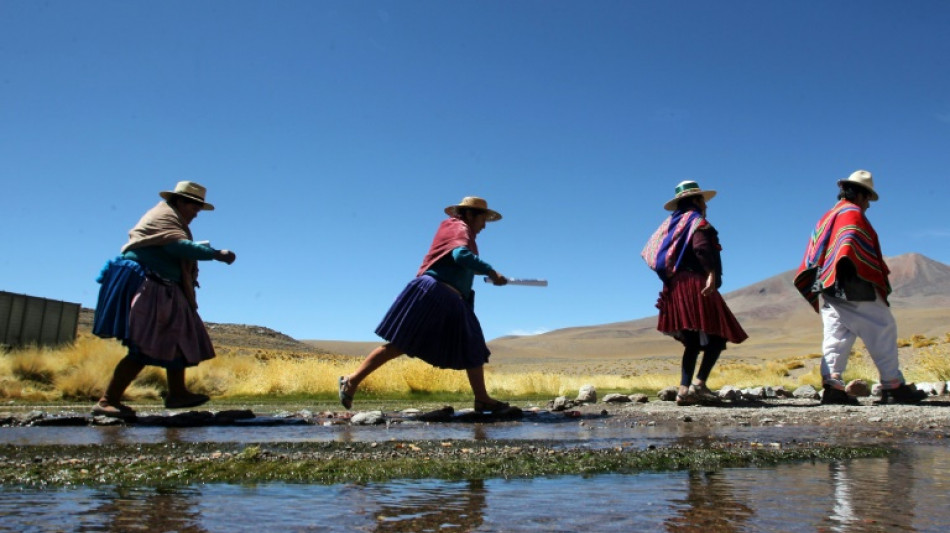
Chile and Bolivia have agreed on the status of a disputed cross-border river, the International Court of Justice said on Thursday, adding that judges were not required to rule on the climate-fuelled row.
The fractious South American neighbours had been battling at the UN's top court since 2016 over the River Silala, which flows from Bolivia's high-altitude wetlands into Chile's Atacama desert.
The Hague-based tribunal said that there was "no doubt the Silala is an international watercourse" as Chile had argued when it first filed the case in 2016, and that "both parties now agree".
Judges said they were "not called upon to give a decision" on the core issues in the case since the positions of Bolivia and Chile had now largely converged over the past six years.
But both countries claimed victory after the case, the latest in a series of water-sharing disputes between drought-stricken Chile and landlocked Bolivia.
They have had no diplomatic relations since 1978 and have been rowing over access to the Pacific Ocean for nearly 150 years.
Santiago had asked the ICJ -- which rules on disputes between UN member states -- to formally declare the five-mile-long (eight-kilometre-long) Silala an international waterway and give it equal rights to the river.
La Paz had insisted that the waters flow artificially into Chile due to a system of canals built to collect water from springs, and has demanded its neighbour pay compensation.
- Troubled waters -
Back in 2018 the court sank Bolivia's bid to gain access to the Pacific, which it lost to Chile in the 1879-1884 War of the Pacific.
Former Bolivian president Evo Morales had previously sought to use the river dispute as a bargaining chip in its fight for a route to the ocean.
At the time, Morales threatened to reduce the flow of the Silala into Chile and impose fees for its use.
The two countries broke off ties 44 years ago when Bolivia's last attempt to negotiate a passage to the Pacific broke down in acrimony.
During the last hearings on the Silala case in April, Chile's representative Ximena Fuentes said La Paz's demand for Santiago to pay for the use of the River Silala was "absurd".
Faced with the consequences of global climate change and freshwater becoming scarcer, "countries are called upon to cooperate in the efficient management of shared water resources," Fuentes added.
Bolivia hit back, saying Santiago's case was "hypothetical" and that it had "never" done anything to block the Silala's flow on Chilean territory.
Once handed down, ICJ judgements are binding and cannot be appealed, although the court has no real means of enforcement.
Chile is currently in a 13-year "Mega Drought" that is the longest in at least 1,000 years and threatens the country's freshwater resources.
In Bolivia, the Pantanal -- the world's largest wetlands which also span Brazil and Paraguay -- is experiencing its worst drought in 47 years.
A.Moore--AT