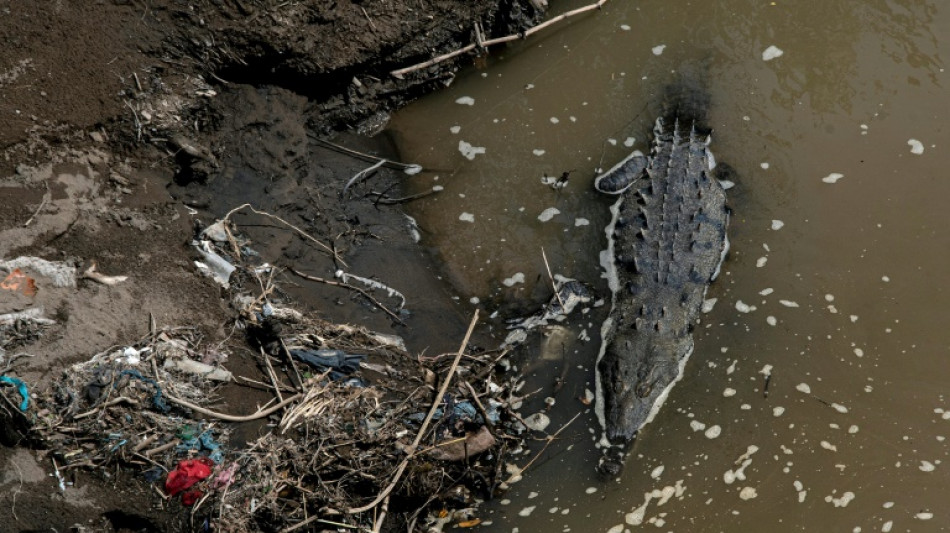
Costa Rica crocodiles survive in 'most polluted' river / Photo: Ezequiel BECERRA - AFP

 Argentina begin life after Messi with Bolivia friendly

 Helen Mirren delves into Patricia Highsmith's mind in 'A Talent for Murder'
 Sanders, Bannon warn of AI dangers in rare US left-right alignment

 US Senate crypto bill collapses amid partisan deadlock
 Raptors confirm Leonard return after Clippers salary cap scandal

 Empty benches as schools reopen in Venezuela's quake-hit Guaira

 US judge rules Trump's name must remain off Kennedy Center

 Samson fires India to T20 series win over Afghanistan

 Carney sells Canada to global investors but says US ties still key

 Tiny English village holds 'independence' vote over asylum seeker housing

 Trump slams Supreme Court over 'horrible' mail-in ballot ruling

 Protesting shepherds, farmers clash with Romanian police

 Saudi, Egypt demand open Red Sea, as Riyadh vows to hit back against Houthis

 Foundation Lets Ledger Users Switch to Open Source Without Starting Over

 Canada remains 'most important partner' for US in 'key areas': Carney

 Carrick urges Man Utd to use derby pain as fuel against Brighton

 Turkey police detain dozens over pro-LGBTQ Istanbul rally

 'Kenya's moment' as Nairobi to host 2029 world athletics champs in African first

 China warns against space 'battlefield' after US says weapons deployed

 Denmark says Russian frigate fired flares at helicopter
 EU to propose curbing social media, online games for under 15s

 FX Junction Reaches 40,600 Members and 26 Million Trades

 Prominent Greek neo-Nazi exits prison, vows return to politics
 'Obsessed': explosive state crime inquiry grips South Africa

 Sri Lanka's javelin champ returns to 'broken' welcome
In one of the most polluted rivers in Central America, a vulnerable crocodile species is thriving despite living in waters that have become a sewer for Costa Rica's capital, experts say.
Every day, trash and wastewater from San Jose households and factories flood into the Tarcoles River, which vomits tires and plastic into the surrounding mangroves.
Nevertheless, some 2,000 American Crocodiles have adapted to life in the toxic river that bears witness to the country's decades-long battle with waste management.
"It is a super-contaminated area, but this has not affected the crocodile population," said Ivan Sandoval, a biologist with the National University of Costa Rica.
"The Tarcoles River is the most polluted river in Costa Rica, and one of the most contaminated in Central America. Heavy metals, nitrites, nitrates, and a large amount of human waste can be found," added the crocodile expert.
According to the International Union for Conservation of Nature (IUCN), there are only about 5,000 of the crocodile species -- found in 18 countries -- left in the world after decades of hunting and habitat loss.
The organization lists the Crocodylus acutus as "vulnerable," but says its numbers have increased in recent years. The Costa Rica population is "healthy and robust."
Indeed, the large reptiles -- basking in the sun and occasionally feeding on fish that come up the channel from the sea -- appear unphased by some 150 types of bacteria that Sandoval says have been detected in the river.
He describes the carnivores as "living fossils" with the capacity to survive very tough conditions.
"They haven't had to change anything in millions of years, they are perfectly designed."
- Laws not applied -
Sandoval said that since 1980, Costa Rica's population of the crocodiles "are recovering," and warns of the threat of tourist activities.
The river's crocodiles are a major draw for foreign visitors, who take boat tours to see the creatures up close.
Some feed the animals, which is prohibited, and Sandoval worries about them getting too used to being close to people.
Juan Carlos Buitrago, 48, who captains one of the tour boats, says he and other locals regularly pull hundreds of tires and plastic waste from the water.
He delights in the fauna of the river, with macaws flying over ahead at sunset, but wishes his countrymen would stop polluting his "office."
"We cannot hide the pollution," he tells AFP.
Costa Rica has impressive environmental credentials, with a third of its territory marked for protection, 98 percent renewable energy, and 53 percent forest cover, according to the UN's environmental agency.
However, the law is not always strictly applied, as in the case of the Tarcoles River.
Lawyer and environmentalist Walter Brenes, 34, said that all of Costa Rica's rules and regulations "do not solve the problem."
He said the country needs "real public policy that is completely aimed at protecting wildlife."
Y.Baker--AT