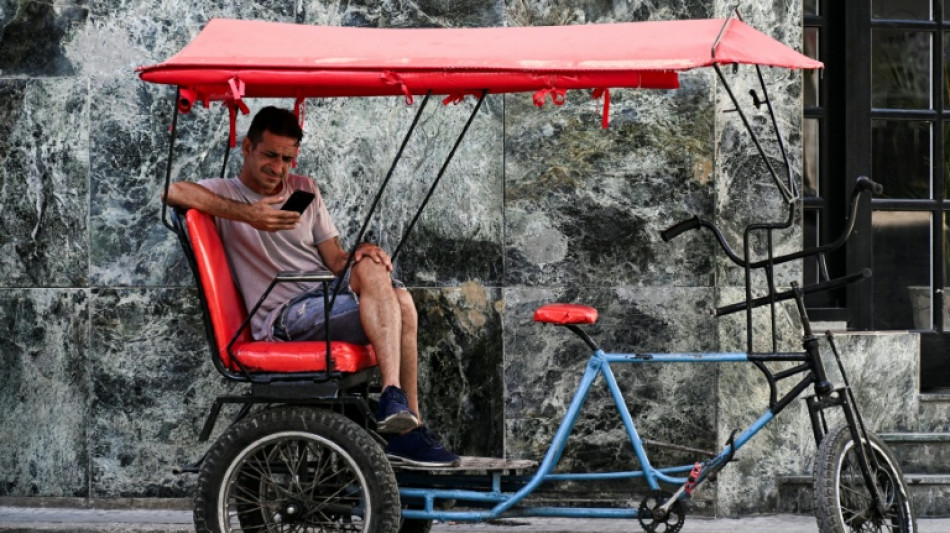
Betraying the revolution: Cuban students reject dollarization / Photo: YAMIL LAGE - AFP

 'It has to stop': runners protest women's murders in S.Africa district

 Fire erupts near Riyadh airport as Houthis claim strikes

 Cuba works to restore power after another blackout

 England thrash Sri Lanka again to return to top of T20 rankings
 Arsenal thrashed by Brighton, sorry Spurs lose again

 South Korea, Austria qualify for Davis Cup finals

 Seare shocks Ingebrigtsen to win world 5km gold

 Brigitte Bardot widower slams sale of star's belongings

 Aston Villa compound Tottenham's misery despite late rally

 Asian Games offer 'deepest apologies' for South Korea anthem blunder

 Inter Milan and Italy icon Mazzola dies aged 83

 Saudi capital issues first air raid alert since renewed fighting in Yemen

 Martin edges title rival Marquez for Austrian MotoGP pole

 Indonesia accepts Malaysia's help to tackle wildfires
 Indians living in Japan on stand-by to house Asian Games athletes
 Trump signs bill authorizing sweeping Russia sanctions

 Protesters form human chain at Kennedy Center after Trump threat

 Death toll from attack at police HQ in Pakistan rises to 31
 Trump says Denmark to give US 'permanent control' over Greenland security

 New to The Street Broadcasts Tonight at 6:30 PM ET Across the United States, Latin America and MENA, Featuring BioVie, Acurx Pharmaceuticals, Lantern Pharma and SafeSpace Global

 Kennedy Center: future unclear for iconic Washington arts hub
 Trump claims 'infinite' Greenland security deal with Denmark
 Helicopters battle wildfire threatening Ecuador's capital

 Brentford batter Chelsea to undo Alonso's promising start
 Kane hits Bundesliga century as Bayern rout Union
It took a steep hike in mobile internet tariffs to unleash a rebellion among Cuban students on a scale unseen since the 1959 revolution that brought Fidel Castro to power.
The new pricing structure, which came into effect on May 30, punished people who exceeded their meager monthly data limit of six gigabytes with steep fees.
On top of that, it made rates cheaper to top up in dollars than in Cuba's own currency, the peso.
State telecommunications company Etecsa said the increases were necessary to fund investments in the mobile network.
But it was also seen as a ploy by the cash-strapped communist government to bring in much-needed foreign currency.
Students in particular reacted angrily to the measure, which not only makes it harder for them to stay connected, but deepens the chasm on the island between dollar-toting haves and peso-using have-nots.
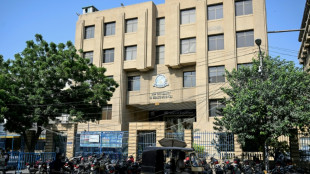
In rare scenes throughout the one-party state, students at several universities organized a boycott of classes, and students' unions issued statements rejecting the reform.
Anxious to avoid a repeat of the protests that rocked the island in July 2021, when thousands of people demonstrated over shortages of basic goods, the government has taken a conciliatory approach.
The Havana students' union this week announced the creation of a discussion group with students, teaching staff from a dozen university faculties in Havana, and Etecsa's representatives.
But on social media, students say they have come under pressure from security forces to fall in line.
In a video shared on social media, which AFP was unable to verify, a medical student claims she was threatened by a state security agent on campus with being taken to "an official place where you won't be able to use your phone."
The protests have ballooned into a wider mobilization over the subtle dollarization of the Cuban economy.
Students at the University of Holguin's law faculty in eastern Cuba issued a statement denouncing the new mobile tariffs as "elitist and classist" and said the growing shift towards dollars was an affront to the principle of equal rights.
In another viral video, a medical student at the University of Havana warned that the currency of the United States was becoming the country's "flagship currency."
For opposition activist Manuel Cuesta Morua, the protests mark a return to the kind of activism last seen on campuses in the 1950s, which forged the revolutionary careers of Castro and others.
Today's students are spearheading "a revolution within the revolution," Cuesta Morua said, adding that their tirades against inequality marked a return to the "original discourse of a revolution that became militarized and more conservative" over time.
- Not against communism -
The row over the internet fees comes amid the emergence of a two-speed society on the communist island, which is mired in its worst economic crisis in 30 years.
Inflation rose by 190 percent between 2018 and 2023, according to official figures, eroding the value of the peso against the dollar.
Food, fuel and medicine are all in short supply.
Cubans who receive dollar remittances from relatives abroad fare better, with well-stocked dollar payment grocery stores and gas stations only too happy to serve them.
- 'Last straw' -
In January, the government announced a partial dollarization of the economy, claiming it wanted to get its hands on some of the greenbacks.
But mobile top-ups in dollars were "the last straw" for many, according to Tamarys Bahamonde, a Cuban economist at American University in Washington.
In a joint manifesto, students from various faculties in Havana made it clear they were not "opposed to the government nor the revolution but to specific policies that betray its (egalitarian) ideal."
For Bahamonde, the crisis underscores the widening gulf between Cuba's decision-makers and its citizens.
To win over the students, Etecsa last week announced that they would be allowed two monthly top-ups at the basic rate of 360 pesos ($3), compared with one for the rest of the population.
But the students rejected the offer, saying they wanted everyone to benefit.
For activist Cuesta Morua, their reaction was proof that young Cubans, rather than the government, have become the voice of the people.
"It is the students... who are representing the country's concerns."
J.Gomez--AT