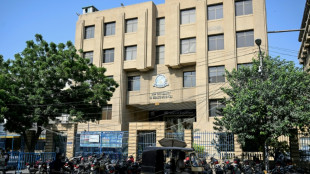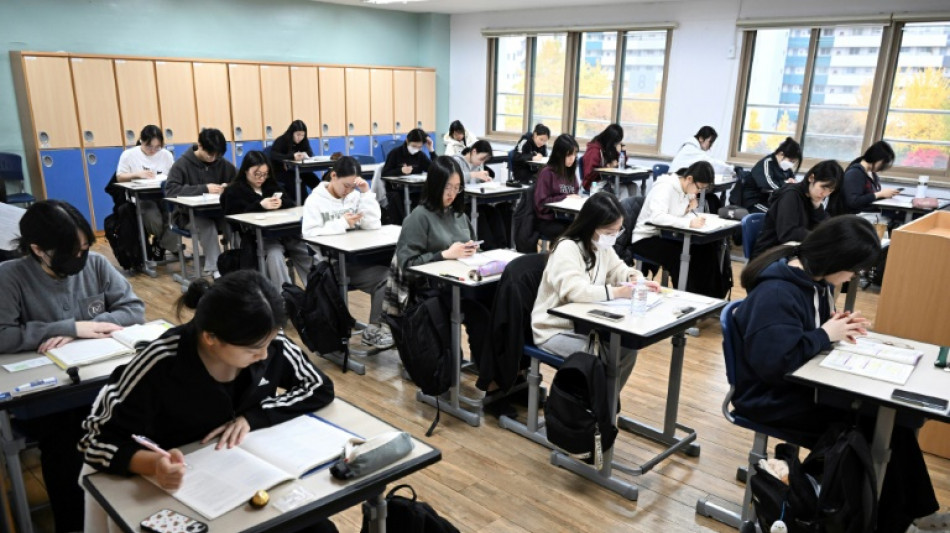
South Korea exam sees record number of re-takes after medical reforms / Photo: SONG Kyung-Seok - POOL/AFP

 Carapaz out of cycling world championships

 'Fragile' Tottenham beaten by Aston Villa despite late rally
 Mourinho hails Real Madrid grit before Atletico derby clash

 Martin wins Austrian MotoGP sprint after Acosta crash
 Japan edge Fiji to win Pacific Nations Cup
 Black smoke, flames rising near Riyadh airport: residents to AFP
 UK actor Naomi Watts honoured at Spain film festival
 Japan emperor declares Asian Games open after turbulent build-up
 Asian Games open with unity message after troubled build-up
 Denmark hails 'binding' Greenland deal with Trump

 We don't want Games host Japan losing money, says Asian Olympic official
 Ed Sheeran returns to stage after Palestinian controversy
 Asian Games to open in Japan after troubled build-up
 Drone owners rush to offload devices ahead of Beijing ban
 Trump's beef policies irk Texas ranchers, testing their loyalty

 Batman Appears Atop the Sydney Opera House for Batman Day 2026
 Nvidia, OpenAI CEOs to attend Xi dinner at White House
 Anthropic picks Accenture for in-house AI safety evaluation
 Balogun returns as Monaco beat Lens to continue strong Ligue 1 start

 'Pause' on overt repression in Venezuela, but reforms still needed: HRW

 Global stocks mixed as yen falls despite Bank of Japan rate hike
 Cuba hit with seventh major blackout of the year
 Murray out with concussion so Wentz will start for Vikings
 UN chief 'deeply regrets' US visa refusal to Abbas for annual meeting
 England quick Carse to face no charges over alleged nightclub assault
South Korean students are sitting a crucial university entrance exam Thursday, with a record number re-taking the test in a bid to capitalise on reforms that made it easier to get into medical school.
Nearly a third of those sitting the nine-hour exam this year are retaking it -- the highest percentage ever -- as people hope to join expanded cohorts of trainee doctors.
Lee Sang-joon, 21, who is taking the test for the third time, told AFP he was "so happy" when he learned about the reforms, which gave him fresh hope of pursuing a medical career.
This year is his "final chance" to succeed, he said.
"It was nearly impossible to go to medical school, the top 0.01 percent in the country could go in. Now it's about 0.015 percent, which sounds like a chance to me".
Thousands of trainee doctors and medical students stopped working in February in protest of the plans, which sharply increased the number of places available for trainee doctors.
But the government has pressed ahead, even as a roughly nine-month work stoppage has hit hospitals across the country.
Good results on the test -- locally known as "Suneung", a Korean abbreviation for the College Scholastic Ability Test -- are essential for admission to top universities.
They are also widely seen as a pathway to social mobility, economic security, and even a good marriage.
South Korea takes extraordinary measures to make sure test-takers do not face any disruptions, including rescheduling flights and slowing traffic to reduce noise -- and asking offices to change working hours.
An education ministry official told AFP "we have placed all the measures we can, working with relevant ministries, to assure that the students can do their best and focus only on the test".
To minimise noise around the more than 1,200 test centres nationwide, traffic has been ordered to slow, with bus and taxi driver unions agreeing not to honk during test hours.
Construction work near the schools will also be halted.
During the crucial listening portion of the English test, the land ministry imposed a nationwide ban on all aircraft takeoffs and landings outside of emergency situations.
More than 156 flights were rescheduled because of the exam.
Businesses were asked to adjust opening hours to alleviate traffic congestion and ensure that students arrived on time for the test, which started at 8:40 am.
Even the stock market will also open an hour later at 10:00 am.
Anxious parents wept while wishing their children good luck and police escorted test-takers who were running late into schools early Thursday.
The exam uses a multiple-choice format and will be taken by 522,670 pupils this year.
E.Rodriguez--AT