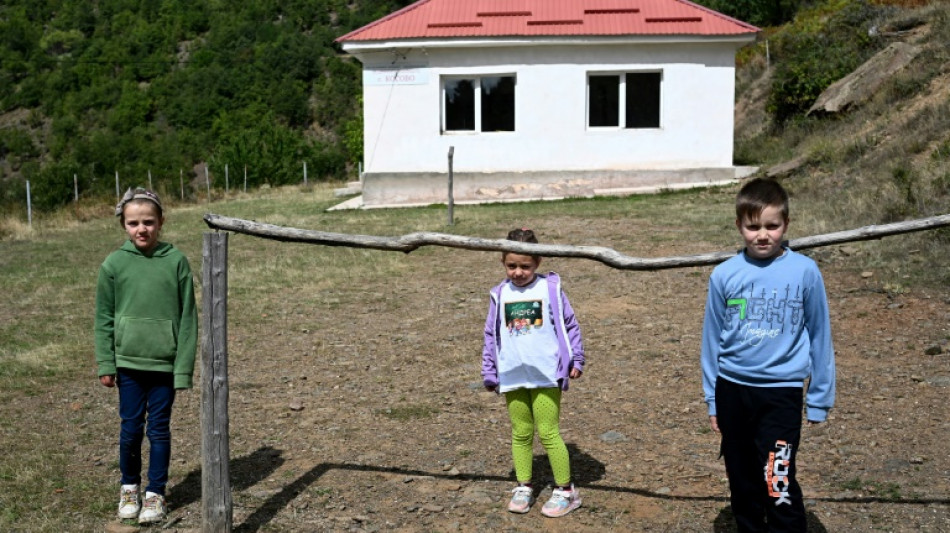
Rural schools empty in North Macedonia due to exodus / Photo: Robert ATANASOVSKI - AFP

 Carapaz out of cycling world championships

 'Fragile' Tottenham beaten by Aston Villa despite late rally

 Mourinho hails Real Madrid grit before Atletico derby clash

 Martin wins Austrian MotoGP sprint after Acosta crash

 Japan edge Fiji to win Pacific Nations Cup
 Black smoke, flames rising near Riyadh airport: residents to AFP
 UK actor Naomi Watts honoured at Spain film festival
 Japan emperor declares Asian Games open after turbulent build-up

 Asian Games open with unity message after troubled build-up
 Denmark hails 'binding' Greenland deal with Trump

 We don't want Games host Japan losing money, says Asian Olympic official
 Ed Sheeran returns to stage after Palestinian controversy

 Asian Games to open in Japan after troubled build-up
 Drone owners rush to offload devices ahead of Beijing ban

 Trump's beef policies irk Texas ranchers, testing their loyalty

 Batman Appears Atop the Sydney Opera House for Batman Day 2026
 Nvidia, OpenAI CEOs to attend Xi dinner at White House

 Anthropic picks Accenture for in-house AI safety evaluation
 Balogun returns as Monaco beat Lens to continue strong Ligue 1 start

 'Pause' on overt repression in Venezuela, but reforms still needed: HRW

 Global stocks mixed as yen falls despite Bank of Japan rate hike

 Cuba hit with seventh major blackout of the year

 Murray out with concussion so Wentz will start for Vikings

 UN chief 'deeply regrets' US visa refusal to Abbas for annual meeting
 England quick Carse to face no charges over alleged nightclub assault

Teacher Zarko Blazevski spends nearly an hour crossing empty mountain passes to reach his remote school with only three students in North Macedonia.
With a spiralling population decline, enrolments have plummeted and the future of schools such as the one where Blazevski has taught for nearly a decade is uncertain.
Located in the village of Kosovo -- which shares the same name as the neighbouring Balkan nation to the north -- Blazevski has however seen only the smallest fluctuations in numbers in the school.
"We first had four, later nine, which was the highest number. And now we have three students," Blazevski told AFP.
Since declaring independence in 1991, North Macedonia has seen vast chunks of its people emigrating amid a stagnating economy.
According to the last census conducted in 2021, it has just 1.8 million inhabitants, a drop of nearly 10 percent in less than two decades.
A report published in September by the Center for Civil Communications NGO said elementary schools have lost some 10,000 pupils in the past decade.
"The decrease of the number of students is especially seen in secondary education where in 10 years the number of students dropped by 20 percent," said the report, based on figures from the national statistical office.
The decline covers both rural communities and urban areas.
North Macedonia's new government, which was elected in June, has pledged to tackle this but it is an uphill task.
Led by the right-wing VMRO-DPMNE party, the government has created a ministry for social policy, demography and youth but has not spelt out how it plans to stem the exodus.
- No children, no future -
The effects are most visible in the countryside.
Abandoned villages and crumbling homes dot the mountainous landscape, where summer forest fires are often allowed to rage as they do not threaten inhabited areas.
At the remaining village and town schools, education officials are often faced with the difficult decision of whether to close, thereby forcing pupils to take lengthy commutes.
"It means a lot to them because they have school close to their home, they do not need to travel and at the same time they have their family near them," Blazevski says.
In Brest, just eight kilometres (five miles) south of Kosovo village, Jasmina Kuzmanovska runs a ramshackle school with only two students.
"I think there will be no other children in the village for the school to continue," Kuzmanovska said.
Kuzmanovska and others like her face the additional challenge of teaching children of a variety of ages in a single classroom, with different courses at different levels.
During one school year, she had seven students spread across five age groups.
"First I worked with one class, then another... that's how we managed the work," she told AFP.
Education Minister Vesna Janevska announced new plans to merge schools with small numbers of students but has yet to announce a start date.
But closing schools in places like Brest and Kosovo may signal the beginning of the end of their villages, warn educators.
"It would be great if these students, even though there are not many left, at least get to study until fifth grade where they are born," said Toni Stavreski, a school administrator in nearby Makedonski Brod.
"That will also help these villages to continue existing."
W.Moreno--AT