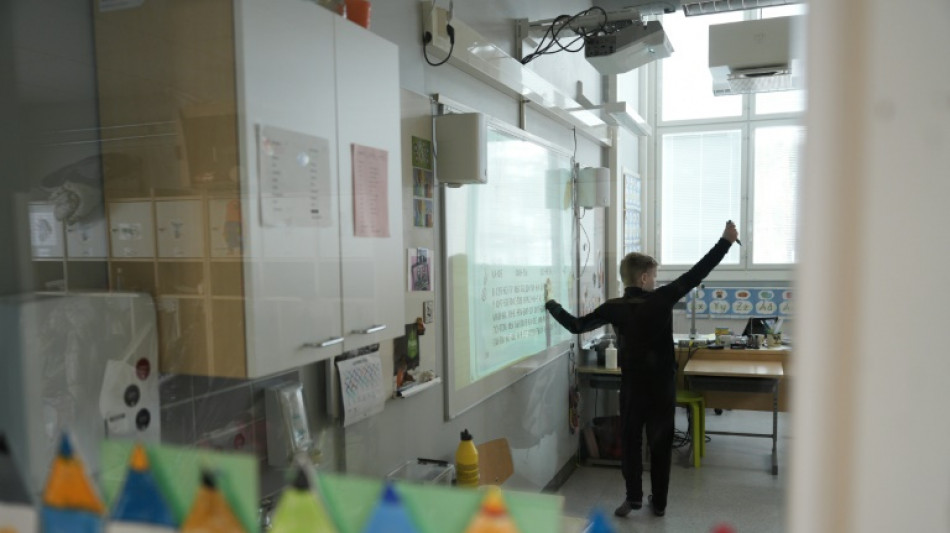
Do svidaniya! Finland's fading interest in Russian language / Photo: Alessandro RAMPAZZO - AFP

 Martin wins Austrian MotoGP sprint after Acosta crash

 Japan edge Fiji to win Pacific Nations Cup
 Black smoke, flames rising near Riyadh airport: residents to AFP

 UK actor Naomi Watts honoured at Spain film festival
 Japan emperor declares Asian Games open after turbulent build-up

 Asian Games open with unity message after troubled build-up
 Denmark hails 'binding' Greenland deal with Trump
 We don't want Games host Japan losing money, says Asian Olympic official
 Ed Sheeran returns to stage after Palestinian controversy

 Asian Games to open in Japan after troubled build-up
 Drone owners rush to offload devices ahead of Beijing ban

 Trump's beef policies irk Texas ranchers, testing their loyalty

 Kennedy Center: future unclear for iconic Washington arts hub

 Trump claims 'infinite' Greenland security deal with Denmark

 Helicopters battle wildfire threatening Ecuador's capital

 Brentford batter Chelsea to undo Alonso's promising start
 Kane hits Bundesliga century as Bayern rout Union
 Trump says CNN, MS NOW, Politico banned from White House
 Hushing and hedging: US companies retreat on climate

 Springboks to face Fiji before 2027 Rugby World Cup
 Nigeria miners struggled to breathe in cell before 37 died: survivors

 McIlroy on the charge at PGA Championship as Reed withdraws

 McIlroy on the charge at PGA Championship

 Crisis-wracked Volkswagen warns of 10-bn-euro hit to profits

 Costa Rica's Grynspan tops third informal poll for UN chief: diplomat

Two Finnish towns near the Russian border plan to close schools offering Russian language and culture classes, upsetting parents and students who say cross-cultural understanding is needed more than ever.
Finland's relations with its powerful eastern neighbour have soured since Russia's 2022 invasion.
The war prompted Helsinki to reverse its decades-long policy of military non-alignment and join NATO in April 2023, a decision that angered Moscow.
When the towns of Lappeenranta and Joensuu announced this year they would close their two schools focusing on Russian language and culture due to a lack of resources, school representatives saw it as fallout from the rise of anti-Russian sentiment in Finland since the war in Ukraine.
The headmaster of the School of Eastern Finland, Katri Anttila, said town officials were no longer keen to maintain Russian language studies after the invasion.
"This is part of the same trend, which is very sad. I am happy we have parents and students who do not link the Russian language to Russian President (Vladimir) Putin and the Russian government, because language should never be linked to politics or a certain country," Anttila said.
The School of Eastern Finland has three branches in the towns of Lappeenranta, Imatra and Joensuu, the only schools outside the capital Helsinki that offer Russian culture and language studies in addition to the Finnish curriculum.
The state-funded schools founded in 1997 have 700 students aged six to 18.
- Declining interest -
During a recent visit to the Lappeenranta school, classrooms were bustling with students chatting in Finnish and Russian, colourful posters hanging on the walls with writing in the two languages.
Located some 30 kilometres from Finland's 1,340 kilometre (832-mile) border with Russia, the first spring flowers were beginning to bloom in the schoolyard under a gloomy April sky.
Both students and teachers were upset about Lappeenranta's recent decision.
"I was shocked when I heard the school will close," Eetu Varis, an 18-year-old at the upper secondary school, told AFP.
A city official in charge of Lappeenranta educational services, Juhani Junnilainen, told AFP the closure was due to a school network reform.
"We do not have enough resources to maintain all the schools we have," he said.
In addition, "interest for the Russian language has decreased for more than a decade" while "Spanish has become more and more popular" in Lappeenranta schools.
The city of Turku also decided this year it would end a Finnish-Russian language programme offered at one public school, citing declining student enrolment.
A separate school in Helsinki offering classes in Russian told AFP it had no plans to close.
- 'Next to us' -
Before the Covid pandemic and Russia's war in Ukraine, almost two million Russian tourists crossed Finland's border to visit the Lappeenranta region annually, bringing in more than 300 million euros ($322 million).
Now, Russian licence plates are a rare sight on the streets of Lappeenranta.
In late 2022, Finland imposed entry restrictions on Russian tourists, allowing only essential travel.
"Before the ongoing situation in Ukraine you heard Russian everywhere," said student Varis, adding: "It is important in this area."
Like the majority of his classmates, Varis is a native Finnish speaker interested in learning about other languages and cultures.
Finland closed its entire eastern border with Russia in December, five months after Moscow began pushing undocumented migrants over the border in what Finnish officials labelled a "hybrid attack". Russia has denied the charge.
Tuomas Laitinen, a parent of two children at the Lappeenranta school, accused the towns of miscalculating the need for an understanding of the Russian culture and language in Finland.
"Finland has been known for decades for our knowledge of Russia, and it benefits the EU and NATO," he said.
"Geographically we are not moving anywhere. Russia is next to us, and we have to know about their culture."
Anttila meanwhile underlined that Finland must be able to "understand the language of the Russian opposition", emphasising that the school would continue to fight to keep its doors open.
H.Gonzales--AT