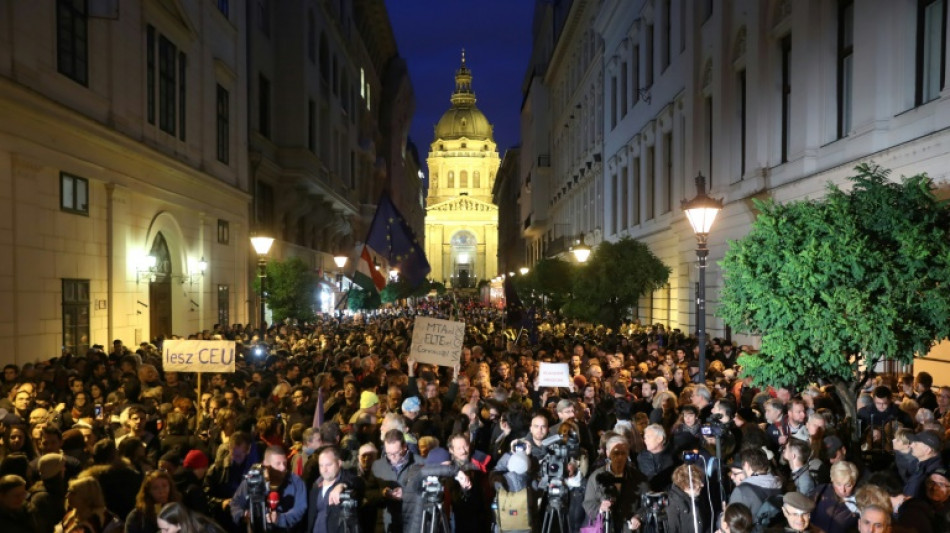
Academic freedom declining globally, index finds / Photo: FERENC ISZA - AFP/File

 Martin wins Austrian MotoGP sprint after Acosta crash

 Japan edge Fiji to win Pacific Nations Cup
 Black smoke, flames rising near Riyadh airport: residents to AFP

 UK actor Naomi Watts honoured at Spain film festival

 Japan emperor declares Asian Games open after turbulent build-up

 Asian Games open with unity message after troubled build-up
 Denmark hails 'binding' Greenland deal with Trump

 We don't want Games host Japan losing money, says Asian Olympic official
 Ed Sheeran returns to stage after Palestinian controversy

 Asian Games to open in Japan after troubled build-up
 Drone owners rush to offload devices ahead of Beijing ban
 Trump's beef policies irk Texas ranchers, testing their loyalty

 Kennedy Center: future unclear for iconic Washington arts hub

 Trump claims 'infinite' Greenland security deal with Denmark

 Helicopters battle wildfire threatening Ecuador's capital

 Brentford batter Chelsea to undo Alonso's promising start
 Kane hits Bundesliga century as Bayern rout Union
 Trump says CNN, MS NOW, Politico banned from White House
 Hushing and hedging: US companies retreat on climate

 Springboks to face Fiji before 2027 Rugby World Cup
 Nigeria miners struggled to breathe in cell before 37 died: survivors

 McIlroy on the charge at PGA Championship as Reed withdraws
 McIlroy on the charge at PGA Championship

 Crisis-wracked Volkswagen warns of 10-bn-euro hit to profits
 Costa Rica's Grynspan tops third informal poll for UN chief: diplomat

Just one in three people live a nation that guarantees the independence of universities and research, according to an annual index warning that academic freedom is declining worldwide, particularly in Russia, China and India.
Attacks on freedom of expression, interference at universities and the imprisonment of researchers are just some ways that "academic freedom globally is under threat," the index said.
The Academic Freedom Index -- based on input from more than 2,300 experts in 179 countries -- was published last month as part of a report on democracy by the V-Dem Institute at Sweden's University of Gothenburg.
It measures changes in higher education and research over the last half century by looking at five different indicators: freedom of research and teaching; of academic exchange; of academic and cultural expression; of institutional autonomy and campus integrity.
Katrin Kinzelbach, professor at Germany's University of Erlangen-Nuremberg and one of the organisers of the index, told AFP that 171 states have ratified a human rights treaty which commits them to respect the freedom of scientific research.
But because of recent "significant deteriorations" in countries with large populations, "only every third person in the world today lives in a country where research and higher education enjoys a high degree of freedom," she said.
Accounting for the world's growing population, the proportion of people living in nations with academic freedom is comparable to 1973, she added.
"Now, 45.5 percent of the world's population -- 3.6 billion people -- live in 27 countries where academic freedom is completely restricted," the report said.
- 'From bad to worse' -
Significant declines were particularly seen in India, China and Russia -- the first, second and ninth most populous nations -- which Kinzelbach called "clear examples of autocratisation".
"Academic freedom has fallen dramatically" in India since Prime Minister Narendra Modi took power in 2014, she said.
Kinzelbach cited the example of British-Indian academic Nitasha Kaul, a politics professor at the UK's University of Westminster denied entry to India for a conference last month.
In Russia and China, "academic freedom was never great, and it has now deteriorated from bad to worse," Kinzelbach said.
Perhaps more surprisingly, the index found academic freedom had also fallen in the United States since 2019, which Kinzelbach called "a shock for many academics".
She emphasised both society and the political system in the US were "highly polarised".
"University campuses have become arenas where this polarisation unfolds," she said, calling for "calm, evidence-based debates on campus -- including about highly divisive issues."
Most European countries had very high academic freedom according to the index, with Hungary scoring the lowest rate followed by Poland.
However Kinzelbach said Poland's score will likely improve under the new government of Prime Minister Donald Tusk.
A.Ruiz--AT