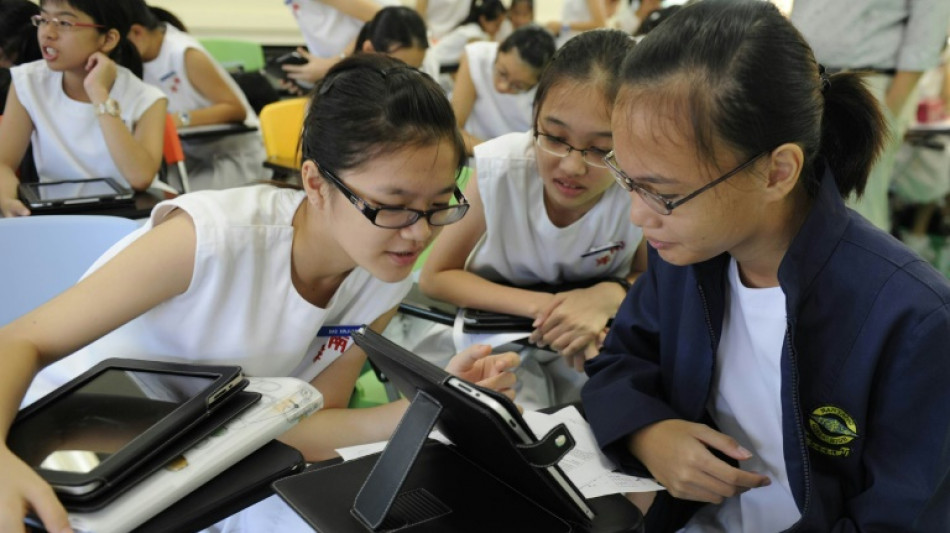
Asian countries score high in key education survey / Photo: SIMIN WANG - AFP

 Martin wins Austrian MotoGP sprint after Acosta crash

 Japan edge Fiji to win Pacific Nations Cup

 Black smoke, flames rising near Riyadh airport: residents to AFP

 UK actor Naomi Watts honoured at Spain film festival

 Japan emperor declares Asian Games open after turbulent build-up

 Asian Games open with unity message after troubled build-up

 Denmark hails 'binding' Greenland deal with Trump

 We don't want Games host Japan losing money, says Asian Olympic official

 Ed Sheeran returns to stage after Palestinian controversy

 Asian Games to open in Japan after troubled build-up

 Drone owners rush to offload devices ahead of Beijing ban

 Trump's beef policies irk Texas ranchers, testing their loyalty

 Kennedy Center: future unclear for iconic Washington arts hub

 Trump claims 'infinite' Greenland security deal with Denmark

 Helicopters battle wildfire threatening Ecuador's capital

 Brentford batter Chelsea to undo Alonso's promising start

 Kane hits Bundesliga century as Bayern rout Union
 Trump says CNN, MS NOW, Politico banned from White House
 Hushing and hedging: US companies retreat on climate

 Springboks to face Fiji before 2027 Rugby World Cup

 Nigeria miners struggled to breathe in cell before 37 died: survivors

 McIlroy on the charge at PGA Championship as Reed withdraws

 McIlroy on the charge at PGA Championship

 Crisis-wracked Volkswagen warns of 10-bn-euro hit to profits

 Costa Rica's Grynspan tops third informal poll for UN chief: diplomat

Asian countries dominated the top spots in a keenly watched survey of education capabilities published Tuesday, while levels in Europe slipped at a record pace -- and not just because of Covid.
However, the report also showed that students in top performing countries were not necessarily happier.
The PISA survey is carried out every three years by the Paris-based Organisation for Economic Cooperation and Development (OECD) to assess the ability of 15-year-olds to meet real-life challenges.
"The Pisa 2022 results show a fall in student performance that is unprecedented in Pisa's history," OECD education analyst Irene Hu told reporters.
Singapore took top ranking in the latest assessment, which was carried out in 2022 and involved 690,000 students in 81 participating countries and economies.
The south-east Asian island city state scored highest in all three of the survey's areas: mathematics, reading and science.
"These results suggest that, on average, Singaporean students are the equivalent of almost three to five years of schooling ahead of their peers," the report said.
Five other Asian education systems -- in Macao, Taiwan, Hong Kong, Japan and South Korea -- came next in mathematics, and also scored near the top in reading and science.
But while Asia did well, other parts of the world declined, sparking an overall "unprecedented drop in performance", the report said.
Germany, Iceland, the Netherlands, Norway and Poland, for example, all saw notably lower achievements in mathematics, it said.
- 'Not just about Covid' -
Covid-19 shutdowns hurt education standards, the report said, but there were also other factors behind the downturn.
Students in Finland, Iceland and Sweden -- once star performers -- have been scoring lower marks for years.
"This indicates that long-term issues in education systems are also to blame for the drop in performance," it said. "It is not just about Covid."
A key factor is "the level of support pupils received from teachers and school staff", the OECD's Hu said.
Some education systems have not given sufficient resources for supporting students, said Eric Charbonnier, another OECD education analyst.
"Countries have invested in education over the past 10 years, but maybe they didn't invest efficiently, or sufficiently into the quality of teaching," he said.
"We also see less parental involvement with the progress of children compared to 2018," he added.
While there was some correlation between spending and academic performance, "history shows that countries determined to build a first-class education system can achieve this even in adverse economic circumstances", the report said.
"The world is no longer strictly divided between rich and well-educated nations and poor and badly-educated ones", it said.
In some cases, 2022's drop in skills amounted to roughly a year's worth of education.
"For example, in mathematics, in Denmark, France, Greece, Portugal and Sweden, the average 15-year-old in 2022 scored at the level expected of a 14-year-old in 2018," the report said.
The best European performer was Estonia. The EU's two biggest countries, Germany and France, ranked below Switzerland, Ireland, Belgium and Britain.
"Germany is more worrying than France," said Charbonnier, adding that Norway and Finland also declined more than France.
The US education system showed little change from the last survey, with students there weaker in mathematics, and slightly above average in reading and science.
- 'Fear of failure' -
For the first time, the OECD also examined the happiness of students, using nine aspects of their lives to measure their well-being.
They include engagement with school, material and cultural well-being, openness to diversity and psychological well-being.
This showed that in top maths performers Singapore, Macao and Taiwan, "many students reported a high fear of failure and limited engagement in extracurricular activities such as sports".
In contrast, with students in countries with lower average PISA test scores, such as Spain and Peru, researchers often found "lower levels of anxiety and a greater focus on sports".
E.Hall--AT