South Koreans sit key exam as flights halted to limit distraction / Photo: Chung Sung-Jun - POOL/AFP

 Martin wins Austrian MotoGP sprint after Acosta crash

 Japan edge Fiji to win Pacific Nations Cup

 Black smoke, flames rising near Riyadh airport: residents to AFP

 UK actor Naomi Watts honoured at Spain film festival

 Japan emperor declares Asian Games open after turbulent build-up

 Asian Games open with unity message after troubled build-up

 Denmark hails 'binding' Greenland deal with Trump

 We don't want Games host Japan losing money, says Asian Olympic official

 Ed Sheeran returns to stage after Palestinian controversy

 Asian Games to open in Japan after troubled build-up

 Drone owners rush to offload devices ahead of Beijing ban

 Trump's beef policies irk Texas ranchers, testing their loyalty

 Kennedy Center: future unclear for iconic Washington arts hub

 Trump claims 'infinite' Greenland security deal with Denmark

 Helicopters battle wildfire threatening Ecuador's capital

 Brentford batter Chelsea to undo Alonso's promising start

 Kane hits Bundesliga century as Bayern rout Union
 Trump says CNN, MS NOW, Politico banned from White House
 Hushing and hedging: US companies retreat on climate

 Springboks to face Fiji before 2027 Rugby World Cup
 Nigeria miners struggled to breathe in cell before 37 died: survivors

 McIlroy on the charge at PGA Championship as Reed withdraws
 McIlroy on the charge at PGA Championship

 Crisis-wracked Volkswagen warns of 10-bn-euro hit to profits

 Costa Rica's Grynspan tops third informal poll for UN chief: diplomat

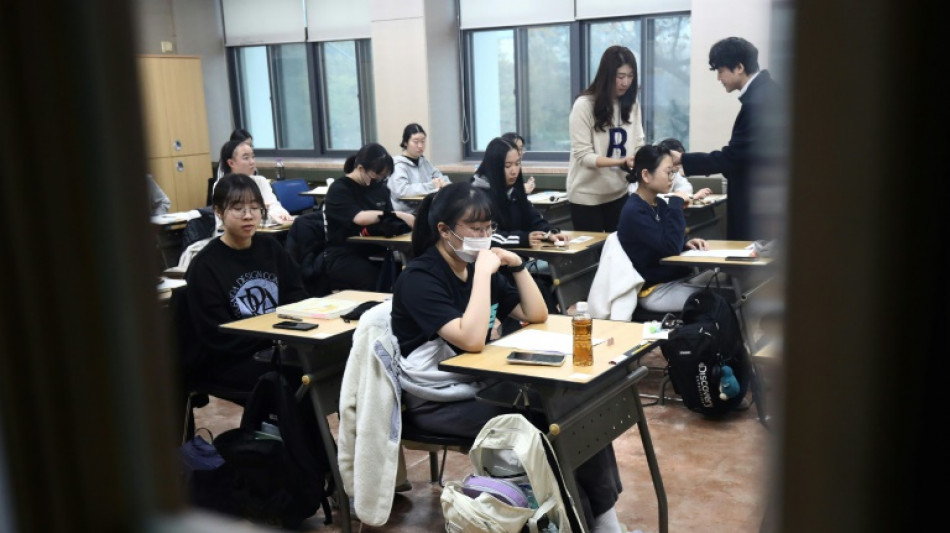
More than half a million students in South Korea are sitting the crucial national university entrance exam on Thursday, with authorities set to take extraordinary measures including halting flights to minimise distraction.
The nine-hour test, which is being taken by 504,588 pupils this year, is crucial for securing spots in top universities. It is also considered key to elevated social status, lucrative careers, and even marriage prospects.
Enormous pressure placed on students in South Korea's ultra-competitive education system has been blamed for teenage depression and suicide rates which are among the highest in the world.
"I'm nervous and trembling because what I've been studying for three years ends with this exam today," Lee Min-yup, a test-taker, told AFP outside Kyungbock High School in central Seoul.
The importance of the test was reflected by the aggressive measures authorities were taking to prevent any disturbance.
To reduce noise disruption during the listening portion of the English test, Seoul's transportation ministry has announced a nationwide ban on all aircraft takeoffs and landings outside of emergency situations.
The ban will be in effect for 35 minutes, from 1:05 pm to 1:40 pm local time (0405 to 0440 GMT).
With the exception of aircraft in distress, all airborne planes must maintain an altitude higher than 3,000 metres (10,000 feet) during the restricted time.
More than 90 flights had to be rescheduled because of the exam.
Public offices and major businesses were requested to adjust their opening hours to 10 am or later to alleviate traffic congestion and ensure that students arrived on time for the nationwide exam, which commenced at 8:40 am.
The stock market also opened an hour later than usual.
Police cars and regional government officials were on standby to help students running late for the exam reach their test sites in time.
This year's test also marks the first time that test-takers are allowed to take the exam without wearing masks since the pandemic began.
- Killer questions -
Outside Kyungbock High School, some test-takers appeared visibly nervous, with others running late for the exam arriving on motorcycles that had been designated as emergency convoy vehicles by the authorities.
High school freshmen and juniors gathered outside the entrance of the venue to show their support for the test-takers.
They chanted phrases including "Success in Suneung", using the local name for the exam, while enthusiastically waving banners adorned with messages such as "Strive for a perfect score in Suneung".
Relatives also showed up to express their support for their children.
"Right now, for them this is everything," Lee Jong-hwa, a mother of one of the exam-takers, said.
"At this moment it's too much of a burden for them to just let it pass by."
For this year's exam, authorities dropped so-called "killer questions" -- which cannot be answered by simply studying the curriculum taught at public schools -- in a bid to reduce reliance on expensive private cram schools.
"In accordance with the Ministry of Education's measures to reduce private education, so-called 'killer questions' were excluded," Jeong Moon-seong, a university professor who supervised the exam's administration this year, told reporters Thursday morning.
"Questions of suitable difficulty were selected evenly to ensure that (students) can demonstrate their understanding based solely on the content covered in the public education curriculum," he added.
South Korean households spent more than $20 billion on private education for primary, middle and high school students last year, according to Statistics Korea.
W.Morales--AT