Poland, Hungary risk funding slashes after EU rule-of-law decision

 Verstappen wins chaotic Singapore sprint after Russell crashes

 Kiss tells Wallabies to 'return fire' after first loss as coach

 Russian strikes kill 11 including 3 children: Ukrainian authorities

 Russian teenager Andreeva breezes into China Open final

 Major earthquake hits Panama, injures at least 27

 India detains 'cockroach' leaders ahead of election protest

 'No divisions, no borders', French astronaut says of seeing Earth

 India's 'cockroach' movement chief detained ahead of major protest

 Year later, Gaza ceasefire promises mostly unfulfilled

 Taiwan's leader says increasing defence spending to 'deter war'

 Major quake hits Panama, no deaths reported

 Hurricane Isaias makes landfall in Florida

 Brazil prosecutors sue Shell for $108 mn over deadly 2024 floods

 Major earthquake destroys buildings, roads in Panama

 Anthropic AI model sent fake murder tip to Philadelphia police

 7.7-magnitude quake rocks Panama, triggers tsunami warning

 Prince Harry booed at English rugby match

 Kiplimo and Feysa seek repeat Chicago Marathon wins

 Fuellkrug halts Dortmund after late goal flurry

 Injured Ravens quarterback Jackson ruled out of Falcons clash

 Brewers aim to take down two-time defending champion Dodgers in NLCS rematch

 Tsunami alert after major earthquake rocks Panama

 Outer bands of Hurricane Isaias lash US Gulf Coast

 Hope, Rutherford fire West Indies to record T20 chase of 250

 Farhan leads Pakistan to T20 win over Sri Lanka

The EU's top court on Wednesday rejected a challenge by Poland and Hungary to a mechanism allowing Brussels to slash funding to member states that flout democratic standards.
The judgment exposes Poland and Hungary -- seen as democratic backsliders in the 27-nation bloc -- to the risk of seeing money cut from the billions in EU funding they receive.
The two countries responded immediately with fury. Both are expected to mount further legal battles against it.
Poland called it "an attack on our sovereignty" while Hungary slammed it as a "political decision".
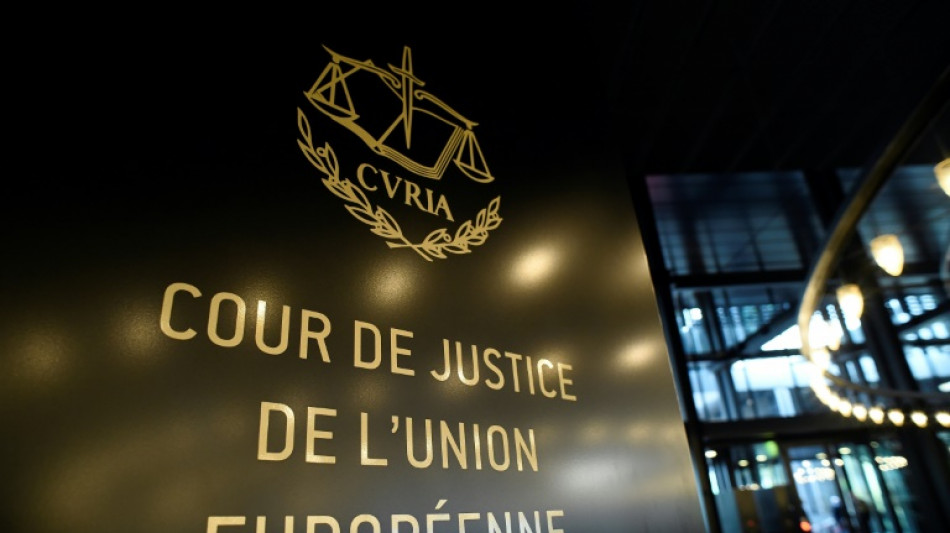
In its judgment, the European Court of Justice (ECJ) said that all EU member states had signed up to the bloc's "common values... such as the rule of law and solidarity" and that the European Union "must be able to defend those values".
It dismissed Poland and Hungary's arguments that their rights under EU treaties were being violated by a "conditionality mechanism" that came into force just over a year ago.
Instead it stated that the EU's budget -- which covers seven-year stretches and amounts to two trillion euros ($2.3 trillion) for 2021-2027, including 800 billion euros in coronavirus recovery spending -- "is one of the principal instruments for giving practical effect" to EU solidarity.
The conditionality mechanism, it said, "is intended to protect the Union budget from effects resulting... from breaches of the principles of the rule of law" and was thus allowed under EU treaties.
- Commission welcomes ruling -
The European Commission, which acts as the guardian of the EU treaties and distributes EU money, was not expected to quickly wield the ruling in any application of the conditionality mechanism.
It needs a qualified majority of member states to approve the mechanism's use.
The commission has said it intends to build any cases step-by-step, so they are airtight.
EU Commission chief Ursula von der Leyen issued a statement welcoming the ruling, saying it confirms "that we are on the right track" and would now be studied.
The mechanism, she said, "enables us to protect better the EU budget and the financial interests of the Union against breaches of the principles of the rule of law".
"Taking into account these judgments, we will adopt in the following weeks guidelines providing further clarity about how we apply the mechanism in practice," von der Leyen said.
The commission has been under pressure from the European Parliament to apply the conditionality mechanism against Poland and Hungary. The legislature launched legal action to make the commission act.
But Poland and Hungary have been fiercely fighting back against the use of the mechanism.
After Wednesday's ruling Poland's Deputy Justice Minister Sebastian Kaleta tweeted that "we need to stand together in the face of this attack on our sovereignty".
"Poland needs to defend its democracy from blackmail that aims to take away our right to self-determination," he added.
Hungary's justice minister, Judit Varga, said in a Facebook post that "the decision is living proof that Brussels is abusing its power" and called the ruling "politically motivated".
- Democratic shortcomings -
The commission has already put Warsaw and Budapest on notice, sending them formal letters last November setting out what it sees as their democratic shortfalls.
For Poland, the commission criticises judicial reforms it believes undermine judges' independence and a refusal to accept the primacy of EU law over Polish law.
For Hungary, it is about public procurement, conflict of interests and corruption.
In the conditionality case, 10 member states spoke in support of the mechanism, including France, Germany, the Netherlands, Ireland and Sweden.
In a sign of how anticipated Wednesday's judgment was, the court for the first time broadcast the pronouncement of the ruling.
Poland's Constitutional Court was due to study the EU conditionality mechanism on Wednesday, but delayed its decision to an unspecified date.
The court is considered to be close to the ruling Law and Justice party that continues to defy Brussels.
The conditionality mechanism was created in 2020, after a summit at the height of the coronavirus pandemic that agreed common borrowing to build 800-billion-euro in grants and loans for EU countries to recover.
F.Ramirez--AT