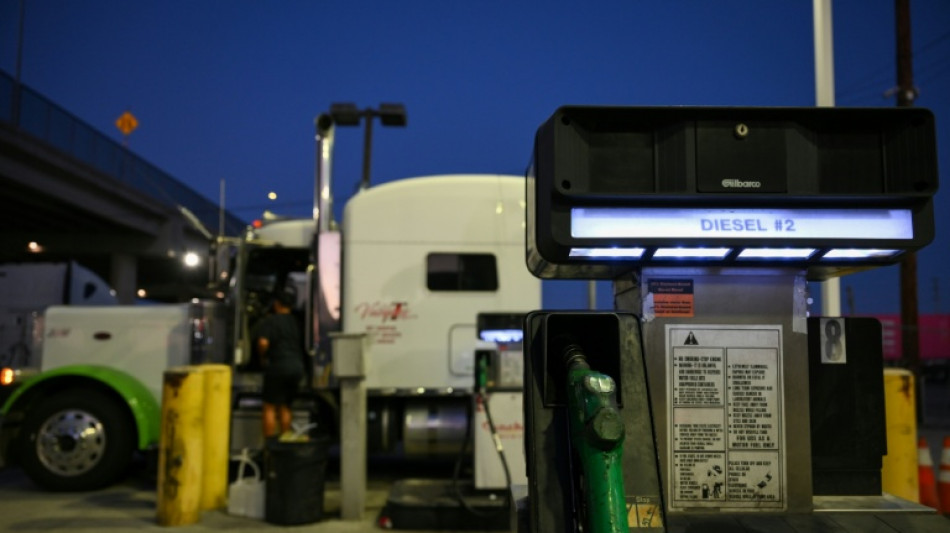
What happens if the US bans diesel exports / Photo: Patrick T. Fallon - AFP

 Zach Hickerson Recounts Hayden Panettiere's Final Moments in New Interview

 Luxembourg Housing Petition Passes Threshold for Parliamentary Consideration

 Raheem Sterling Receives Suspended Sentence After Lamborghini Crash

 Audience to Choose the Set List at Luxembourg's First FAMIL Jukebox Night

 Luxembourg Pay Rise Delayed as Regional and World Headlines Develop

 Chennai Urbanist Sashna Develops 'Anniki' Card Game to Gamify Tamil Nadu History

 Transport Minister Defends Land Seizure Powers for Toronto-Quebec City High-Speed Rail

 UAE Weather Forecast: Scattered Showers and Fog Expected as Temperatures Drop
With diesel prices hitting records ahead of the US midterm elections, President Donald Trump has expressed support for a ban on diesel exports, but analysts warn the move could drive up wider fuel prices.
AFP examines the reasons below:
- Why Trump wants a ban -
Average diesel prices have struck record highs in recent weeks, pushing US prices to a fresh peak of $6.53 per gallon on Tuesday, according to the motorists' association AAA.
Prices have surged from $3.76 a gallon at the start of the US-Iran war in late February.
Soaring fuel prices threaten to cost Trump's Republicans their control of Congress in November's midterms.
Diesel is used largely in road hauling, agriculture and construction, meaning price rises can quickly spread across the economy and spur inflation.
The question of a ban still appears to be dividing the Trump administration. But several Republican figures have called for restricting diesel exports.
"I've said let's not send out the diesel," Trump told reporters on Tuesday.
- Consequences for US prices -
In the short term, "if there's an export ban, then there will be more supply in the US and therefore, prices will come down," in the country, Rystad Energy analyst Jorge Leon told AFP.
The United States produces more diesel than it consumes, exporting 1.3 million barrels per day and importing 0.2 mb/d, according to Morgan Stanley analysts.
Diesel is refined from crude oil along with other transport fuels, notably petrol and kerosene that is used to power planes.
An export ban would mean storage tanks for refined products in the US Gulf coast would "fill up in around three weeks," Morgan Stanley analysts said.
"If there's too much diesel in the US that cannot be exported, then refineries in the US will have to reduce runs," meaning they will produce less petrol and less jet fuel, said Leon.
"What we would see is prices of diesel coming down, but prices of gasoline and jet fuel increasing," he added.
- Global consequences -
If there is a ban, "international refining margins will surge" along with prices at the pump, said Helge Andre Martinsen and Tobias Ingebrigtsen at DNB Carnegie.
It could create a new energy shock, particularly for Europe which is dependent on Washington for diesel imports and would struggle to replace the volumes it needs.
Global diesel supply is already severely weakened.
A large portion of refined products from the Middle East are unavailable due to disruptions to maritime transport linked to the war, while some facilities have suffered damage from attacks.
Additionally, Ukraine's attacks on Russian refineries have forced Moscow, a key producer, to implement a moratorium on its diesel exports.
A halt in US exports to Europe could drive the price of diesel at the pump in France to around 3.90 euros ($4.40) per litre, according to consulting firm Bersingeco.
A.Williams--AT