
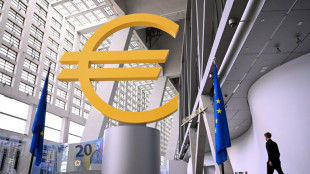
Google handed setback as EU court upholds record fine / Photo: DAVID MCNEW - AFP

 Pietersen joins England coaching team ahead of World Cup

 Germany's triumphant far-right AfD aims fire at Merz

 Fury claims Joshua bout is off, calls for Usyk trilogy

 British family bids to row back against suicide taboo

 China's teenage 223cm basketball player 'just a little girl'

 Tokyo's Shinjuku to ban more than half of vacation rentals

 Australian Rules limits contact training to reduce concussion

 Germany's Merz under pressure from far-right election triumph

 Nepal tunnel rescues face 'unprecedented' challenge

 Mourinho's Real Madrid European revival bid starts with Inter reunion

 Solomons PM survives attempt to oust government

 Ohtani 'unlikely' to pitch again this season, says Dodgers manager

 Driver thanks 'superhero' rival for saving him from flaming race car

 Can dogs sniff cancer? AI joins the hunt in India

 Shelton steams into US Open quarter-final clash with Alcaraz
 25 years on, America seeks to keep 9/11 memories alive

 'Trumpapalooza' tests Republican bet on unpopular US president

 Pegula tops Cirstea to reach US Open quarter-finals

 Australians could opt out of social media algorithms under new law

 Genflow Biosciences PLC Announces Appointment of Investor Relations Adviser

 Enjoying the moment: Alcaraz steps it up to reach US Open quarter-finals

 Five dead, five injured after Amazon cargo plane overshoots Miami runway

 La Rochelle half-backs lead fightback against Toulouse

 US envoys have 'more effective proposals': Ukraine official

 Defending champion Alcaraz powers into US Open quarter-finals

The European Union's second-highest court on Wednesday overwhelmingly upheld the EU's record fine against Google over its Android operating system for mobile phones, slightly reducing the fee for technical reasons.
In a statement, the EU's General court said it "largely confirms the commission's decision that Google imposed unlawful restrictions on manufacturers of Android mobile devices" in order to benefit its search engine.
The court, however, said the fine should be slightly reduced to 4.125 billion euros ($4.1 billion), instead of the 4.3 billion euros decided by the commission in 2018, after reviewing the duration of the infringement.
The levy remains the EU's biggest ever despite Google's arguments that the commission's case was unfounded and falsely relied on accusations it imposed its search engine and Chrome browser on Android phones.
The company also pushed the case that the EU was unfairly blind to the strength of Apple, which imposes or gives clear preference to its own services such as Safari on iPhones
"We are disappointed that the Court did not annul the decision in full," a Google spokesperson said in a short statement.
"Android has created more choice for everyone, not less, and supports thousands of successful businesses in Europe and around the world," it added.
The complainants welcomed the decision as it confirmed that Google "can no longer impose its will on phone makers", said Thomas Vinje, a lawyer representing the industry group FairSearch, whose original complaint launched the case in 2013.
"This shows the European Commission got it right," he added.
The commission said it "took note" of the decision and "will carefully study the judgement and decide on possible next steps".
The decision by the General Court is not necessarily the end of the story. Both sides can turn to the EU's highest court, the European Court of Justice, for a final say on the fine, which was the equivalent of $5 billion when levied.
- Global action -
The Android case was the third of three major cases brought against Google by the EU's competition czar Margrethe Vestager, whose legal challenges were the first worldwide to directly take on the Silicon Valley giants.
Since then, global regulators have followed suit, with Google facing a barrage of cases in the United States and Asia based on similar accusations.
Last year, South Korea fined Google nearly $180 million for abusing its dominance in a similar case targetting Android.
Vestager has already won against Google in its appeal of a separate case, a 2.4-billion-euro fine for the company for abusing its search engine dominance. As expected, the tech giant appealed that setback to the high court.
The EU, however, has lost recent cases involving the microchip industry.
Vestager's team lost an appeal against a $1 billion fine imposed on Qualcomm in the same court in June.
That followed another setback in January when the EU lost the court's backing for a 1.06-billion-euro fine on Intel.
Frustrated at the length of time it takes to pursue competition cases, Brussels has since adopted the Digital Markets Act (DMA), which puts a much tighter leash on the way Big Tech can do business.
The new law, set to come into force next year, would set up a rulebook of do's and don'ts for Big Tech companies such as Google and Facebook.
The DMA includes specific bans or limits on Google, Apple and other gatekeepers from promoting their own services on platforms.
H.Romero--AT