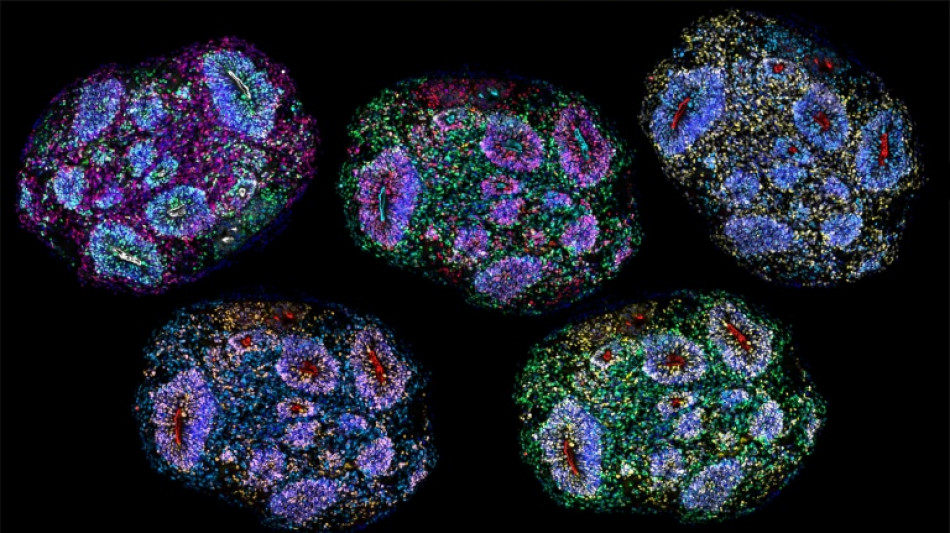
Oldest human brain cells grown in lab 'recorded passage of time' / Photo: Noelia ANTON-BOLANOS, Irene FARAVELLI - Springer Nature/AFP

 Marseille snap losing skid with win at Troyes

 Lula stages mass rally ahead of Brazil's presidential run-off

 Poland holds suspect in alleged assassination plot against PM Tusk

 Russia hits Ukraine power plants despite Trump energy ceasefire claim

 Isco's Betis rise back above Real Madrid to third

 Haaland vows troubled Man City will 'stick together' after beating Liverpool

 Abhishek, Arshdeep guide India to T20 win over West Indies

 'Other Mommy' scares up N. American box office win

 Zelensky surprised, Moscow mum as Trump announces energy ceasefire

 Ready Player 1: Paris to host 2027 edition of EVO combat video games event

 Bill Gates warns cyberattacks most imminent AI threat

 Lazio join Inter at top of Serie A as Roma held at Como

 Trump says Russia and Ukraine agree to 'energy ceasefire'

 Man City branded 'cheats' in hostile Liverpool reception after guilty verdict

 Smith breaks fielding record as Australia take control of 1st Test

 Smith breaks fielding record as Australia take first innings lead

 Saints win south coast derby after Eckert's suspended 'Spygate' ban

 Zheng beats Andreeva to become first home player to win China Open

 Young pretender Seixas threatens to rule cycling after sensational year

 Serie A stalemate as Roma held by Como

 Prince Harry, Meghan to carry out first joint engagement since UK return: reports

 Last Ceuta migrant camp removed ahead of Spanish king's visit

 Ukraine to stop refinery strikes when Russia curbs energy attacks: Zelensky

 Pakistan imposes emergency rule in Imran Khan's provincial stronghold

 Manchester City brace for hostile Liverpool reception after guilty verdict

Peppercorn-sized clumps of human brain cells grown in a lab for a record seven years aged similarly to those inside our heads, suggesting they "recorded the passage of time," scientists said Wednesday.
These tiny clumps called organoids are grown from stem cells by scientists around the world in the hopes of uncovering the mysteries of our brain -- and to test new medicine without having to use animals such as mice.
Normally these organoids live for a few months, meaning they can only offer a window into the earliest stages of human brains, which take nearly 20 years to fully develop.
So a US-led team of researchers grew some for around seven years, making them the "oldest ever", Paola Arlotta, the senior author of a new study describing the experiment, told AFP.
They discovered that the brain organoids continued to change and mature over the years, despite never having been inside an embryo, let alone a body.
"The brain can continue to develop outside the context of a person for this unprecedented amount of time," explained Arlotta, a Harvard University professor.
The scientists hope this will help shed light on how a range of disorders such as autism and schizophrenia first emerge and then progress later in life.
The study, published in the journal Nature, said the organoids "recorded the passage of time and retain a memory of the developmental steps already performed".
This does not mean organoids have memories like we tend to think of them -- such as recalling something from childhood -- but simply that their past is "engraved" on a cellular level, Arlotta emphasised.
Organoids are "biological models" or "avatars" for human brain cells that are far less complex and do not receive sensory input, she added.
Scientists widely agree that organoids are not capable of consciousness or other higher-order brain functions.
- Experiment 'warped time' -
The researchers analysed their ageing organoids with three different kinds of recently developed genetic "clocks" that can roughly determine the biological age of cells.
They all showed that the organoids changed over time in similar ways to normal brain cells.
To further confirm their theory, the scientists carried out what Arlotta described as a "crazy experiment".
They mixed cells that had been developing for a year together with others that were only two weeks old, creating a "chimera".
The young cells behaved as normal.
But the older cells "jumped ahead a whole chunk of development" and started making neurons that normally take around four months, Arlotta said.
This effectively "warped time" for brain development, which was "super cool", she added.
In the future, it could be possible to use this technique to rapidly speed up the development of certain brain cells, Arlotta speculated.
The previous record for the oldest grown brain organoids was a little under two years, according to the study.
Unlike the brains inside our heads, these organoids do not have a body that can get sick and die.
So could brain organoids grown and maintained in a lab hypothetically outlive humans?
"Nobody really knows," Arlotta said, adding she suspected organoids could hypothetically last a little longer.
That will not be the case for the brain organoids used for the new research, which were recently destroyed.
W.Morales--AT