South Africa's migrant exodus leaves employers short-handed / Photo: RODGER BOSCH - AFP

 Pope warns against losing humanity in 'paradise of machines'

 From FBI warning to literary acclaim: the Russian journalist who took on Putin
 China swimmer in Asian Games first as North Korea lifters reign

 French literary prize removes novel from longlist after AI claims

 China's Zhang wins record seventh Asian Games swimming gold

 Verstappen edges Russell in final practice in Azerbaijan

 English, Spanish, Italian, German football leagues call for FIFA reform

 Pope arrives in France on first official visit in 18 years

 Pope arrives in France on first state visit in 18 years

 Heavy fighting, internet disruption as Ethiopia conflict rages

 From transit to consumption: drug use surges in Mozambique
 Chicago teams, Guardians and Padres all book MLB playoff berths
 Bijan Robinson destroys Packers in 35-14 win for Falcons

 Harimoto hails new era as Japan dethrone table tennis kings China

 India rape cases turn focus back onto women's safety
 Rebellious Afghan taxi drivers defy ban on music

 Brazil candidates mount digital armies for fierce online campaign
 Nepal PM says floods 'a warning to the world' about climate change

 Trump hosts Xi for state dinner as pomp masks tensions
 Core Silver Announces Grant of Stock Options

 Tocvan Reports Positive Closed-Circuit Column Leach Results at Gran Pilar

 InterContinental Hotels Group PLC Announces Transaction in Own Shares - September 25

 Helio Concludes Successful Southwest Roadshow, Expands Investor Outreach to the Northeast in Support of Its Uplisting Strategy

 American Hotel Income Properties REIT LP Announces Corporate Update

 Karbon-X (OTCQB:KARX) to Present Global Growth Strategy and Showcase SkyXero at 26th MK-Equity Investment Conference in Munich

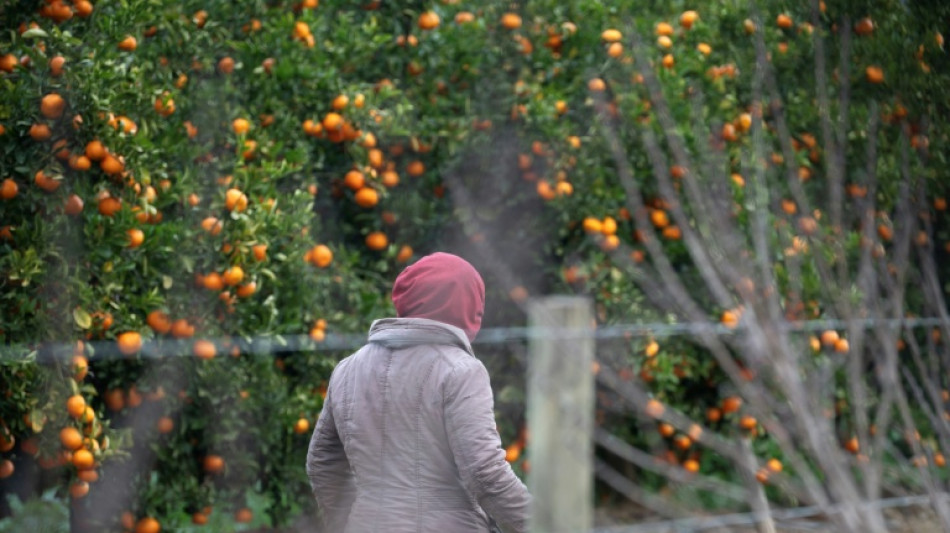
Zimbabwean farmworker Aaron Majatamhe was heading home at sunset after a shift in one of South Africa's top fruit-producing regions, where bushes laden with bright unpicked citrus stood in rows.
"I see a lot of farm owners who are crying now... people have to harvest those naartjies but there is no one," the 33-year-old told AFP.
The same shortage, he said, is looming in the vineyards. "It's time to cut off the grapes and there is no one."
Similar scenes are playing out across South Africa as factories, farms and even ordinary households scramble for labour after thousands of foreign workers left in a matter of weeks to escape deadly anti-migrant protests and intensified immigration enforcement.
Fringe anti-foreigner groups had set June 30 as an unofficial deadline for undocumented migrants to go home, triggering the exodus of more than 160,000 people, according to an AFP tally based on figures from African governments repatriating their citizens.
Zimbabwe, which accounted for the largest share of those returning, said many had worked in South Africa's farming, domestic work and construction sectors.
The first cracks were felt almost immediately in KwaZulu-Natal's sugar belt.
One farmer on the north coast said he lost up to 80 percent of his cane-cutting workforce virtually overnight.
"Production and supply have deteriorated to the point where it is going to be difficult for the mills to stay open," he said, speaking anonymously because he feared retaliation.
- 'Back-breaking' work -
Another grower near Mid-Illovo, a region of rolling hills south of Durban, said most cane cutters in his area came from Lesotho, the tiny kingdom encircled by South Africa.
"There are fields we are supposed to be cutting, but there are just not enough people. Local people don't like this job because it is back‑breaking and physical," he said.
That argument is fiercely disputed.
With unemployment above 33 percent -- and far higher when discouraged job seekers are included -- labour unions and researchers argue there is no shortage of South Africans willing to work.
Instead, they say, many employers favour migrant workers because they are cheaper, more flexible and less likely to demand formal contracts, benefits or legal protections.
"They are making a profit out of foreign nations," said Patrick Williams, a local organiser with the Commercial, Stevedoring, Agricultural and Allied Workers Union.
Foreign farmworkers, he said, routinely worked seven days a week, skipped lunch breaks to maximise piece-rate earnings and were often paid below the national minimum wage.
- 'Locals first' -
For employers, the challenge is not only finding workers, but replacing years of experience.
In Durban's Chatsworth industrial area, a manager at a clothing factory said the departure of skilled machinists from Malawi and Mozambique had left factories struggling to meet orders.
"We can barely meet our targets because most were forced to go," she said on condition of anonymity, adding it would take time for local workers to master the job.
The government has sought to respond to public anger over migration by promoting a "locals first" approach, while acknowledging that some industries rely on foreign skills and labour.
This week it expanded its Trusted Employer Scheme that fast-tracks worker visas for companies that meet requirements including predominantly employing South Africans, investing in skills development and operating in priority sectors.
Industry groups are urging the government to create legal pathways for seasonal foreign labour, arguing that sectors such as agriculture have become dependent on migrant workers and cannot replace them overnight.
South Africa should consider a regulated seasonal worker programme similar to one in the United States, said Siyabonga Madlala, chief executive of the South African Farmers Development Association.
"There may be a need for a special dispensation allowing seasonal labour from SADC countries where local supply is insufficient," he told Newsroom Afrika, referring to the 16-member Southern African Development Community bloc.
More than 60 percent of South Africa's immigrants are estimated to come from SADC.
Yet for many who left, the debate over labour policy has been eclipsed by fears for their safety after at least four foreigners were killed, according to police data.
Wayne Chimbadzwa Mutasa, a Zimbabwean national who had lived in Robertson since 2014, said he left after foreign workers were targeted in door-to-door raids.
"The people who came into the houses of Zimbabweans were police officers saying that you are living here illegally," he told AFP as he prepared for repatriation.
His fellow national Majatamhe, the farm worker, has decided to remain for now.
"We are afraid to stay even in this place, but the problem is, we don't have enough money to go home," he said.
strs-ho/br/giv
E.Flores--AT