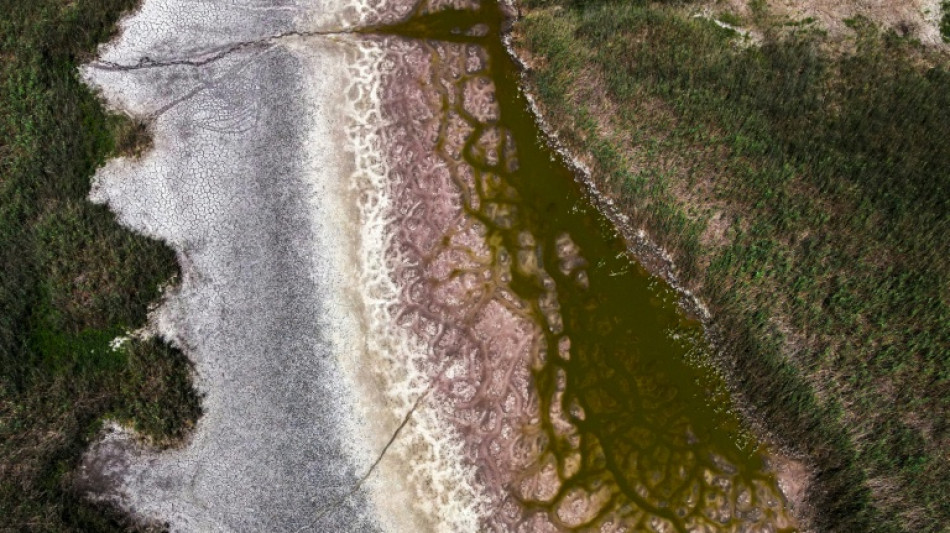
Climate change, mismanagement dry up beloved Hungarian lake / Photo: STR - AFP

 How young is too young as child prodigies win big at Asian Games

 UK Labour party meets buoyed by Burnham but eager for concrete plans

 Thousands protest ahead of Mexican president's report on missing students

 Bangkok floods force thousands into shelters

 AI startup urges optimism from Europe despite safety fears

 'Godlike, invincible': Japan hails 11-year-old Games history-maker

 Nepal's hydropower ambitions face climate reality check

 Power cuts, rubble: millions come home to find Sudan's capital unlivable

 Internationals keep Presidents Cup lead with late fightbacks

 Tuchel to 'keep pushing' England to reach Spain's level

 Alcaraz saves match points to keep Europe ahead in Laver Cup

 Spain success driven by hunger to improve, says De La Fuente

 Lyon collapse at Stade Francais to suffer first Top 14 loss
 Oyarzabal and Spain sink England again as Modric shines for Croatia

 Housing protesters camp in central Madrid after mass demonstration

 Louise Trotter expands her palette at Bottega Veneta

 Pope prays at Lourdes after huge Paris mass

 USA trims International lead after Presidents Cup four-balls

 Russia accuses Europe of blocking Ukraine talks, as strikes drag on

 'He said hello': Families pray with pope on Paris avenue

 Pope celebrates giant Paris mass, flies to Lourdes

 Thousands march in Madrid over eviction of 87-year-old woman

 England women back to winning ways with last-gasp defeat of New Zealand

 Trump rejects Iran proposal for deal to reopen Hormuz

 England's Cox says injured Buttler leaves 'big shoes to fill'
The beaches of Hungary's once-popular Lake Velence lie largely deserted, summer holidaymakers staying away because climate change and mismanagement have dried up the waters to record lows.
"We pray for rain, but we know the whole country is facing water scarcity," said Gyorgy Simon, whose lakeside leisure company was forced to suspend sightseeing cruises in late June.
A shallow inlet where children once splashed beneath sunshades has turned into a weed-covered patch of dry land at one Velence beach, 45 kilometres (28 miles) southwest of Budapest in the town of Gardony.
The only lifeline for the area's ailing businesses is the cyclists circling the 33-kilometre route around Hungary's third-largest lake, much of which has become a cracked or muddied expanse.
"The lake's entire tourism sector is suffering, with angling facing its worst year in decades," said Imre Palinkas, the local representative of the MOHOSZ national fishing association.
"The low water level also puts the lake's ecosystem in an extremely vulnerable state. An adverse weather event... could lead to collapse," he added.
Hungary is among the countries worst affected by central and eastern Europe's recurring droughts, which scientists have long warned are being worsened and lengthened by human-driven climate change.
But environmental activist Tibor Horanyi of the Great Lakes and Wetlands Association also blames decades of flawed policies that focused on removing water from the landscape rather than retaining it.
- 'Damage control' -
"Over the past five years, the country accumulated one year's worth of rainfall deficit," Attila Szegi, spokesman for the National Directorate General for Water Management (OVF), told AFP.
He said the authorities were focusing on "damage control" for Lake Velence, which risks splitting into separate bodies of water if it evaporates further.
Last week, the OVF measured a water level of 41 centimetres (16 inches) at Gardony, the lowest since measurements began in 1931.
That said, historical documents record that the lake has previously disappeared, most recently in 1866.
"It is the type of lake that dries out from time to time, because of its shallowness and connection to the local groundwater network," hydrogeologist Anita Eross of Budapest's ELTE university told AFP.
An influx of new residents to the region over recent decades has also caused the shoreline to recede, she said.
"Many newcomers have dug wells for watering their gardens or filling their swimming pools, taking groundwater away that would otherwise feed the lake," she added.
- 'Artificial interventions' -
On the lake's north shores, a kayaking academy built by the previous nationalist government of Viktor Orban was due to be the scene of an international student canoe competition in August.
But the low ebb means the venue, built in 2024 at a cost of about 142 million euros ($162 million), will be unable to host the event.
The new pro-EU government, which replaced Orban's in May, has made the lake's restoration a priority, Viktoria Bogi, state secretary at the newly created ministry of the living environment, told AFP.
She said they were drafting new regulations under which water extraction would be subject to stricter oversight.
"The aim is to restore natural recharge sources before considering any artificial interventions," added Bogi, the ruling party's local deputy.
Suggestions to bolster its water levels include releasing treated wastewater into the lake or constructing a costly canal to the Danube some 15 kilometres away.
But many experts caution that bringing in water from elsewhere could alter the ecological balance of the naturally alkaline lake.
Zsombor Boromisza, of the Hungarian University of Agriculture and Life Sciences, also warned that replenishment was not a viable long-term strategy -- as Hungary's other water sources might dry up too.
"In the long run, we must prepare for the possibility that we might not be able to bring water from other parts of Hungary," the landscape architect warned.
W.Moreno--AT