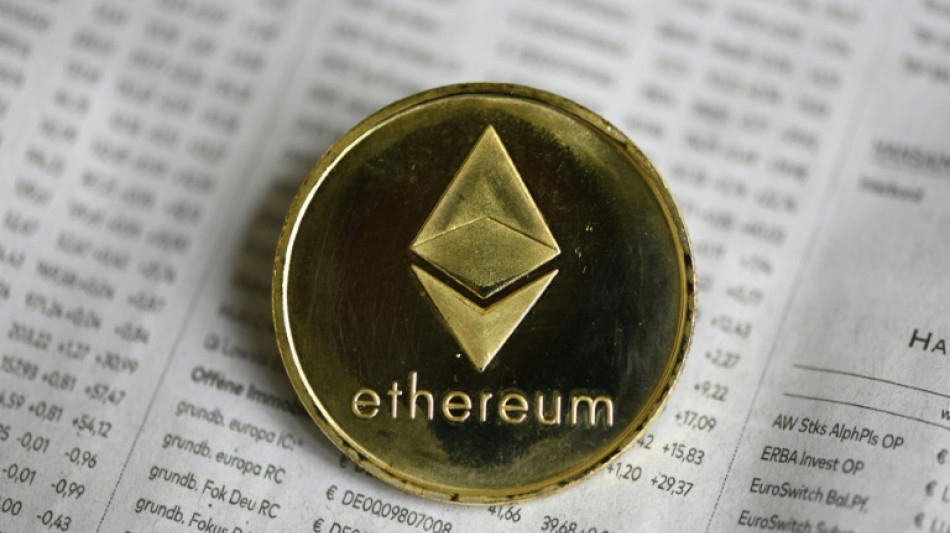
Ethereum crypto overhaul targets environmental impact / Photo: INA FASSBENDER - AFP/File

 Indonesia's main airport suspends operations after volcanic eruption

 US aircraft carrier departs Thailand after port call

 Haze emergency grips Malaysian Borneo town

 Messi creates both Miami goals in 2-2 draw with Atlanta

 Rybakina books US Open fourth-round berth, inches closer to No. 1

 Sobering reality: Curbs on alcohol in northeast Syria cause discontent

 Wobbly Osaka 'shocked' to battle past Mertens and reach last 16

 Indian Oscar-nominated filmmaker turns camera on his cancer

 Argentina 'let off hook' by Australia as Kiss's winning run ends

 Argentina threatens to sanction oil projects around Falklands

 Gauff into round four at US Open after straight-set win

 Bordeaux hammer Racing in Top 14 start as Bielle-Biarrey extends deal

 Zheng, Potapova pull off upsets to reach US Open last 16

 Swiatek into US Open fourth round in tight two-setter

 Werro wins in Brussels, as Russell and Dos Santos shine

 Kolbe breaks jaw and shoulder injury sidelines Savea

 US military strikes oil tankers as Iran vows tougher reprisals

 Zheng rallies to stun Keys, Anisimova out in US Open third round

 Bayern held to draw by stubborn Schalke

 Lens lose again ahead of Champions League date

 Olympic champion Zheng storms home to reach US Open last 16

 Big-spending Spurs must make better attacking decisions, says De Zerbi

 South Africa dominate New Zealand in second half to lead series

 Kiefer Sutherland still in action, but ibuprofen lending helping hand

 'Are we ready?' Oasis film captures band's frosty reunion

The world's second biggest cryptocurrency after bitcoin, ethereum, will soon overhaul its blockchain technology to curb the network's much-criticised environmental impact.
Ethereum, whose digital unit ether tumbled in a crypto crash earlier this year, will in September undergo a major technical revolution.
So what is the backdrop for the looming reset -- known as the Merge -- and how will it calm prices and cut electricity usage?
- Why does crypto use so much energy? -
Bitcoin, ethereum and other such currencies are "mined" by solving complex puzzles using powerful computers that consume enormous amounts of energy in vast warehouses, often near cheap electricity sources.
A blockchain is the decentralised and secure ledger for recording those transactions, which occur when encrypted codes are passed across a computer network.
Users validate their success via a so-called "proof of work" mechanism that rewards them with cyber currency -- but only after they have proved their participation in such energy-intensive mining.
The lucrative crypto industry is worth about $1.0 trillion, despite crashing in the first half of 2022.
However, ethereum is still down by a hefty 55 percent in value so far this year.
- Why is ethereum popular? -
Ethereum is nevertheless regarded as vital because it is where most virtual assets, including headline-grabbing non-fungible tokens (NFTs), are bought and sold.
That is partly because users can create "smart contracts" or algorithmic computer code, which carry out customised transactions for different functions.
"The ethereum blockchain is the base layer infrastructure of the majority of the whole crypto ecosystem," summarised Lennart Ante, CEO and co-founder of the Blockchain Research Lab.
"Everything relies on ethereum," he told AFP.
"In the last few years, there have been other similar platforms such as Solana or Cadano, but none of these have this huge network and this huge amount of developers and projects, and historical success."
- Why is it changing? -
Ethereum's broad adoption makes it even more important to address environmental concerns and change tack, as those worries had sparked a partial boycott.
"Proof-of-work mining is environmentally destructive, expensive, and inefficient," summarised digital currency specialist Eswar Prasad, a professor at Cornell University.
Yet the carbon footprint of a decentralised blockchain system is difficult to assess because electricity sources are not always identified.
- What is the switch? -
Ethereum creator Vitalik Buterin has planned for a switch to a so-called "proof of stake" mechanism from the middle of September.
This means that participation no longer requires proof of electricity usage, and instead relies on staking blocks of ether.
Users will then validate, or effectively bet their currency, in order to try and win more ether.
Ethereum currently consumes about 45 terawatt hours of power per year.
Bitcoin in contrast is estimated to use 95 terawatt hours of power per year, equivalent to Pakistan's annual consumption.
- What are pros and cons? -
Experts estimates the upgrade will use 99 percent less energy than the current set-up.
It would therefore allow users to execute quicker and more efficient transactions.
"The energy consumption would be close to zero," Ante told AFP.
"You do not need any of the hardware anymore, only the software."
At the same time, the new approach is not without risks.
Some users might decide to switch to rival networks where they can still able to use enormous amounts of energy to mine currency.
Prasad also cautioned that the proof-of-stake method was "not perfect" owing to liquidity and governance concerns.
M.O.Allen--AT