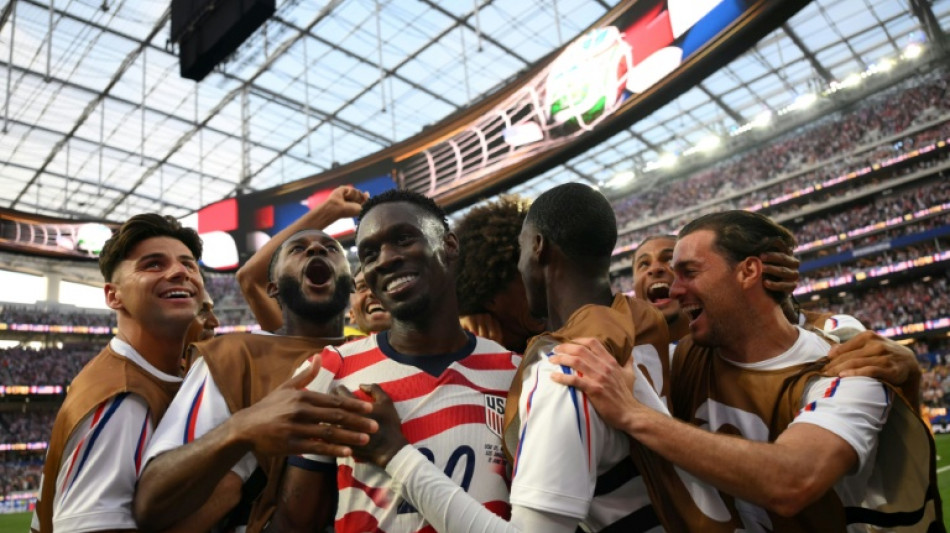
Birthright citizenship helps spark US World Cup run / Photo: Patrick T. Fallon - AFP/File

 England's Carse charged by cricket body over nightclub incident
 Amazon vows $1 bn for data center towns, decries 'myths'
 Oil prices drop on G7 fuel release, US jobs data boosts stocks

 G7 agrees deal to ease global energy supply concerns
 Spain's government dealt blow as lawmakers reject housing bills
 Food, medicine shortages deepen in Russian-occupied Oleshky
 Man City whistleblower Rui Pinto facing 'dire consequences' - lawyers
 Russia 'tearing Kyiv apart', mayor says, as strikes paralyse traffic
 Taiwan boxer Lin wins Games gold as Japan edge North Korea on penalties

 Japan tame North Korea to win Games gold after shootout drama
 US posts weak job growth data in September

 Ethiopia's conflict: the regional dimension

 Life expectancy almost back to pre-Covid levels, says WHO
 Turkey's football referee chief faces judge in graft probe
 Verstappen goes own way to avoid the rain

 Oil slides, bonds steady as EU addresses diesel price surge
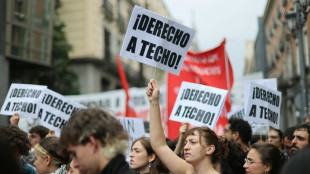 Spain housing package at risk in parliament, as protests mount
 Swedish Social Democrats leader to make new bid to form government
 North Korea calls Seoul 'despicable' after DMZ apology demand

 Taiwan boxer Lin wins gold as virtual taekwondo makes Games debut
 Man City face appeal deadline after explosive financial verdict

 Pole vault superstar Duplantis to skip indoor season
 Sri Lanka drop Asalanka from T20 against Pakistan
 Disney president says layoffs 'extremely painful' but necessary

 Indian flydubai pilot opened cockpit door to save passengers
President Donald Trump's bid to end birthright citizenship has gone all the way to the US Supreme Court but the issue's impact is already being felt on a giant stage: the World Cup.
Historically, anyone born on US soil automatically has the right to citizenship. Trump wants to end that as part of wider restrictions on immigration.
As Supreme Court justices prepare their ruling, Americans got a vivid illustration of the policy at work in the form of star US striker Folarin Balogun, who scored twice in the 4-1 rout over Paraguay.
Balogun may have shone in the US jersey, but if not for an accident of fate he wouldn't even be American.
"(My mother) came to the US to visit her sister, and she had her return ticket but then they said that she was too pregnant. So I was born in New York," Balogun said in an Instagram video posted by the US team this week.
Even though Balogun grew up in London from the age of one month, he qualified for birthright citizenship.
Still so British that he prefers English tea over coffee, Balogun ultimately chose to play for the United States over England or his family's native Nigeria.
"The way I was eligible to represent America...I'm not going to be the person to stand in the way of this story," he said in his distinct London accent.
The three co-hosts of the World Cup -- United States, Mexico and Canada -- are among the few countries in the world, mostly in the Americas, that grant automatic citizenship to those born there.
Trump wants to restrict citizenship for babies born in the US to those with at least one parent who is an American citizen or lawful permanent resident -- none of which applied to Balogun.
- Football's Silicon Valley -
Experts interviewed by AFP said Balogun's citizenship story is an outlier in the world of football, but that it nevertheless is an example of how migration is increasingly interwoven into the sport.
Nearly one-quarter of players at this World Cup were born in countries other than the one they are representing, said Marissa Kiss of George Mason University's Institute for Immigration Research.
"As with the World Baseball Classic, the Olympics, and the World Cup, countries are competing for talent and immigration policy is a competitive tool," she said.
"Countries that make citizenship easier to obtain have an advantage in recruiting talent."
Diaspora communities are increasingly playing a role in widening player pools, said Gijsbert Oonk, a professor at Erasmus University Rotterdam who studies the intersection of migration and sports.
This World Cup features 75 European-born players on African teams, according to data compiled by Oonk.
"France has become the world's most important exporter of football talent. During the 2026 World Cup, close to 100 participating players were born in France. Yet only a minority of them represent the French national team," he wrote in a recent blog post.
French-born players of African heritage are representing countries like Algeria, Morocco, Senegal, Mali and Haiti -- a reflection of France's colonial history.
"The banlieues surrounding Paris have become football's equivalent of Silicon Valley," he said of the suburbs home to many immigrant families.
- Brothers and refugees -
According to the US team, half of its 26 players have at least dual nationality.
They include Tim Weah, the son of football legend George Weah, the only African player to win the Ballon d'Or and who later became president of Liberia.
The younger Weah choose to play for the Americans but had been eligible to represent Liberia, Jamaica and France.
Meanwhile, tiny Curacao has only one player born in the Caribbean island nation, according to David Storey, honorary professor of human geography at the University of Worcester.
The team's other 25 members were born in the Netherlands, which counts Curacao as a constituent country.
"Although they have a small population (of 158,000), they have used their diaspora to expand the player pool," he told AFP.
This World Cup also features four sets of brothers where each pair is playing for a different team.
For their next match on Friday, the Americans will play Australia, whose roster includes three players with refugee backgrounds.
They are joined by Canada's captain Alphonso Davies, who was born in a refugee camp in Ghana to Liberian parents.
E.Flores--AT