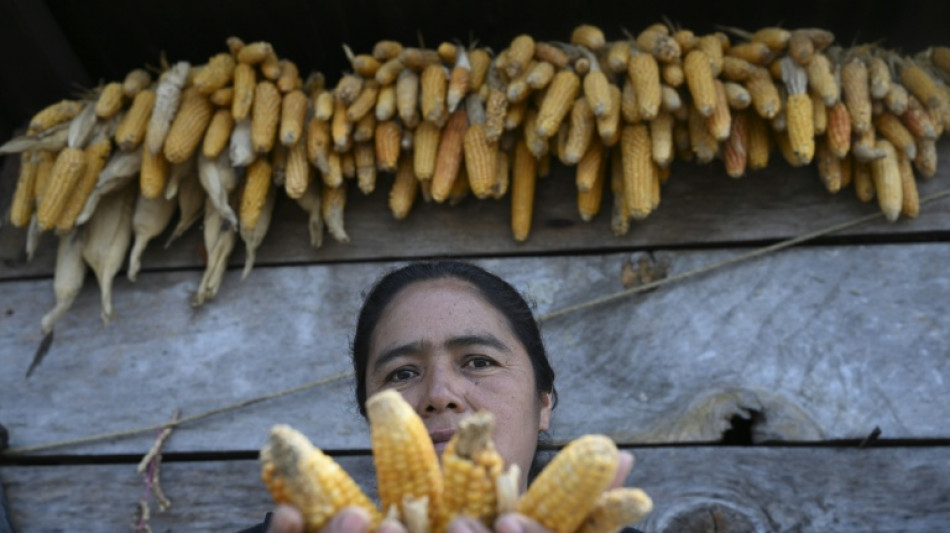
Fears of hunger overwhelm Guatemalan village as El Nino approaches / Photo: Johan ORDONEZ - AFP

 PSG outgun embattled Man City in six-goal Champions League thriller

 In Chicago, pope's hometown, Catholics express shock and support

 Musk suggests US govt behind any slowdown in Ukraine's Starshield system

 Chiclayo prays for recovery and return of the 'Peruvian pope'

 Barcola scores hat-trick as Liverpool hit LASK for six

 Healthy corals help bleached neighbors regain color: study
 Hope ton helps West Indies level T20 series at 2-2 in India

 Ukraine war reaches shores of Bulgarian fishing village
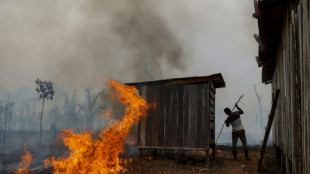 Brazil probing 'criminal' origin of forest fires: minister to AFP

 Sally Rooney books cannot be sold in UK amid Palestine Action ban: publisher
 Italian ski stars Goggia and Brignone to miss season opener

 Bournemouth boss Rose urges Cherries to bounce back from Chelsea 'slap'

 Top seed Sabalenka falls at first hurdle in Wuhan

 FX Junction Brings Copy Trading to Everyone, While Their Money Never Leaves With Their Broker

 Brighton defender Struijk's red card overturned

 Saudi league postpones three matches after Houthi attacks

 US consumer inflation up more than expected as midterms loom

 Canadian publisher supports novelist Orelien after AI denial

 Medvedev sees off Tsitsipas to reach Shanghai Masters quarters

 Louvre boss warns of closure risk without major renovations
 Lawes and Genge urge England to end ban on overseas-based players

 Metrika Selected by OCC to Support Stablecoin Supervisory Framework Under the GENIUS Act

 Kenya hosting 2029 World Championships will help doping fight, says Coe
 UK prosecutor tells jury Russell Brand a 'sexual predator'

 Fulham manager Arbeloa fined £25,000 after Man Utd outburst

While drought expands through Cunen as the specter of El Nino climate instability approaches, one fear has seized this indigenous Guatemalan village: death by hunger.
The rains still haven't come here, where local farmers fear the lack of water could ruin the subsistence crops they need to survive.
"If there isn't rain, (the crops) won't come...If there isn't anything we're going to die of hunger," Cecilia Pasa Sarat, a 38-year-old woman who has planted a small amount of corn, told AFP in Xetzac, a village in Cunen.
Cunen is a hard-to-reach mountainous region where the majority of the approximately 47,000 residents are poor, and rely on water from wells that are now going dry.
This village in the Indigenous Maya department of Quiche lays in the heart of the Dry Corridor, an arid mountainous stretch running through Honduras, El Salvador and Nicaragua that's become vulnerable to extreme climatic events.
Quiche was one of Guatemala's most hard-hit regions during the El Nino related food crisis in 2023. Some worry the crisis could return due to a lack of government support.
The phenomenon now fueling local residents' hunger fears occurs every two to six years as part of a natural climatic cycle that affects the surface temperatures on the Pacific Ocean.
It's expected to start between June and August, creating monthslong planetary ripple effects.
- Prolonged damage -
Weeks of drought have dessicated the dusty streets of Xetzac, where the creeks that usually irrigate the town's patchwork of corn, potato, broccoli and bean fields are evaporating under the brutal sun.
Taking refuge in the tree shade where the resin-scent of pines drifts down the hillside, Elvira Pasa says the eventual loss of the village harvests will only end in "hunger."
"We farm, we don't sell it, we just eat it," the 27-year-old community leader and mother of a two and seven-year-old son told AFP.
"Whatever we plant is what we eat. What will happen if it doesn't rain?" 43-year-old Lucia Rojop asks herself.
Her fears are well-founded: around 2.5 million Guatemalans face potential food insecurity due to the drought and the high probability of a powerful El Nino weather cycle.
The Guatemalan government says it has 1.1 million rations ready to distribute in the face of an emergency.
According to experts, the chance that El Nino could spiral into a more dangerous event depends on numerous atmospheric factors.
Governments across the dry countries of Central America raised alert levels over the El Niño phenomenon.
But El Nino isn't the only reason the situation is worsening.
Just in Guatemala, the "dry corridor" expanded from 40 to 160 municipalities since 2004, meaning almost half of the country has been subjected to climate change-fueled drought, according to the government.
El Nino has reduced by half, according to Alex Guerra, the director of the Private Institute for Investigation on Climate Change (ICC).
Cecilia Pasa walks through a puny corn farm, a clear testimony of the drought. "The plants can't take it anymore, the ground is drier, it's not humid anymore like it used to be," she says categorically.
It means that only half of her neighbors planted corn this year. Everyone else, including Catarina Sica, didn't even bother.
"There isn't rain, and the time has passed for us to plant," Sica says while showing the black, white, and yellow seeds still on the cob of corn.
- Migratory impact -
The brutal challenges of working the fields in Cunen, for years, were eased with remittances migrants sent home from the United States. Yet Donald Trump's mass deportations have taken away that support.
Around 24,000 Guatemalans have been deported this year, many from Quiche.
The deportations have paralyzed the construction of homes — the great dream of many migrants — as well as the jobs that go with it.
Families now deal with the crisis by raising pigs, sheep, chickens and turkeys for sale.
Sica's husband returned two years ago after saving enough money to build a concrete house. Now he works occasionally in agriculture, though the $10 daily wage he earns means the family diet is limited to beans, herbs and potatoes, like most locals.
"We're seeing what to do, but it all depends on God," the woman says with resignation.
N.Mitchell--AT