
Japan economy grows faster than expected in first quarter / Photo: Andrew CABALLERO-REYNOLDS - AFP

 Two dead as Istanbul endures heaviest rainfall in 80 years

 After latest Nepal flood, survivors fear for future

 EU leaders clash over budget as spectre of French elections looms

 'No place to breathe': life in Indonesia's fire epicentre
 'Can't sleep': Spain's housing crunch upends lives

 Musk calls on Ukraine's Zelensky to 'go' after satellite slowdown row

 Still smiling at 117, Albanian may be world's oldest woman

 Pope has 'good night' in hospital: Vatican
 China's economy seen missing target as global shocks bite: AFP poll

 Costa Rica opens jail inspired by El Salvador mega-prison

 Same-sex couple takes fight for equality to Slovakian court

 'High hopes' as Indonesian women get a football league, again
 'Expectations high' for Bordeaux-Begles' Champions Cup hat-trick bid, says Depoortere
 Rennie urges All Blacks to stay focused against 'hurting' Wallabies
 Palmeiras beat Fluminense 2-1 in Libertadores semi-final first leg

 Brewers blasts leave Dodgers on brink

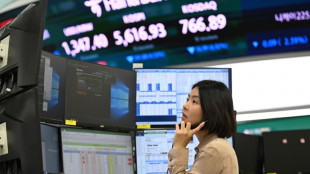
 Tech stock lead rout after US inflation fuels rate hike bets

 Al-Fayed survivors say UK police missing 'bigger picture'

 Online 'witch hunt' sweeps up Asians misidentified as US rape accused

 Prospect of Bolsonaro win looms large over Brazil's Indigenous

 Freed from Belarus, founder of Lady Gaga's biggest fan site tells his story

 Behind AI's carbon footprint, a potential climate tool

 Trump's new press secretary faces scrutiny over credentials

 Spider Labs: 75.0% of Bot-Classified Ad Clicks Lacked Basic Browser Automation Signs

 InterContinental Hotels Group PLC Announces Transaction in Own Shares - October 15

Japanese economic growth surpassed expectations at the start of 2026, official data showed on Tuesday, but Prime Minister Sanae Takaichi is mulling an extra budget as concerns grow over inflation due to the Middle East war.
Gross domestic product (GDP) in the world's fourth-biggest economy expanded 0.5 percent in the first quarter, exceeding market forecasts of 0.4 percent.
Growth in private consumption and corporate investment contributed to the expansion, according to the cabinet office data.
It follows growth of 0.2 percent -- revised downwards from an earlier reading of 0.3 percent -- in the last quarter of 2025.
The data came as Takaichi plans to draft a supplementary budget in a bid to safeguard growth, as consumers face soaring prices of everything from energy to rice due to the Middle East conflict.
"Given the continuing uncertainty surrounding the situation in the Middle East, it is important to closely monitor the trend of prices and the impact on the economy," the government's top spokesman Minoru Kihara told reporters Tuesday, adding that Takaichi had instructed the minister of finance to consider arrangements to minimise risk.
- 'Grind to a halt' -
Marcel Thieliant of Capital Economics warned the Middle East conflict was likely to impact data going forward.
"Japan's economy approached the Iran war with solid momentum but we think that GDP growth will grind to a halt this quarter and next," he wrote in a note.
Japan has been trying to stem rising oil prices with government subsidies, but the nation is likely to feel the full impact of soaring energy prices in months ahead, Thieliant said.
The country depends on the Middle East for around 95 percent of its oil imports.
Already consumer confidence has begun to slump, Thieliant added.
The Bank of Japan (BoJ) said it expected consumer prices to rise 2.8 percent in the current fiscal year, compared with the 1.9 percent previously forecast, due to the impact of the conflict. It lifted next year's outlook to 2.3 percent from 2.0 percent.
This could prompt it to raise interest rates as early as June.
It also slashed its fiscal 2026 growth forecast to 0.5 percent from 1.0 percent, and for next year trimmed its projection to 0.7 percent from 0.8 percent.
Taro Saito of the NLI Research Institute said that "disruptions in logistics will trigger production adjustments, while the deterioration of terms of trade due to soaring crude oil prices will put downward pressure on corporate profits and the real purchasing power of households".
Expectations of monetary tightening, along with concerns over Takaichi's fiscal policy, have helped drive a sharp rise in Japanese government bond yields in recent days.
Japan is also believed to have spent tens of billions of dollars in the market to boost the value of the yen, which has weakened in recent months due to the global uncertainty, as well as the gap between US and Japanese interest rates.
A weaker yen makes the cost of imports more expensive in Japan, which relies on foreign countries for much of its energy and food needs.
W.Nelson--AT