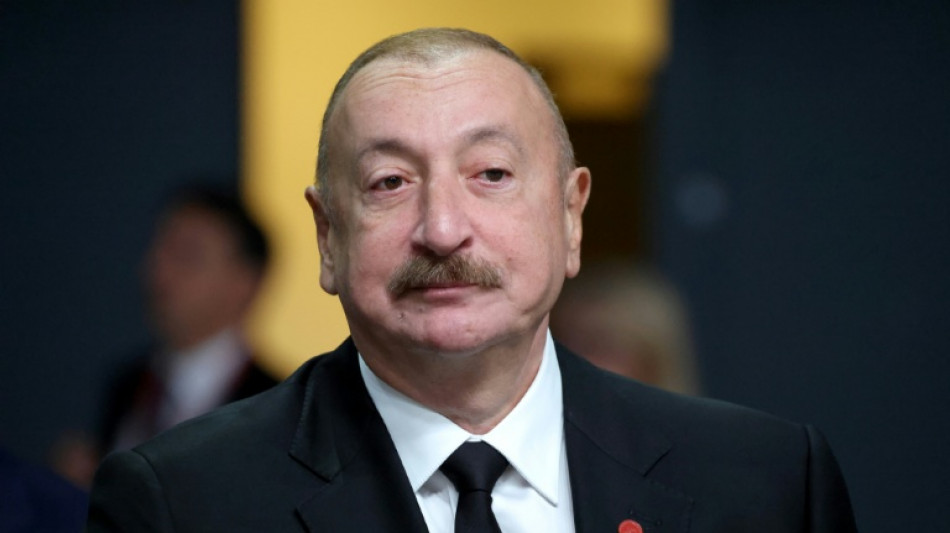
Iran drone strike on Azerbaijan raises fears of Mideast war spreading to Caucasus / Photo: Ludovic MARIN - AFP/File

 Australia's new Ghost Shark submarines grow some 'teeth'

 'I call it a bribe': Pennsylvania residents spurn $10,000 data center checks

 In a former US steel city, ordinary people struggle to get by

 'Liar,' 'clown': Lula and Bolsonaro spar in Brazil poll debate

 Record El Nino? Depends who's counting

 On the front line of ocean conservation off Portugal's Madeira

 Wembanyama targets title breakthrough as NBA season tips off

 With LeBron on board it's title or bust for Philly fans

 One year after Louvre heist, where are the missing jewels?

 Knicks face tall task in NBA championship repeat bid

 Warriors' Curry 'fine' after limping out of practice - Kerr

 Zelensky speaks to US envoys as Trump lashes out

 'Surprise package' Lazio crush Juve to keep pace with Serie A leaders Inter

 China growth expected to miss official target in third quarter

 Lazio crush Juventus to move level with Serie A leaders Inter

 Leeds draw feels like 'fresh start' for Man Utd's Carrick

 Macron denounces 'unbridled' violence as France hit by new clashes

 Hurzeler lauds 'hard worker' Gomez after Brighton goal from halfway line
 Toulouse hold off Exeter, Northampton save English Champions Cup blushes

 Arsenal snatch late win to keep pressure on Man City as Man Utd held
 Arsenal strike late to keep pressure on Man City as Man Utd held

 Four soldiers dead, dozens injured in fire at Canada military base

 Ton-up Agha helps Pakistan down Sri Lanka in tri-series opener

 Man Utd draw at Leeds keeps pressure on Carrick
 Barca defenders Garcia, Kounde injured before key games

Iranian drone strikes on Azerbaijan have raised fears that the Middle East war could spill into the Caucasus, as Baku, an ally of Israel, vows to respond.
Azerbaijan announced on Friday it was withdrawing diplomatic staff from Iran, a day after drones launched from Iranian territory targeted an airport and exploded near a school in the country's Nakhichevan exclave, bordering Iran.
Four people were wounded.
President Ilham Aliyev accused Tehran of carrying out a "terrorist act" and ordered the armed forces to prepare retaliatory measures, placing them on the highest level of mobilisation.
Iran denied responsibility and blamed Israel -- Azerbaijan's close ally and arms supplier -- of staging a provocation aimed at disrupting relations between Muslim countries.
Tehran has long accused Israel of using Azerbaijani territory for intelligence operations and potential attacks.
The drone strikes have fuelled concerns that the war could spill into the strategically sensitive South Caucasus, some analysts said.
"The risk of the war spreading to the Caucasus is not small," Armenian analyst Hakob Badalyan said.
"Much will depend on the risks Baku and its ally Ankara are willing to take in responding to the attack."
- 'Unclear chain of command' -
The attack has also raised questions about who is calling the shots in Iran and the unpredictability of its military command structure.
"The chain of command within Iran's armed forces is unclear," said Farhad Mammadov, head of the Baku-based South Caucasus Studies Center.
The country has a dual structure, whereby Iran's defence ministry and general staff operate alongside the powerful Islamic Revolutionary Guard Corps (IRGC).
"This creates a high degree of unpredictability," Mammadov added.
He expected Azerbaijan's response would be defensive and said he believed it had no plans to launch ground operations against Iran.
"The possibility of escalation will depend on the actions of the Iranian side," he added.
Azerbaijani lawmaker Rasim Musabekov has also said the incident reflects confusion inside Iran's leadership following the killing of Supreme Leader Ali Khamenei in an Israeli-US strike.
"At the moment we are seeing spasmodic actions by the Iranian authorities, firing missiles indiscriminately," he said.
"If they claim the drone directed at Azerbaijani territory was sent by Israel or Israeli spies, then the Iranian authorities should admit they do not control their own territory."
- 'Drown in blood' -
Analysts brushed off the chance the strike was a case of accidential targeting or some drones gone wayward.
Farid Shafiyev, head of Azerbaijan's Center of Analysis of International Relations, said evidence suggested the drones were launched intentionally by Iranian forces.
"The only question is at what level the decision was taken -- in Tehran or at a lower command level," he said.
According to social media accounts unofficially linked to the IRGC, the decision may have been taken by the Guard Corps leadership itself, he added.
"This is not accidental. Iran is targeting everyone," Shafiyev said.
The IRGC has long viewed Azerbaijan with hostility.
"The IRGC portrays Iran as a fortress besieged by enemies and Thursday's attack was a symbolic demonstration that it considers Azerbaijan one of them," analyst Gela Vasadze of the Georgian Strategic Analysis Centre said.
"For the sake of its survival, the Iranian regime appears ready to drown the country and the entire region in blood."
- Strategic stakes -
There are also worries about the vulnerability of strategic energy infrastructure linking the Caucasus to global energy markets.
Azerbaijan's Baku–Tbilisi–Ceyhan oil pipeline, which runs through neighbouring Georgia and Turkey and carries around a third of Israel's oil imports, could become a potential Iranian target.
"The pipeline's above-ground facilities, such as terminals and pumping stations, could be vulnerable to drone strikes," said Ilham Shaban, head of the Baku-based Centre for Oil Research.
Iran has long accused Israel -- a key arms supplier to Baku -- of using Azerbaijani territory for intelligence operations and potential attacks.
In June 2025, Baku reassured Tehran it would not allow its territory to be used for strikes on Iran after Israel launched a large-scale attack on Iranian targets.
Tehran has also historically been wary of separatist sentiment among the around 10 million ethnic Azeris living in Iran.
For now, analysts say Baku is biding its time.
"Azerbaijan does not wish to enter into an armed conflict with Iran," Musabekov said.
"But it must be prepared for any scenarios."
P.A.Mendoza--AT