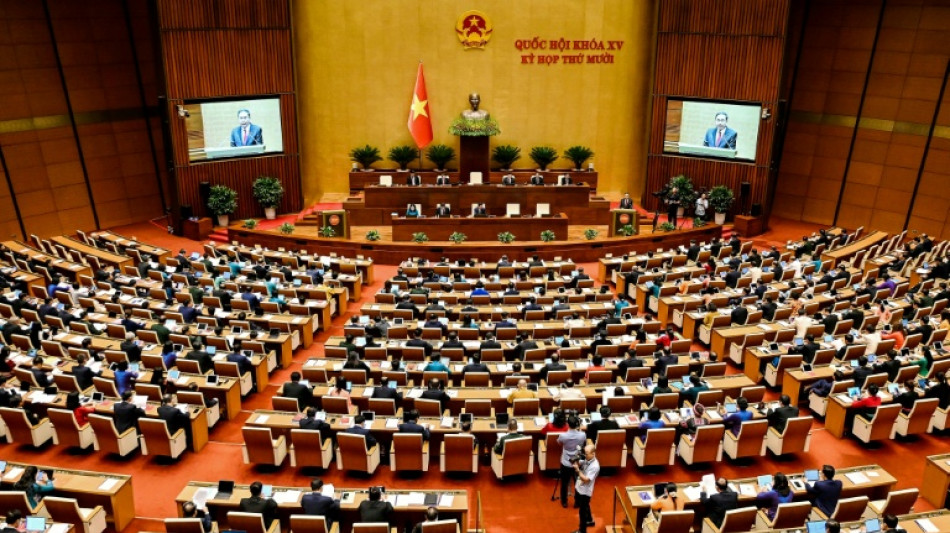
Vietnam AI law takes effect, first in Southeast Asia / Photo: Nhac NGUYEN - AFP

 European stocks retreat as France violence spreads

 North Korea warns 'grave situation' prevailing along border

 Raya proud of Arsenal's 'incredible' reaction after third straight win

 Indonesia fires have burned nearly two million hectares: monitor

 Australian lawmaker 'critically' hurt in attack, officials say

 Indonesia fires burned over 1.9 mn hectares through September: monitor

 Asian tech stocks mixed after Wall St losses, eyes on earnings

 China's third-quarter growth narrowly beats forecasts

 Asian stocks start week on back foot, tracking tech-led Wall St losses

 China growth narrowly beats forecasts

 Faith and fury: Texas Senate rivals offer contrasting visions

 Women await justice for police killings in Brazil

 The painstaking task of cataloguing the world's species

 Nations seek reset at UN talks as nature goals off track

 Rubio seeks to strengthen US foothold in Central Asia

 LeBron joins 76ers to chase one more NBA title at age 41

 Rays one win from World Series return after downing Guardians

 Stillwater Critical Minerals Files NI 43-101 Technical Report for the Updated Stillwater West Mineral Resource Estimate in Montana, USA

 Caledonia Mining Corporation Plc: Notification of Relevant Change To Significant Shareholder

 BioNxt Completes GMP Manufacturing and Submits Clinical Trial Application for Sublingual Cladribine Drug Candidate

 DEA Denies Federal Marijuana Manufacturing License: Are State Operators Next?

 Great Western Mining Corporation PLC Announces Holding(s) in Company

 HyProMag USA Deploys Mobile Inserma System, Extending Hard Disk Drive Processing to Customer Sites Across the United States

 CoTec Holdings Corp. Notes HyProMag USA Deployment of Mobile Inserma System, Extending Hard Disk Drive Processing to Customer Sites Across the United States
 Kings' Ben Simmons tears Achilles in training

A law regulating artificial intelligence went into effect in Vietnam on Sunday, making it the first country in Southeast Asia with a comprehensive framework on the booming technology.
Passed by the National Assembly in December, the law focuses on the risks posed by generative AI, requiring human oversight and control along the lines of the European Union's landmark AI Act.
Many nations are moving to address the dangers of chatbots and image generators -- from misinformation to online abuse and copyright violations -- but few have enacted legislation.
The legislation, which is in force as of March 1, "paves the way for Vietnam to deeply integrate with international standards while maintaining digital sovereignty", the government said in a December report.
It requires companies to clearly label AI-generated content such as deepfakes that cannot readily be differentiated from reality.
It also requires them to disclose to customers when they are interacting with an artificial rather than human agent.
The law applies to developers as well as providers and deployers of the technology, whether they are Vietnamese organisations or foreign entities operating in the country.
Vietnam has set ambitious double-digit growth targets for the next five years, with expansion of the digital economy a key part of its development strategy.
AI and the data economy are "pillars" of a "more sustainable and smarter new development" model, Prime Minister Pham Minh Chinh was quoted as saying Wednesday on the government's website.
Under the law, the government will establish a national AI computing centre, improved data resources and large language models in Vietnamese.
- 'Not the final word' -
So far only a handful of countries have implemented far-reaching regulatory frameworks on AI.
The United States has opposed what Vice President JD Vance called "excessive regulation", warning it could stifle innovation in the key sector.
In January, South Korea became the first country to have an AI law take full effect, while the European Union is gradually phasing in a set of rules that will become completely applicable in 2027.
While Vietnam's law is a regulatory milestone, analysts said its impact would depend on how the government enforces it and on what guidance it issues on implementation.
The law is "not the final word" but rather a "decisive starting point", Vietnam-based LNT & Partners law firm said in an analysis on its website.
"It establishes responsibility, human control, and risk management as the governing themes of AI regulation," the firm said.
However, it added, "the true impact will depend on implementing decrees, sectoral regulations, and enforcement practice".
Patrick Keil, senior legal adviser at law firm DFDL, called the law "a significant statement of national ambition" but told AFP businesses will continue to face some uncertainty about their obligations until the government issues further guidance.
At an AI summit hosted by New Delhi in February, 91 countries and international organisations called for "secure, trustworthy and robust" AI.
But their declaration, signed by the United States and China, was criticised by AI safety campaigners for being too generic to protect the public.
W.Nelson--AT