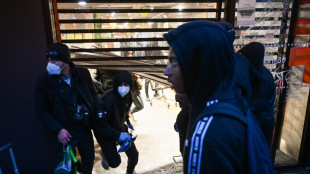
In 'big trouble'? The factors determining Iran's future / Photo: - - KHAMENEI.IR/AFP/File

 Rising UK inflation, debt knocks govt ahead of budget
 UK govt approves drilling in controversial Jackdaw gas field
 US envoy to meet Putin after 'positive' talks with Zelensky

 UK govt approves drilling in Jackdaw gas field
 Rome hospital taps culture to help heal cancer patients
 'Media capture': Serbian journalists squeezed before vote
 US envoy to meet Russia's president after 'positive' talks with Zelensky
 South Korea launches new bid to guide crowd-pulling shark to sea
 US envoy to meet Russia's president after 'productive' talks with Zelensky
 LeBron optimistic after launching Sixers era with win

 Fear as Indians struggle to prove voting rights
 Asian stocks rally as tech firms enjoy bounce ahead of key earnings
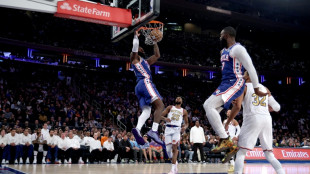 LeBron, Sixers spoil Knicks party as NBA season tips off
 Man in court over alleged 'targeted' attack on Australian lawmaker
 Regulator has 'power' to force Man City sale
 Man allegedly behind 'targeted' attack on Australian lawmaker appears in court
 Guardian Metal Resources PLC Announces Strengthening of Senior Management Team

 Guardian Metal Resources PLC Announces Warrant Exercise
 Musk backs SpaceX-Tesla merger as rocket firm turns profit
 Zelensky, US hail 'productive' talks to end Trump feud
 'Unbelievable' Foden back in the groove with treble in Man City rout
 Pistons rally to beat Celtics in NBA 2026-27 season opener
 PSG late show downs Barca in Champions League, Liverpool fight back
 Liverpool strike back to beat Villarreal in seven-goal thriller
 Dow boosted as markets rotate from tech shares
Over two weeks of protests mark the most serious challenge in years to Iran's theocratic leadership in their scale and nature but it is too early to predict the immediate demise of the Islamic republic, analysts say.
The demonstrations moved from protesting economic grievances to demanding a wholesale change from the clerical system that has ruled Iran since the 1979 revolution that ousted the shah.
The authorities have unleashed a crackdown that, according to rights groups, has left hundreds dead while the rule of supreme leader Ayatollah Ali Khamenei, now 86, remains intact.
"These protests arguably represent the most serious challenge to the Islamic republic in years, both in scale and in their increasingly explicit political demands," Nicole Grajewski, professor at the Sciences Po Centre for International Studies in Paris told AFP.
She said it was unclear if the protests would unseat the leadership, pointing to "the sheer depth and resilience of Iran's repressive apparatus".
The Iranian authorities have called their own counter rallies, with thousands attending on Monday.
Thomas Juneau, professor at the University of Ottawa, said: "At this point, I still don't assess that the fall of the regime is imminent. That said, I am less confident in this assessment than in the past."
These are the key factors seen by analysts as determining whether the Islamic republic's leadership will hold on to power.
- Sustained protests -
A key factor is "simply the size of protests; they are growing, but have not reached the critical mass that would represent a point of no return," said Juneau.
The protest movement began with strikes at the Tehran bazaar on December 28 but erupted into a full-scale challenge with mass rallies in the capital and other cities from Thursday.
The last major protests were the 2022-2023 demonstrations sparked by the death in custody of Mahsa Amini who had been arrested for allegedly violating the Islamic dress code for women. In 2009, mass rallies took place after disputed elections.
But a multi-day internet shutdown imposed by Iranian authorities has hampered the ability to determine the magnitude of the current demonstrations, with fewer videos emerging.
Arash Azizi, a lecturer at Yale University, said "the protesters still suffer from not having durable organised networks that can withstand oppression".
He said one option would be to "organise strikes in a strategic sector" but this required leadership that was still lacking.
- Cohesion in the elite -
While the situation on the streets is of paramount importance, analysts say there is little chance of a change without cracks and defections in the security forces and leadership.
So far there has been no sign of this, with all the pillars of the Islamic republic from parliament to the president to the Revolutionary Guards (IRGC) lining up behind Khamenei's defiant line expressed in a speech on Friday.
"At present, there are no clear signs of military defections or high-level elite splits within the regime. Historically, those are critical indicators of whether a protest movement can translate into regime collapse," said Sciences Po's Grajewski.
Jason Brodsky, policy director at US-based group United Against Nuclear Iran, said the protests were "historic".
But he added: "It's going to take a few different ingredients for the regime to fall," including "defections in the security services and cracks in the Islamic republic's political elite".
- Israeli or US military intervention -
US President Donald Trump, who has threatened military retaliation over the crackdown, announced 25 percent tariffs on Monday against Iran's trading partners.
The White House said Trump was prioritising a diplomatic response, and has not ruled out strikes, after having briefly joined Israel's 12-day war against Iran in June.
That war resulted in the killing of several top Iranian security officials, forced Khamenei to go into hiding and revealed Israel's deep intelligence penetration of the Islamic republic.
US strikes would upend the situation, analysts say.
The Iranian foreign ministry said on Monday it has channels of communication open with Washington despite the lack of diplomatic relations.
"A direct US military intervention would fundamentally alter the trajectory of the crisis," said Grajewski.
Juneau added: "The regime is more vulnerable than it has been, domestically and geopolitically, since the worst years of the Iran-Iraq war" that lasted from 1980-1988.
- Organised opposition -
The US-based son of the ousted shah, Reza Pahlavi, has taken a major role in calling for protests and pro-monarchy slogans have been common chants.
But with no real political opposition remaining inside Iran, the diaspora remains critically divided between political factions known for fighting each other as much as the Islamic republic.
"There needs to be a leadership coalition that truly represents a broad swathe of Iranians and not just one political faction," said Azizi.
- Khamenei's health -
Khamenei has now been in power since 1989 when he became supreme leader, a post for life, following the death of revolutionary founder Ruhollah Khomeini.
He survived the war with Israel and appeared in public on Friday to denounce the protests in typically defiant style.
But uncertainty has long reigned over who could succeed him, with options including his shadowy but powerful son Mojtaba or power gravitating to a committee rather than an individual.
Such a scenario between the status quo and a complete change could see "a more or less formal takeover by the Revolutionary Guards", said Juneau.
A.Clark--AT