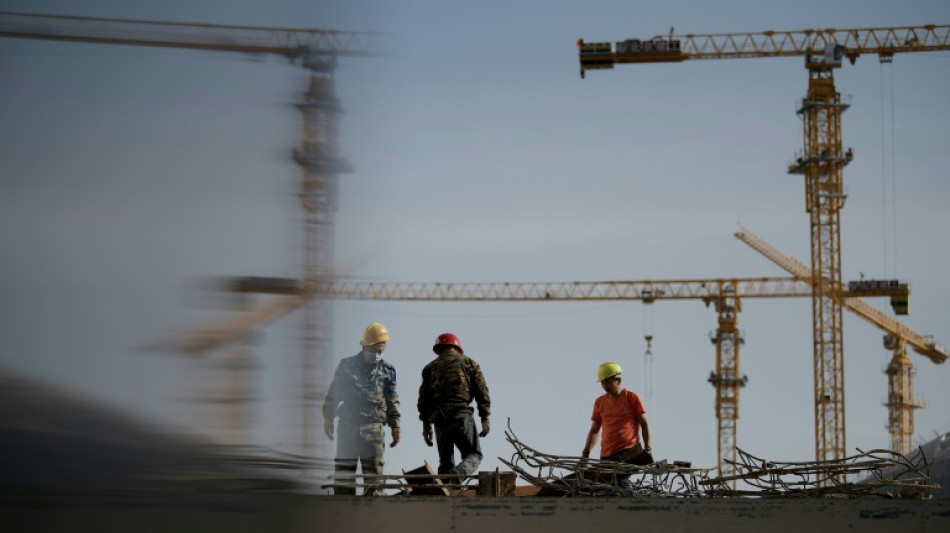
Why is the world worried about China's property crisis? / Photo: Noel Celis - AFP/File

 Indonesia doing 'everything' but still struggling to curb fires
 Once decried as 'human cockfighting', MMA wants Olympic spot

 China's Yu, 13, great for swimming says multiple Olympic medallist

 Putin's party set to retain power after Russia vote hit by cyberattacks, drones

 Germany's Merz under pressure after bruising state election losses

 Messi, Miami frustrated in 2-2 draw with San Diego

 Thousands march in France against 'licence to kill' draft law

 Best Gold IRA Accounts 2026 Rankings Released: Top Precious Metals IRA Companies Compared in New Guide

 Braves clinch division title as Red Sox reach MLB playoffs

 Bordeaux-Begles hammer Stade Francais despite Jalibert injury

 Milan and Juventus end blips with home wins
 Bridgeman wins PGA Biltmore title with sizzling 61

 Williams injured as Bears shut down by Vikings

 US warns of rapid escalation in Middle East war

 Germany's far-right AfD celebrates another state election win

 Russia vows revenge for election-day attacks as poll shows ruling party win

 Spaun late shows snatches PGA Championship win

 Conceicao strikes as Juventus beat Atalanta
 Britain, Zverev-inspired Germany, Spain complete Davis Cup finals

 Man Utd salvage Fulham draw as pressure mounts on Carrick

 Spanish civil war drama 'The Black Ball' wins at Toronto festival

 Germany's Merz shaken by far-right and far-left gains in state votes

 Macron welcomes Canada's Carney to French Atlantic territory

 Fiorentina frustrate Napoli with Serie A draw, Como upset

 Five-star Man City top Premier League after Sunderland thriller

China's troubled property sector suffered another blow this month when frustrated homebuyers stopped making mortgage payments on units in unfinished projects.
The boycott came with many developers struggling to manage mountains of debt, and fears swirling that the crisis could spread to the rest of the Chinese -- and global -- economy.
How big is China's property sector?
Colossal. Property and related industries are estimated to contribute as much as a quarter of China's Gross Domestic Product (GDP).
The sector took off after market reforms in 1998. There was a breathtaking construction boom on the back of demand from a growing middle class that saw property as a key family asset and status symbol.
The bonanza was fuelled by easy access to loans, with banks willing to lend as much as possible to both developers and buyers.
Mortgages make up almost 20 percent of all outstanding loans in China's entire banking system, according to a report by ANZ Research this month.
Many developments rely on "pre-sales", with buyers paying mortgages on units in projects yet to be built.
Unfinished homes in China amount to 225 million square metres (2.4 billion square feet) of space, Bloomberg News reported.
Why did it plunge into crisis?
As property developers flourished, housing prices also soared.
That worried the government, which was already concerned about the risk posed by debt-laden developers.
It launched a crackdown last year, with the central bank capping the proportion of outstanding property loans to total lending by banks to try to limit the threat to the entire financial system.
This squeezed sources of financing for developers already struggling to handle their debts.
A wave of defaults ensued, most notably by China's biggest developer, Evergrande, which is drowning in liabilities of more than $300 billion.
On top of the regulatory clampdown, Chinese property firms were also hit by the Covid crisis -- the economic uncertainty forced many would-be homebuyers to rethink their purchase plans.
How have homebuyers reacted?
Evergrande's decline had sparked protests from homebuyers and contractors at its Shenzhen headquarters in September last year.
In June this year, a new form of protest emerged: the mortgage boycott.
People who had bought units in still-unfinished projects announced they would stop making payments until construction resumed.
Within a month, the boycott spread to homebuyers in more than 300 projects in 50 cities across China.
Many of the unfinished projects were concentrated in Henan province, where mass protests in response to rural bank fraud broke out and were suppressed.
Chinese lenders said last week that the affected mortgages account for less than 0.01 percent of outstanding residential mortgages, but analysts say the fear is how far the boycotts will spread.
Why is there global concern?
China is the world's second-largest economy, with deep global trade and finance links.
If the property crisis spreads to China's financial system, the shock would be felt far beyond its borders, analysts say.
"Should defaults escalate, there could be broad and serious economic and social implications," Fitch Ratings wrote in a note on Monday.
This echoed a warning by the US Federal Reserve, which said in May that while China has managed to contain the fallout so far, a worsening property crisis could impact the country's financial system too.
The crisis could spread and impact global trade and risk sentiment, the Fed said in its May 2022 Financial Stability Report.
What can China do to fix it?
A bailout or rescue fund for the entire property sector is unlikely, even as mortgage boycotts mount, analysts say, as those would mean the government is admitting to the scale of the crisis.
A major bailout may also encourage developers and home buyers to continue with risky decisions as they would see the government and banks taking on responsibility.
But pressure has been building on Chinese banks to help ease the situation. China's banking regulator said Thursday that it would help ensure that projects are completed and units handed over to buyers.
Some intervention has happened at the local level in Henan province, where a bailout fund was set up in collaboration with a state-backed developer to help stressed projects.
Chen Shujin at Jefferies Hong Kong said local governments, developers and homeowners might also be able to negotiate interest waivers and suspension of mortgage payments for a certain period on a case-by-case basis.
P.A.Mendoza--AT