
Primary Hydrogen Reports Anomalous Hydrogen Values From Phase 1 Soil Gas Sampling at Point Rosie and Mary's Harbour Properties, Newfoundland and Labrador

 UK singer-songwriter Raye wins Mercury Prize for second album

 Antonelli needs ‘perfect weekend’ to realise title dream

 Reclaiming the walls in a former Salvadoran gang hotspot

 Musk wants to merge SpaceX and Tesla: Here's what to know

 Musk's wants to merge SpaceX and Tesla: Here's what to know

 Hashimoto sweeps to gymnastics world all-around title

 Super Bowl MVP Walker returns to Seattle with unbeaten Chiefs

 Red Bull advisor Marko slams Horner memoir as 'collection of untruths'

 France reports first human Shamonda virus case, says no health risk

 Rekindled Gucci desirability fails to light flame under Kering sales

 Thousands rally as Serbia heads to pivotal poll

 Marathon star Aga banned six years for doping and misleading investigation

 USA to host women's football Club World Cup in 2028 - FIFA

 Finland grants licence for world's first nuclear waste repository

 'Old-fashioned' South Africa thump Australia to level Test series

 No more taking out the trash at your Airbnb

 Swiss supreme court upholds Guatemala ex-police chief sentence

 UN climate disaster fund moves to provide $20 mn aid for Nepal

 Africa faces 'complex' Ebola outbreak after spread to Nigeria: WHO

 American detained in Russia arrives in US: lawyer

 Pentagon, Lockheed announce deal for 850 F-35 jets over 10 years

 French authorities seek to ban or curb fresh protests

 Nearly all coral reefs risk collapse in 50 years: IUCN

 Foden can be one of Premier League's best again, says Maresca

 'Solution from the heavens': Indonesians pray for rain as fires burn

CALGARY, AB / ACCESS Newswire / November 26, 2025 / Primary Hydrogen Corp. (TSXV:HDRO)(OTCQB:HNATF)(FRA:83W0) (the "Company" or "Primary Hydrogen") announces completion of its Phase 1 field program at the Point Rosie and Mary's Harbour properties in Newfoundland and Labrador. The soil gas sampling program returned anomalous hydrogen values over targeted fault structures, with peak readings of 531 ppm H₂ at Point Rosie and 665 ppm H₂ at Mary's Harbour.
Natural hydrogen exploration relies on detecting hydrogen gas escaping from subsurface sources. Soil gas sampling measures hydrogen concentrations at the surface, with elevated readings near fault structures potentially indicating migration pathways from deeper generation zones. The results reported herein represent the first systematic hydrogen soil gas survey on these properties.
"Phase 1 exploration at Point Rosie and Mary's Harbour was completed successfully, with anomalous hydrogen soil gas values corresponding to deep-seated fault structures," said Peter Lauder, P.Geo., VP Exploration. "These results provide encouraging indicators for hydrogen migration pathways. The Company is currently reviewing all data to determine and plan appropriate follow-up work."
The multi-phase program encompassed soil and soil gas sampling across 8,550 hectares. Targeted areas included northeast and east-southeast trending faults, and additional soil samples were collected from the sample stations. The outcomes of these programs will guide future exploration initiatives.
Point Rosie
The Point Rosie property is located on the Burin Peninsula on the southern coast of Newfoundland, within a region characterized by mafic intrusions and volcanic sequences. This area is known for its extensive mafic dikes and sills, which are ideal candidates for serpentinization and hydrogen production.
The region contains several prominent fault zones, particularly along the contact between mafic intrusions and older basement rocks. These fault systems could serve as migration pathways for hydrogen, originating from deep crustal or mantle sources.
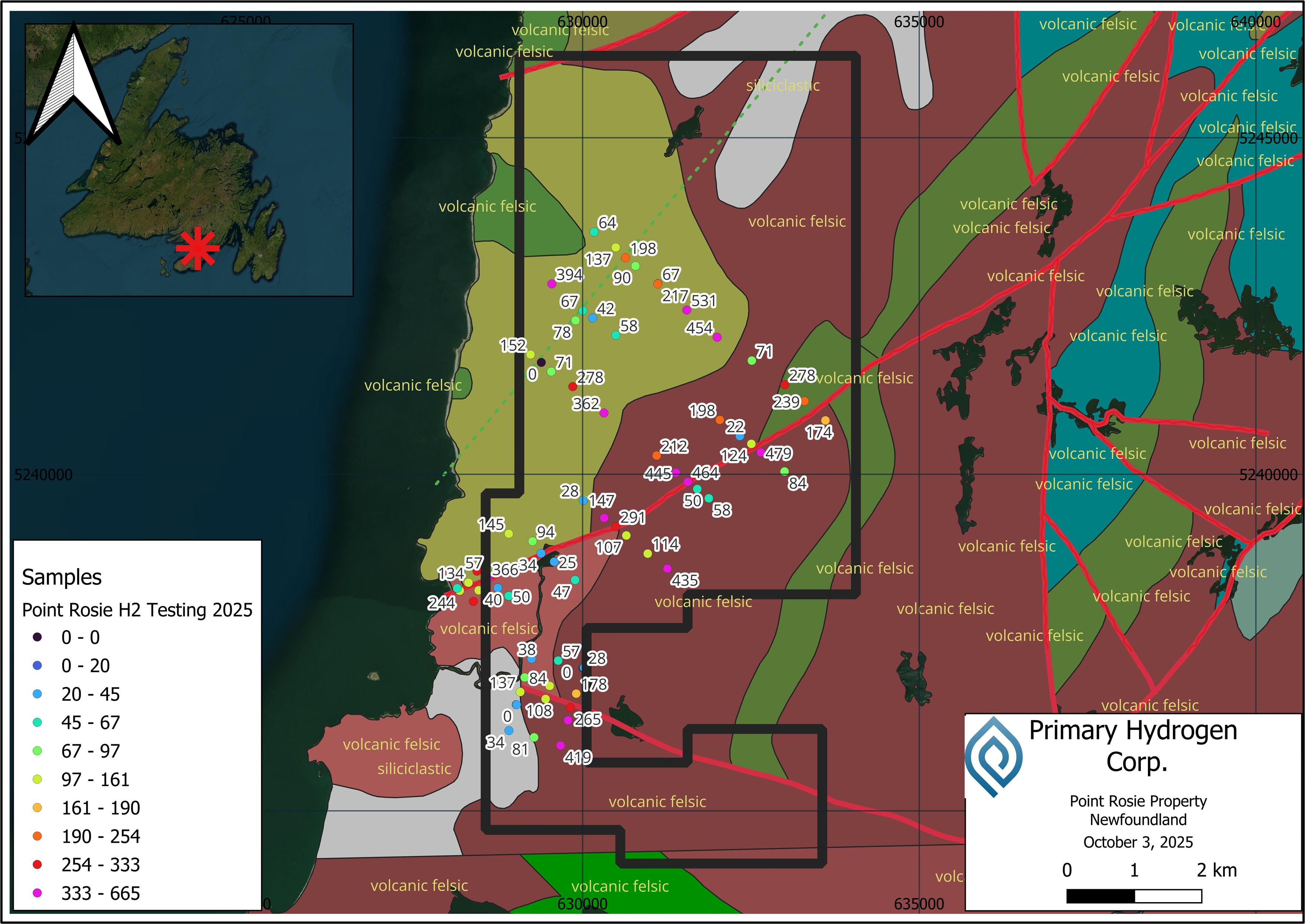
A total of 78 soil gas stations were sampled at Point Rosie, with an emphasis placed on fault structures and geological contacts within the property. Hydrogen soil gas analysis revealed anomalous concentrations, reaching up to 531 ppm H2 (see Figure 1). A corridor of elevated readings is evident along a northeast-trending fault, with values generally decreasing with distance from the structure. This pattern may indicate that the fault acts as a conduit for hydrogen migration from deeper sources.
The Company plans to validate these findings through additional investigation, including an infill soil gas survey.
Figure 1: Point Rosie H2 results
Mary's Harbour
Mary's Harbour is located along the southeastern Labrador coast, characterized by mafic to ultramafic rocks associated with the Grenville Province. The region contains gabbros, pyroxenites, and peridotites, which are conducive to serpentinization and hydrogen generation.
The area is intersected by several fault systems, including deep-seated thrust faults. These faults provide potential conduits for hydrogen migration from deeper crustal levels. The structural complexity of the region suggests the possibility of both hydrogen generation and accumulation.
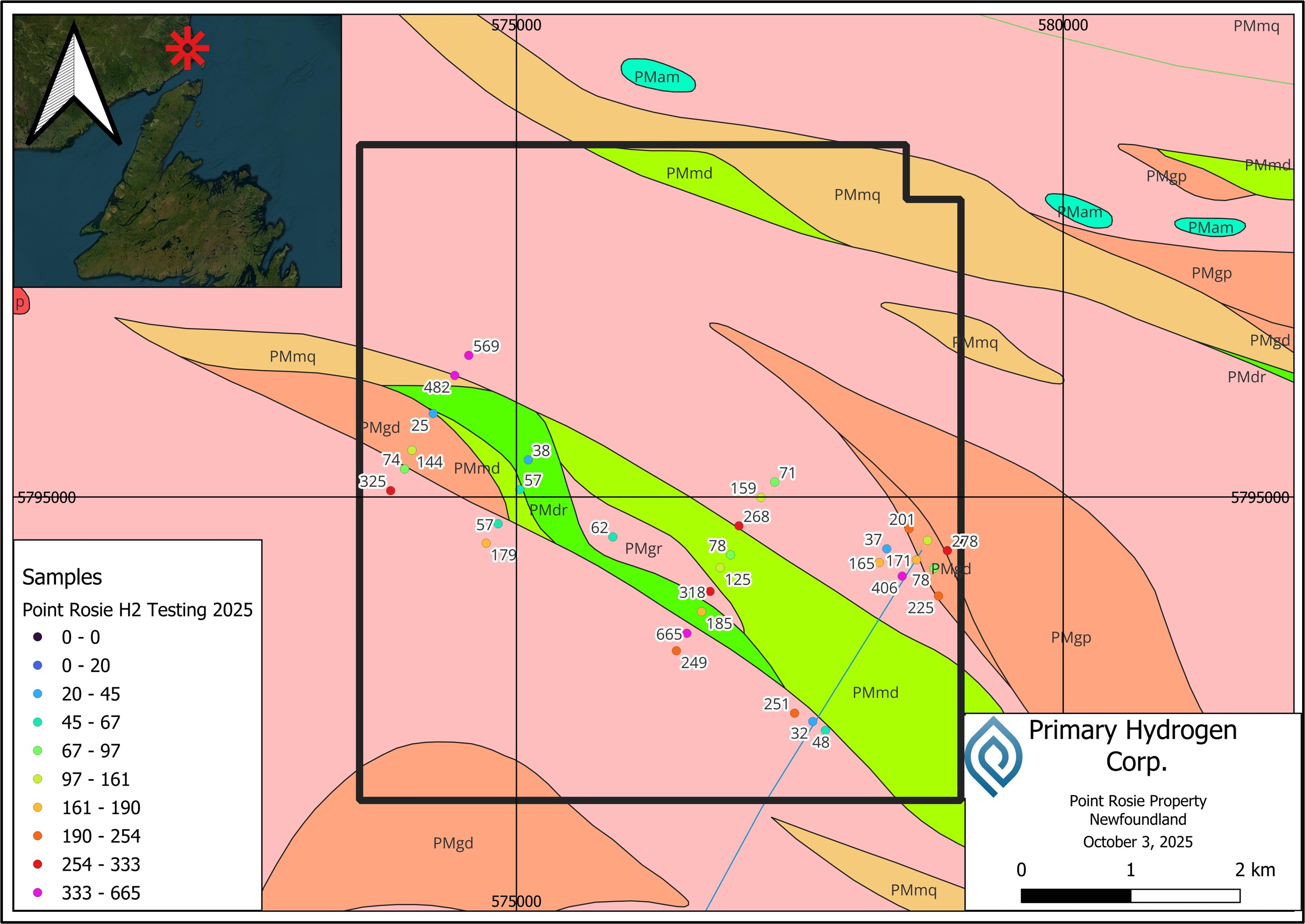
A total of 33 soil gas samples were taken at stations on the Mary's Harbour property, focusing on the northwest trending contacts, with the highest reported value of 665 ppm H2 (see Figure 2). The anomalous values do not appear to be associated with any particular structure or geological unit; further study is required to confirm this observation.
A follow-up program will focus on verifying the anomalous readings using additional gas detectors and probes.
Figure 2: Mary's Harbour H2 results
A total of 49 soil samples were obtained from multiple stations across both properties, selected based on suitable soil cover for sampling. The results of the soil sampling program did not yield conclusive associations between elemental concentrations and hydrogen readings; therefore, additional investigation is recommended to validate these observations.
Sampling Methodology and QA/QC
The exploration program integrates portable gas detectors, including the ATO Gas Dog H2 detector, providing immediate in-field measurements, with conventional geological exploration techniques including soil sampling, prospecting, and geological mapping. Soil gas sampling involves the collection and analysis of gases present in soil pores near the surface, helping to detect anomalies indicative of potential subsurface hydrogen accumulations. This integrated approach is specifically aimed at efficiently identifying the presence of any natural hydrogen at surface levels, while simultaneously refining the Company's geological understanding of potential hydrogen generation sources, migration pathways, and accumulation zones.
Soil gas samples were systematically collected at intervals ranging from 100 to 400 metres, depending on the level of detail required for a first pass survey, along transects oriented perpendicular to structural features and geological contacts, which are considered to be particularly susceptible to hydrogen outgassing from deeper sources. These survey lines were spaced approximately one kilometre apart. Sampling was conducted using a hollow stainless-steel probe featuring lower ports for soil gas entry and an upper valve for detector attachment via a flexible conduit. The probe was inserted into the ground to depths between 80 and 100 cm using a portable electric drill. Gases present in the soil pores were extracted by the detector, which pumped them through the probe for analysis.
Field gas measurements were performed with the ATO GasDog GD200-H2 detector, offering a detection limit of 1 ppm H₂, an accuracy of ≤±3% full scale, repeatability of ≤±1%, and a linearity error of ≤±1%. The detector was zeroed in ambient air at the start of each sampling day and underwent both bump testing and calibration with certified standard gas at the commencement of each project.
Soil samples were sent to Eastern Analytical's Springdale laboratory in Newfoundland for analysis using ICP-34 method plus gold, which consists of a 200mg subsample totally dissolved in a four-acid dilution and analysed by ICP-OES. Each batch of 24 samples included two laboratory standards, the results of which consistently fell within their respective certified acceptable limits.
Primary Hydrogen's sampling methodology and procedures have been collaboratively developed with INRS, leveraging laboratory-verified techniques to ensure consistent, reliable results and minimize artificially generated hydrogen. Collected data will directly inform subsequent exploration phases, increasing confidence in the identification and evaluation of prospective natural hydrogen targets. The Company is currently reviewing all data collected during this program to determine and plan appropriate follow-up work, and anticipates providing further updates as this review is completed.
Qualified Person
The scientific and technical information in this news release has been reviewed and approved by Peter Lauder, P.Geo., Vice President, Exploration of the Company, who is a Qualified Person as defined by National Instrument 43-101. Mr. Lauder is not independent of the Company within the meaning of NI 43-101.
About Primary Hydrogen Corp.
Primary Hydrogen is dedicated to the exploration and development of natural hydrogen resources. With over 740 acres in the U.S. and 230 square kilometers across Canada, the Company's portfolio includes the Blakelock, Hopkins, Mary's Harbour, Point Rosie, Crooked Amphibolite, Coquihalla, and Cogburn projects. Primary has an option to acquire a 75% interest in a hydrogen-REE project known as Wicheeda North located in British Columbia.
FOR FURTHER INFORMATION PLEASE CONTACT:
Ben Asuncion
Chief Executive Officer
Primary Hydrogen Corp.
Email: [email protected]
CAUTIONARY NOTE REGARDING FORWARD-LOOKING INFORMATION
This news release contains "forward-looking information" and "forward-looking statements" within the meaning of applicable Canadian securities laws. Forward-looking statements in this release include statements regarding: (i) the interpretation and significance of exploration results, including the potential for natural hydrogen generation through serpentinization at depth; (ii) the prospectivity of the Point Rosie and Mary's Harbour properties for natural hydrogen exploration; (iii) the potential for fault structures to serve as hydrogen migration pathways; (iv) plans for additional sampling, infill surveys, and follow-up programs to validate exploration results; (v) the effectiveness of sampling methodologies developed with INRS; and (vi) the use of collected data to inform future exploration phases.
Forward-looking statements can generally be identified by the use of words such as "may," "will," "could," "believes," "expects," "intends," "plans," "potential," "projects," "suggests," or similar expressions. These statements are based on assumptions made by the Company regarding, among other things: the accuracy and reliability of sampling results; the validity of geological interpretations; the effectiveness of exploration methodologies; continued availability of funding and resources; timely receipt of necessary permits and approvals; and the absence of unforeseen operational issues or other impediments.
Forward-looking statements involve significant risks and uncertainties that could cause actual outcomes to differ materially from those projected. Such risks include, but are not limited to: uncertainties inherent in the interpretation of exploration results; the preliminary nature of soil gas and soil geochemistry sampling; potential inaccuracies or inconsistencies in sampling results; inability to secure necessary permits or regulatory approvals for future work; potential logistical or environmental challenges; unforeseen operational issues or increased costs; failure to identify economic concentrations of natural hydrogen; and other general economic, market, regulatory, or geological risks detailed in the Company's public disclosure filings available on SEDAR+ at www.sedarplus.ca
Although the Company believes its expectations and assumptions are reasonable based on current information, there can be no assurance that these forward-looking statements will prove accurate. Readers should not place undue reliance on forward-looking statements or information, as actual outcomes may vary materially from those anticipated. The Company undertakes no obligation to update forward-looking information except as required by applicable securities laws.
Neither the TSX Venture Exchange nor its Regulation Services Provider (as that term is defined in policies of the TSX Venture Exchange) accepts responsibility for the adequacy or accuracy of this release.
SOURCE: Primary Hydrogen Corp.
View the original press release on ACCESS Newswire
H.Thompson--AT