India's mango man, father of 300 varieties / Photo: Maryke VERMAAK - AFP

 UN says world must navigate 'reality' of 1.5C overshoot

 Taliban govt defends ban on protest, citing Islamic law

 10 missing as Turkish cargo ship sinks after collision off Istanbul

 easyMarkets Expands Commodity Offering with 24/7 Gold, Silver and Oil Trading
 Australia defends Pacific climate meeting despite doubts on attendance

 Iran attacks US sites after American strikes, wedding deaths

 Stocks drop, yields at three-decade highs on Mideast flare-up

 EU summons Russian envoy, eyes sanctions after Germany drone 'attack'
 Stocks drop as yields and oil prices spike on Mideast flare-up
 Cricketers to get best rooms at Asian Games, says Japan chief

 Zverev out-lasts Sonego in wild five-setter to advance at US Open

 Amid war, Ukrainian soldiers celebrate love at ritual wedding

 Venice to roll out red carpet for Clooney on opening night
 Hong Kong democracy activist Wong pleads guilty to foreign collusion: AFP

 Stocks sink, yields at multi-decade highs and oil spikes on Mideast flare-up

 US defends Trump Venezuela oil deal as energy secretary lands in Caracas
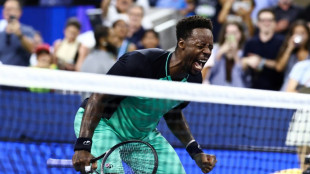 Jubilant Monfils celebrates birthday with US Open win
 The Japanese idealist behind the last deradicalisation NGO in Somalia

 Rybakina, Gauff advance as Zverev launches US Open campaign

 Macron in Britain to help unveil tapestry, hold Burnham talks
 China's Xi to hold talks with Sisi in rare visit to Egypt

 Confident Gauff reaches US Open 2nd round with straight-set win

 US postal whistleblower warns ballot system could disrupt midterms

 Protagonist Therapeutics to Participate in Two Investment Bank Conferences in September 2026

 Preppy Pledges to Help 250,000 People Enter Allied Health Careers by 2031

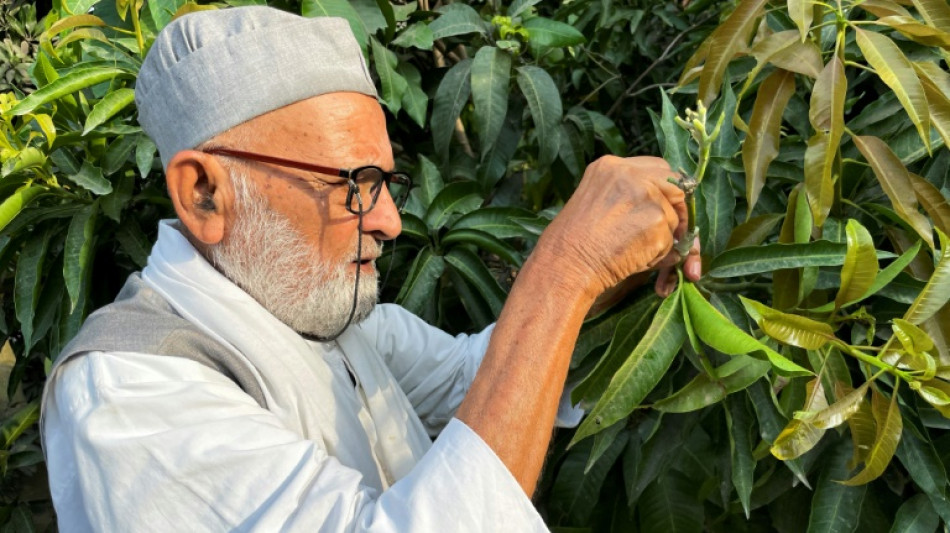
Every day, Indian octogenarian Kaleem Ullah Khan wakes at dawn, prays, then ambles about a mile to his 120-year-old mango tree, which he has coaxed into producing more than 300 varieties of the beloved fruit over the years.
His footsteps quicken as he draws nearer and his eyes light up as he peers closely at the branches through his spectacles, caressing the leaves and sniffing the fruits to see if they are ripe.
"This is my prize of toiling hard in the scorching sun for decades," the 82-year-old said in his orchard in the small town of Malihabad.
"For the naked eye, it's just a tree. But if you see through your mind, it's a tree, an orchard, and the biggest mango college in the world."
The school dropout was just a teenager when he conducted his first experiment in grafting, or joining plant parts to create new mango varieties.
He nurtured a tree to produce seven new kinds of fruit, but it blew down in a storm.
But since 1987, his pride and joy has been the 120-year-old specimen, source of more than 300 different types of mango, each with their own taste, texture, colour and size, he says.
One of the earliest varieties he named "Aishwarya" after Bollywood star and 1994 Miss World beauty pageant winner Aishwarya Rai Bachchan. To this day, it remains one of his "best creations".
"The mango is as beautiful as the actress. One mango weighs more than a kilogram (two pounds), has a tinge of crimson to its outer skin and it tastes very sweet," Khan said.
Others he named in honour of Prime Minister Narendra Modi and cricket hero Sachin Tendulkar. Another is "Anarkali", or pomegranate blossom, and has two layers of different skin and two different pulps, each with a distinctive aroma.
"People will come and go, but the mangoes will remain forever, and years after, whenever this Sachin mango will be eaten, people will remember the cricketing hero," said the father of eight.
- Famed fruit -
Standing nine metres (30 feet) tall, his treasured tree has a stout trunk with wide-spreading, thick branches that yield a pleasant shade against the Indian summer sun.
The leaves are a patchwork of different textures and smells. In some places, they are yellow and glossy, and in others, a dark, dull green.
"No two fingerprints are the same, and no two mango varieties are similar. Nature has gifted mangoes with traits like humans," Khan said.
His method for grafting is intricate, and involves diligently slicing a branch from one variety, leaving an open wound into which a branch from another variety is spliced and sealed with tape.
"I will remove the tape once the joint becomes sturdy, and hopefully, this new branch will be ready by next season, and bear a new variety after two years," he explained.
Khan's skills have won him numerous accolades, among them one of India's highest civilian honours in 2008, as well as invitations to Iran and United Arab Emirates.
"I can grow mangoes even in a desert," he says.
- Climate threat -
India is the largest producer of mangoes, accounting for half the global output. Malihabad, in the northern state of Uttar Pradesh, has more than 30,000 hectares of orchards and accounts for nearly 25 percent of the national crop.
Mostly owned by families for generations, the orchards are a mango lover's paradise, with the best-known variety possibly the melt-in-the-mouth Dasheri, named for the nearby village where it originated in the 18th century.
But farmers are worried by climate change, with a heatwave this year destroying 90 percent of the local crop, according to the All-India Mango Growers Association.
The number of varieties has also fallen, which Khan blames on intensive farming techniques and the widespread use of cheap fertilisers and insecticides.
Growers also plant too many trees packed too tightly together, leaving no space for moisture and dew to settle on the leaves, he says.
But he still has a good life, he says.
"I recently moved into a new house inside the farm to be closer to my beloved tree, which I'll keep working on till my last breath."
O.Brown--AT