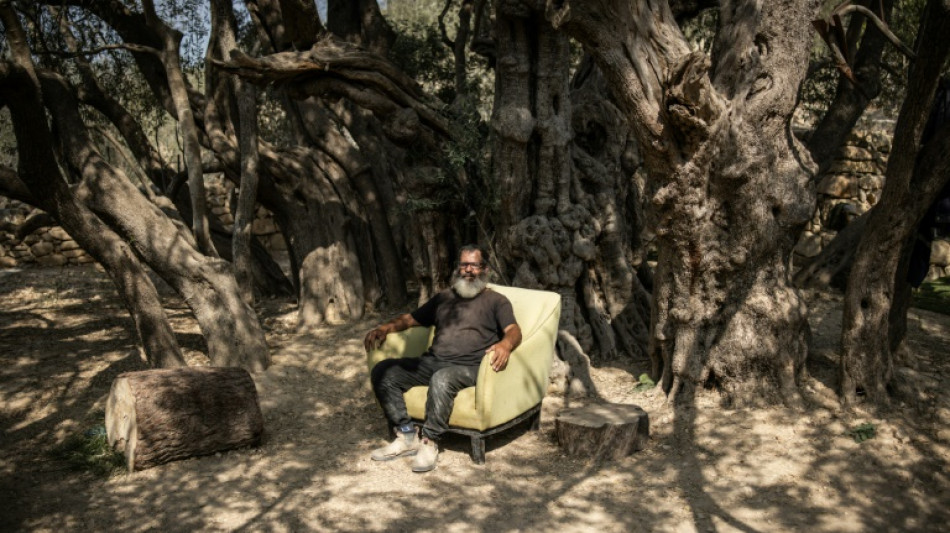
West Bank's ancient olive tree a 'symbol of Palestinian endurance' / Photo: John Wessels - AFP

 Gunman kills one, wounds four in town outside Paris

 France to deploy 70,000 police ahead of new protests
 Mekies hails Verstappen as Red Bull's driving force amid revival
 Tanker with Russian diesel heads to New York under Trump deal

 New centre puts focus on Portuguese dictator Salazar's legacy

 Oil nears $115 with stocks mixed on earnings, AI

 Asian football endorses Infantino re-election in apparent U-turn

 Ukraine says two soldiers died after arrested girl sent Russian poison

 New Greece law bans social media for under-15s

 Netanyahu orders West Bank closure as attack wounds Israelis before election
 Asian stocks mixed ahead of weekend as tech recovers early losses
 How five Boeing 777s linked Madagascar's power elite to Iran

 South Korea proposes holding border talks with North
 Ukraine's young figure skaters twizzle on despite Russian threat

 Asian football endorses Infantino re-election as FIFA president
 Complete Kane hopes for 'special night' as Ballon d'Or rumours swirl
 Rooney calls United squad 'selfish babies' after Fernandes criticism

 Teddy Wilson, son of World Cup-winner David, gets Wallabies call-up

 New Zealand military chief resigns over 'inappropriate relationship'

 Man Utd's Carrick on borrowed time, free-scoring Brighton face Liverpool
 Asian stocks head into weekend on a low as tech extends losses

 'Generational rage': Young Europeans fight to be heard
 Lula, Bolsonaro to clash once more before Brazil vote
 Dressed to kill: Haircuts cap menacing look of Japan's yakuza
 Napa Valley's wineries feel Trump's tariff squeeze

As guardian of the occupied West Bank's oldest olive tree, Salah Abu Ali prunes its branches and gathers its fruit even as violence plagues the Palestinian territory during this year's harvest.
"This is no ordinary tree. We're talking about history, about civilisation, about a symbol," the 52-year-old said proudly, smiling behind his thick beard in the village of Al-Walajah, south of Jerusalem.
Abu Ali said experts had estimated the tree to be between 3,000 and 5,500 years old. It has endured millennia of drought and war in this parched land scarred by conflict.
Around the tree's vast trunk and its dozen offshoots -- some named after his family members -- Abu Ali has cultivated a small oasis of calm.
A few steps away, the Israeli separation wall cutting off the West Bank stands five metres (16 feet) high, crowned with razor wire.
More than half of Al-Walajah's original land now lies on the far side of the Israeli security wall.
Yet so far the village has been spared the settler assaults that have marred this year's olive harvest, leaving many Palestinians injured.
Israel has occupied the West Bank since 1967, and some of the 500,000 Israelis living in the Palestinian territory have attacked farmers trying to access their trees almost every day this year since the season began in mid-October.
The Palestinian Authority's Colonisation and Wall Resistance Commission, based in Ramallah, documented 2,350 such attacks in the West Bank in October.
- 'Rooted in this land' -
Almost none of the perpetrators have been held to account by the Israeli authorities.
Israeli forces often disperse Palestinians with tear gas or block access to their own land, AFP journalists witnessed on several occasions.
But in Al-Walajah for now, Abu Ali is free to care for the tree. In a good year, he said, it can yield from 500 to 600 kilograms (1,100 to 1,300 pounds) of olives.
This year, low rainfall led to slim pickings in the West Bank, including for the tree whose many nicknames include the Elder, the Bedouin Tree and Mother of Olives.
"It has become a symbol of Palestinian endurance. The olive tree represents the Palestinian people themselves, rooted in this land for thousands of years," said Al-Walajah mayor Khader Al-Araj.
The Palestinian Authority's agriculture ministry even recognised the tree as a Palestinian natural landmark and appointed Abu Ali as its official caretaker.
Most olive trees reach about three metres in height when mature. This one towers above the rest, its main trunk nearly two metres wide, flanked by a dozen offshoots as large as regular olive trees.
- 'Green gold' -
"The oil from this tree is exceptional. The older the tree, the richer the oil," said Abu Ali.
He noted that the precious resource, which he called "green gold", costs four to five times more than regular oil.
Tourists once came in droves to see the tree, but numbers have dwindled since the start of the war in Gaza in October 2023, Abu Ali said, with checkpoints tightening across the West Bank.
The village of Al-Walajah is not fully immune from the issues facing other West Bank communities.
In 1949, after the creation of Israel, a large portion of the village's land was taken, and many Palestinian families had to leave their homes to settle on the other side of the so-called armistice line.
After Israel's 1967 occupation, most of what remained was designated Area C -- under full Israeli control -- under the 1993 Oslo Accords, which were meant to lead to peace between Palestinians and Israelis.
But the designation left many homes facing demolition orders for lacking Israeli permits, a common problem in Area C, which covers 66 percent of the West Bank.
"Today, Al-Walajah embodies almost every Israeli policy in the West Bank: settlements, the wall, home demolitions, land confiscations and closures," mayor Al-Araj told AFP.
For now, Abu Ali continues to nurture the tree. He plants herbs and fruit trees around it, and keeps a guest book with messages from visitors in dozens of languages.
"I've become part of the tree. I can't live without it," he said.
W.Morales--AT