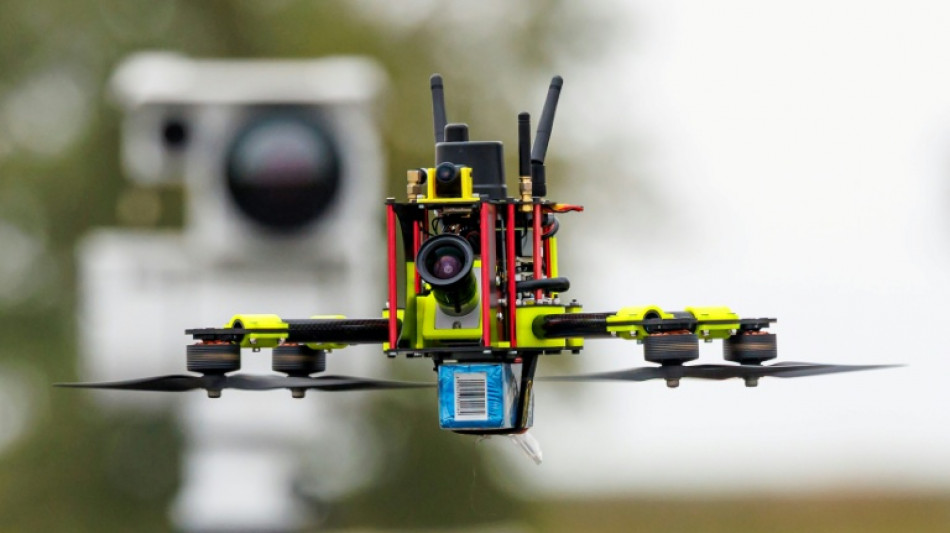
At secluded German airport, researchers tackle tricky drone defence / Photo: JENS SCHLUETER - AFP

 Comeback kings Brewers down Rays to take 2-0 World Series lead

 Sri Lankan turbine project fuels anger as fish hauls plunge
 No LeBron, no problem as Sixers roll on

 Israel to close all land crossings with West Bank on election day

 'Tech debt coming due': AI-found flaw signals chaos ahead

 Stop-motion 'Wildwood' showcases 'human creativity' in AI age

 Expo Contratista Announces 10th Edition in Dallas, Spotlighting Latino Construction Businesses and Workforce Development

 Easy Fitness Routines You Can Do at Home

 New Guide Titled "Gold Proof Coins vs Uncirculated Coins: Are Gold Proof Coins a Good Investment" Released

 Jorge Martin out of Australian MotoGP with fracture: team

 Antonelli storms to US Grand Prix pole on weekend he can take title

 Apologetic Alvarez fires Atletico to win against Deportivo

 Lens beat PFC in Ligue 1 matchday impacted by social unrest

 Valkyries hit back against Dream to level WNBA Finals

 'Fighting for our rights': Paris protesters determined to march on

 Clashes break out in Paris, other French cities amid fresh protests
 Spurs seal rare win at Chelsea as Palmer sees red

 Nearly 1,000 arrested in French protests marred by 'elevated' violence: minister

 France extends detention of suspected racist shooter

 Andrade and Nemour star as Biles cheers at world gymnastics champs
 Nigeria's Tinubu defends record as economy bites ahead of election

 'Guiding star' Fuellkrug bags Bremen brace, Leipzig win

 Man City's perfect start ended by Aston Villa, Arsenal go joint-top

 Arsenal sink Everton to join Man City at Premier League summit
 France protests: Latest developments

Once holidaymakers took off from here, but today an ex-Soviet airfield is a testing ground for ways to take down the drones increasingly buzzing through German skies.
Germany has been rattled by a spate of mysterious sightings of unmanned aerial vehicles (UAVs), believed to be from Russia, over military bases, industrial sites and an airport.
Last week the government said it would give federal police the powers to blast them out of the sky.
But at the airstrip near the eastern city of Magdeburg, researchers of the German Aerospace Center (DLR) have been testing more subtle options to deal with potentially hostile drones.
"The countermeasures used to defend against drones vary greatly -- they have to be tailored very precisely to the situation at hand," said Johann Dauer, who leads drone research at DLR's Institute of Flight Systems.
"If I want to protect a crowd -- for example at a concert or a political event -- then of course I don't want to cause a drone to crash," Dauer said, given the risk of injuries on the ground.
"I would rather use nets or hunter drones with gripping mechanisms to actually remove the drone."
The challenge facing Germany is not just fending off suspected Russian UAVs conducting surveillance or testing NATO responses.
Naive, blundering hobbyists and reckless pranksters can also veer into restricted airspace, setting off alarms and potentially shutting down airport traffic.
Signal jamming and GPS interference with "spoofed" coordinates are other methods Dauer cited for dealing with drones without shooting them mid-air.
- 'Jamming and spoofing' -
Dauer said an infamous 2018 incident at London's Gatwick airport, in which reported drone sightings cancelled hundreds of flights, helped make drone defences a civilian issue as well.
"And since then, reports have been piling up," Dauer said. "Today, we see new reports almost daily, and we need to take a closer look at drone defence."
Germany has been scrambling to deal with the drone incursions, and Interior Minister Alexander Dobrindt has suggested that spending on civil drone defences could run to hundreds of millions of euros.
Helping decide what systems police agencies should spend money on is part of the drone research and evaluation mission at Cochstedt, Dauer said.
The secluded hangars and runways add a degree of secrecy for the sensitive development work there.
But more importantly, the airport's focus on unmanned aerospace research means it is relatively free from safety regulations that would normally tightly restrict testing with drone intruders and interceptors.
Cochstedt is a fully functional airport where occasional Ryanair flights once shuttled passengers to Mediterranean holiday destinations, although those connections have long since been cancelled.
This means drones and various defences can now be tested and integrated into airport operations, said Daniel Suelberg, who runs DLR's testing centre at Cochstedt.
"Permission for jamming and spoofing, permission to shoot lasers at an airport -- everything that you don't really want at airports because it would paralyse operations -- we have here," Suelberg said.
- 'Pressure to innovate' -
Suelberg and Dauer showed off a range of drone detection gear -- high-end optics and cameras, radar arrays and other equipment -- that researchers have been testing at the facility.
Some of it is bought from defence contractors and commercial producers, other gear is specially assembled by the dozen research groups working at Cochstedt.
The goal is to figure out comprehensive systems for detecting drones, identifying whether they pose a threat, and deploying appropriate countermeasures.
But a key challenge is figuring out the best bang for the buck that can be widely deployed without exploding civil defence budgets.
Some high-end systems come with hefty price tags -- limiting their appeal for mass deployment.
Adding to the challenge is just how quickly drone technology is changing, something very clearly on display in the battlefields of Ukraine, where both sides are locked in a deadly race to develop new weapons and come up with countermeasures.
"We are seeing a great deal of innovation and development on the threat side," said Dauer. "And, of course, drone defence must counter this and offer appropriate solutions.
"This means that, on the one hand, we are under a certain amount of pressure to innovate and must make rapid progress.
"At the same time, we have to remain cost-effective, and the drones we are combating are often not particularly expensive -- so the protection must not be too costly."
F.Wilson--AT