
Chesapeake Bay Foundation's Menhaden Blame Game Isn't Backed by CCB Findings

 Catlin to make Masters debut after cruising to Hong Kong win

 Katsuragawa hails 'greatest moment' with South Korea win

 Japan's Yoshida wins first LPGA Tour title with South Korea win
 Comeback kings Brewers down Rays to take 2-0 World Series lead

 Sri Lankan turbine project fuels anger as fish hauls plunge
 No LeBron, no problem as Sixers roll on

 Israel to close all land crossings with West Bank on election day

 'Tech debt coming due': AI-found flaw signals chaos ahead

 Stop-motion 'Wildwood' showcases 'human creativity' in AI age

 HKA Enterprises is Powering the Skilled Trades That Are Moving the U.S. Economy Forward

 7 Creative Things to Do With Your Backyard

 Expo Contratista Announces 10th Edition in Dallas, Spotlighting Latino Construction Businesses and Workforce Development

 Jorge Martin out of Australian MotoGP with fracture: team

 Antonelli storms to US Grand Prix pole on weekend he can take title

 Apologetic Alvarez fires Atletico to win against Deportivo

 Lens beat PFC in Ligue 1 matchday impacted by social unrest

 Valkyries hit back against Dream to level WNBA Finals

 'Fighting for our rights': Paris protesters determined to march on

 Clashes break out in Paris, other French cities amid fresh protests

 Spurs seal rare win at Chelsea as Palmer sees red

 Nearly 1,000 arrested in French protests marred by 'elevated' violence: minister

 France extends detention of suspected racist shooter

 Andrade and Nemour star as Biles cheers at world gymnastics champs

 Nigeria's Tinubu defends record as economy bites ahead of election

 'Guiding star' Fuellkrug bags Bremen brace, Leipzig win

Osprey nest failures occurred prior to menhaden fishing
REEDVILLE, VA, NY / ACCESS Newswire / October 8, 2025 / As Virginians, we share the public concern about the poor 2025 osprey breeding results reported by the Center for Conservation Biology (CCB). But the Chesapeake Bay Foundation's (CBF) attempt to pin those outcomes on the menhaden fishery misstates the timeline, overextends the CCB advisory's inferences, and ignores other environmental factors that CCB itself noted.
What CCB actually reported
CCB's news advisory organizes 2025 results by salinity (used as a proxy for local fish communities) and finds that higher-salinity sites had low productivity while low-salinity sites exceeded population-maintenance thresholds. CCB explicitly states "salinity is a proxy for the fish community" and that ospreys in high-salinity areas are believed to rely more on menhaden. CCB also documents many pairs that did not lay clutches in 2025, arriving on time in late February-early March, then abandoning territories in significant numbers, with many returning in June (a first for the Bay population). Finally, CCB notes that food stress showed up as single-chick broods (67% of broods in waters with salinity levels above 5 parts per thousand) and widespread post-hatch losses.
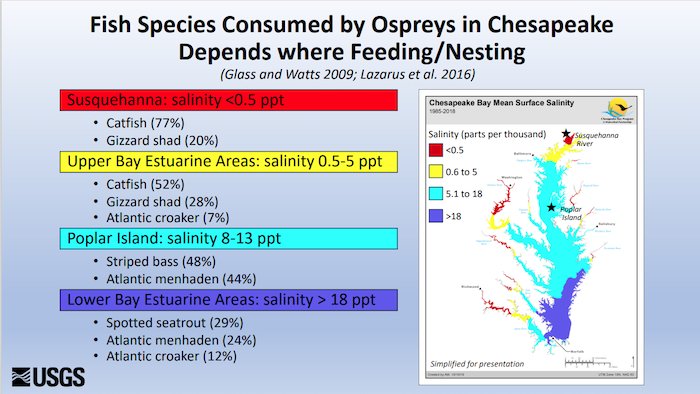
A presentation given by US Geological Survey scientists to the Menhaden Board of the Atlantic States Marine Fisheries Commission in August 2024 shows that past research, including research by CCB Director Dr. Bryan Watts, identified other species as being the primary prey of osprey in the higher salinity areas of the Bay. To make the leap that menhaden is the singular problem is not supported by the data.
Timeline facts that CBF ignores
By Virginia law, purse-seine fishing for menhaden is closed until the Sunday before the first Monday in May (i.e., there is no fishing until early May).
According to Ocean Harvesters' fleet logs provided to state regulators, menhaden fishing did not begin in the Bay until the week of May 26 in 2025, reflecting late arrival/availability of menhaden that is controlled by nature.
CCB states in a photo caption that: "Most young that starve in the nest die within the first two weeks after hatching." If chicks hatch in April/early May, those deaths occur before fishing started.
CCB records pairs arriving late February-early March; many never laid eggs at all, events that obviously precede any fishing and indicate that birds may not return to the area in good health.
Taken together, CCB's description of timing, plus the dates of the legal fishing season, make clear that early nest failures and the chick mortalities in the first two weeks after hatching occurred before the menhaden fishery began harvesting.
Where CBF goes beyond the CCB advisory
The Chesapeake Bay Foundation's press statement asserts that CCB's results "indicate insufficient local food availability in areas where the osprey diet relies on forage fish like menhaden." CBF points to a decline in bait landings and juxtaposes those figures with the industrial reduction fishery's annual catch to imply cause and effect.
That is CBF's biased interpretation, not CCB's conclusion. CCB does not directly blame the menhaden fishery; it infers food limitation from breeding metrics and salinity as a prey proxy.
CCB itself reports weather-related nest losses (high winds, extended rains) and notes that even low-salinity areas performed worse than recent years, evidence that multiple environmental drivers were at work in 2025.
Ospreys are generalist fish-eaters that take a range of species of suitable size; when menhaden aren't present inshore, ospreys use other prey (e.g., gizzard shad, catfish). CCB's map/photo captions and standard references reflect this dietary flexibility.
Fleet operations and observations indicate menhaden have arrived late in recent years, a function of environmental conditions, not fishing. The fishery has no mechanism to delay migration or in-Bay availability.
While menhaden bait landings may be lower in the Bay than in the past, CBF fails to consider the level of effort. There are documented instances of pound netters who have stopped fishing over the past few years through a combination of factors including higher costs for equipment and the inability to find dependable (and affordable) labor.
Bait landings reflect harvest effort and market conditions and are not a direct measure of local fish abundance or near-shore availability to osprey.
CCB's 2025 advisory shows food stress signals in higher-salinity waters, but the timing and the text do not support CBF's misleading narrative that the regulated menhaden fishery caused this year's early nest failures and first-weeks chick mortalities. Those events occurred before the season opened and menhaden boats were still at the dock. Environmental factors, weather-driven nest losses (high winds/extended rains) and widespread post-hatch starvation, are plainly implicated in CCB's account and must be part of any honest discussion, despite the self-interested view of a special interest group like the CBF.
About Ocean Harvesters
Ocean Harvesters owns and operates a fleet of more than 30 fishing vessels in the Atlantic Ocean and Gulf of Mexico. The company's purse-seine fishing operation is exclusively engaged in the harvest of menhaden, a small, nutrient-dense fish used to produce fish meal, fish oil, and fish solubles. Both its Atlantic and Gulf Menhaden fisheries are certified sustainable by the Marine Stewardship Council. Committed to responsible fishing operations, Ocean Harvesters is proud to be heir to a fishing legacy that extends nearly 150 years.
Press Contact
Stove Boat Communications
(202) 595-1212
[email protected]
SOURCE: Ocean Harvesters
View the original press release on ACCESS Newswire
A.Williams--AT