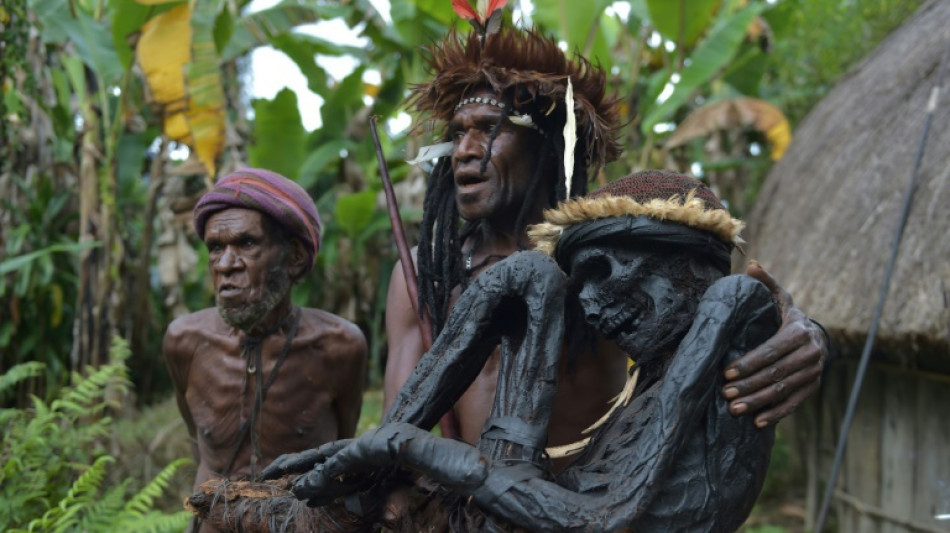
Smoke-dried bodies could be world's 'oldest mummies': study / Photo: ADEK BERRY - AFP/File

 Falcons hand 49ers first defeat of NFL season, Vikings remain unbeaten

 Lula, Bolsonaro in virtual tie halfway through Brazil vote count

 Antonelli looks to seal title 'in style' after US Grand Prix win

 Real Madrid century 'just a detail' for Mbappe after Clasico win

 Mbappe double helps Real Madrid stun Barca in La Liga Clasico

 Antonelli wins US Grand but title triumph has to wait another week

 Manchester United slump deepens as Liverpool climb with Brighton win

 Reus sends Bordeaux second in Top 14 with victory at La Rochelle

 Serbia's student movement ousts longtime leader in parliament poll

 Kuwait minister urges focus on investment quality and development impact

 Descendants of British slave-owning families support reparations campaign

 Aleksandar Vucic: Serbia's veteran ruler felled by student-led movement

 Obama attacks Trump record while campaigning in Ohio and Michigan

 Brazil voting extended in tight race between Lula, Bolsonaro

 'Marine has to win': Le Pen supporters fear for France's future

 QNB expands cross-border funding for AI and digital infrastructure

 France's Le Pen launches presidential bid vowing to restore 'rule of law'

 Qatar Charity delivers Braille Qurans to blind readers in Kosovo and Albania

 Houthis say attacked Riyadh airport hours after flights resume

 Monaco hold Lille as Rennes go top of Ligue 1

 Thousands gather in Prague to protest licence fee plans

 Pease spins to floor gold as US tops gymnastics medal table

 Marchant back in England training squad ahead of Nations Championship fixtures

 French skater Siao Him Fa soars to victory in season-opener at home

 Embattled Albanian PM vows fines for violent protesters

Some ancient societies in China and southeast Asia appear to have smoke-dried their dead, effectively mummifying them thousands of years earlier than their Egyptian counterparts, new research has found.
While the bandage-bound bodies of ancient Egypt date back perhaps as far as 4,500 years ago, the oldest previously known examples of mummification are from ancient Chilean societies.
There, the dry air of the Atacama coastline allowed for natural mummification by drying.
But the bodies retrieved by researchers from China and southeast Asia came largely from humid regions.
The scientists were initially intrigued by the contorted positions of skeletons found in burial sites in China, Vietnam, the Philippines, Laos, Thailand, Malaysia and Indonesia.
The remains appeared to have scorch marks in some places, but in patterns inconsistent with attempts at cremation.
They theorised that the contorted burials might have been possible because no soft tissue remained on the bodies -- the result of mummification by drying, a practice known in parts of Indonesia's Papua.
They tested this by analysing the composition of bone samples from the sites against control samples taken from ancient burial sites in Japan and found evidence of exposure to mostly low-temperature heat.
The intact nature of the skeletons suggested there was no attempt to cremate the bodies, and preservation was the goal.
The samples include some dating back more than 10,000 years, suggesting societies were practicing forms of mummification thousands of years earlier than previously known.
The results were "a great surprise," said Hsiao-chun Hung, senior research fellow at Australian National University.
"The bones are so ancient, and it is remarkable to discover that this tradition is so old, connecting the practices of ancient peoples with those still found in some communities today."
While the scientists said smoking was probably the "most effective option for preserving corpses in tropical climates," the process also likely held cultural significance.
Several societies in Indonesia and Australia are known to have smoke-dried bodies by binding them tightly and placing them above a continuously burning fire, often for several months.
The process allowed relatives to maintain contact with the deceased, and in some cases was believed to allow the spirit to roam freely during the day and return to a body at night.
"I believe this reflects something deeply human -- the timeless wish that our loved ones might never leave us, but remain by our side forever," Hung told AFP.
The researchers theorise that the practice may have been common in ancient Asian civilisations.
"This tradition may have been known among hunter-gatherer societies across a vast region, for many millennia," they wrote in the study, published Monday in the Proceedings of the National Academy of Sciences journal.
A.Anderson--AT