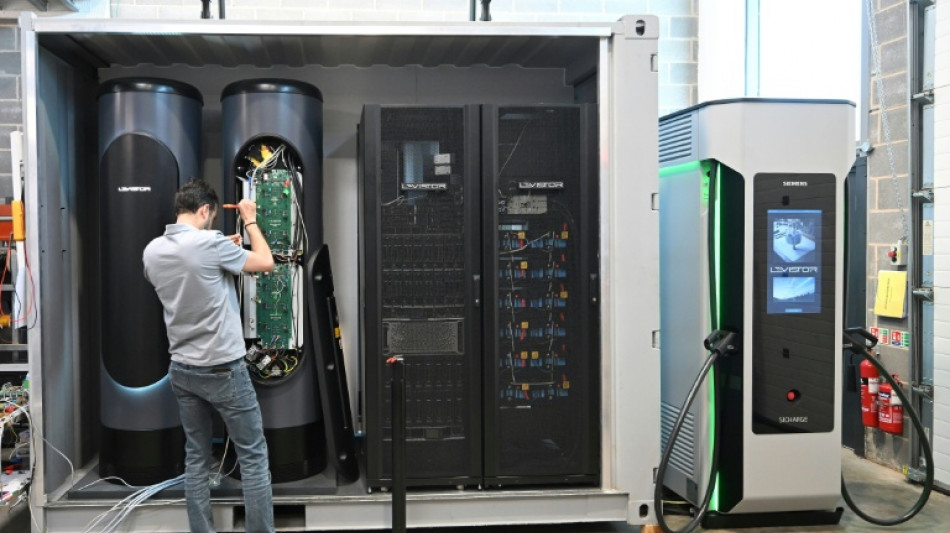
Britain's energy grid bets on flywheels to keep the lights on / Photo: Justin TALLIS - AFP

 Machado ready to meet Venezuela leader after shock return

 Lula celebrates election win as Brazil markets tumble

 France's Macron accuses social media of sowing discord ahead of election
 Anthropic unveils IPO filing showing soaring sales and AI risks

 US singer Chris Brown avoids jail over London nightclub brawl
 US singer Chris Brown avoids jail over UK nightclub brawl

 Man Utd crisis deepens as Carrick faces axe

 Serbian student movement eyes power after resounding snap poll victory

 Eala breezes past world number 411 in Tokyo opener

 Swedish Centre Party leader says government coalition talks failed

 Barca's big-game defeats pose familiar questions

 Russia says open to mini Ukraine ceasefires, but no let up in war
 Bangladesh measles crisis 'warning sign' of other outbreaks: report

 'Historic victory': World leaders celebrate Lula's re-election
 Stock markets mixed ahead of tech earnings, central bank decisions

 Mother renews anti-bullying appeal a decade after son’s death
 'Historic victory': Leftist leaders in the Americas celebrate Lula's re-election

 African players in Europe: Jackson brace ends City's perfect record

 Argentine police arrest stepfather after pregnant 10-year-old reaches hospital
 Mother dies after rescuing sons from riptide in the Bahamas
 James Blunt reportedly sought extra underwear during Celebrity Traitors filming

 Trump says Canada trade deal coming 'soon'

 Police urge home-security checks as darker evenings return

 Kane primed to pip Yamal, Mbappe to Ballon d'Or glory
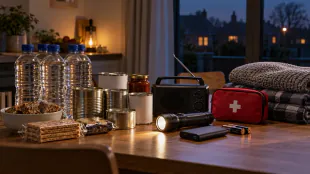 UK households advised to prepare for three days without essential services

Britain's energy operator is betting on an age-old technology to future-proof its grid, as the power plants that traditionally helped stabilise it are closed and replaced by renewable energy systems.
Spinning metal devices known as flywheels have for centuries been used to provide inertia -- resistance to sudden changes in motion -- to various machines, from a potter's wheel to the steam engine.
Grid operators are now looking to the technology to add inertia to renewable-heavy electricity systems to prevent blackouts like the one that hit Spain and Portugal this year.
In an electricity grid, inertia is generally provided by large spinning generators found in coal-fired and gas power plants, helping maintain a steady frequency by smoothing fluctuations in supply and demand.
But renewable energy sources like solar and wind power don't add inertia to the grid, and usually cannot help with other issues, such as voltage control.
Flywheels can mimic the rotational inertia of power plant generators, spinning quicker or slower to respond to fluctuations.
Without rotating turbines, "the system is more prone to fluctuations than it would be otherwise", explained David Brayshaw, a professor of climate science at the University of Reading in England.
"As we get to ever higher levels of renewables, we're going to have to think about this more carefully," Brayshaw told AFP.
- Flywheels and batteries -
The Iberian Peninsula, which is powered by a high share of renewables, went dark on April 28 after its grid was unable to absorb a sudden surge in voltage and deviations in frequency.
Spain's government has since pointed fingers at conventional power plants for failing to control voltage levels.
It could serve as a wake-up call similar to a 2019 outage which plunged parts of Britain into darkness following a drop in grid frequency.
That blackout prompted UK energy operator NESO to launch what it called a "world-first" program to contract grid-stabilising projects.
Flywheels and batteries can add synthetic inertia to the grid, but engineering professor Keith Pullen says steel flywheels can be more cost-effective and durable than lithium-ion batteries.
"I'm not saying that flywheels are the only technology, but they could be a very, very important one," said Pullen, a professor at City St George's, University of London and director of flywheel startup Levistor.
In the coming years, Pullen warned the grid will also become more unstable due to greater, but spikier demand.
With electric cars, heat pumps and energy-guzzling data centres being hooked onto the grid, "we will have more shock loads... which the flywheel smooths out".
- Carbon-free inertia -
Norwegian company Statkraft's "Greener Grid Park" in Liverpool was one of the projects contracted by NESO to keep the lights on.
Operational since 2023, it is a stone's throw from a former coal-fired power station site which loomed over the northern English city for most of the 20th century.
But now, instead of steam turbines, two giant flywheels weighing 40 tons (40,000 kilograms) each whirr at the Statkraft site, which supplies one percent of the inertia for the grid needed in England, Scotland and Wales.
Each flywheel is attached to a synchronous compensator, a spinning machine that further boosts inertia and provides voltage control services in the Liverpool region.
"We are providing that inertia without burning any fossil fuels, without creating any carbon emissions," said Guy Nicholson, Statkraft's zero-carbon grid solutions head.
According to NESO, 11 other similar synchronous compensator and flywheel projects were operational in Britain as of 2023, with several more contracted.
- 'Not fast enough' -
The government is "working closely with our industry partners who are developing world-leading technology, including flywheels, static and synchronous compensators, as we overhaul the energy system", a Department for Energy Security and Net Zero spokesperson told AFP.
But, "we aren't building them fast enough to decarbonise the grid", warned Nicholson.
Britain aims to power the grid with clean energy 95 percent of the time by 2030, before completely switching to renewables in the next decade.
"At the moment... we can't even do it for one hour," said Nicholson.
Even when there is sufficient solar and wind energy being generated, "we still have to run gas turbines to keep the grid stable", he explained.
Still, Britain and neighbouring Ireland seem to be ahead of the curve in procuring technology to stabilise renewable-heavy grids.
"In GB and Ireland, the system operators are leading by contracting these services," Nicholson said. "On the continent, there hasn't been the same drive for that."
"I think these things are driven by events. So, the Spanish blackout will drive change."
R.Chavez--AT