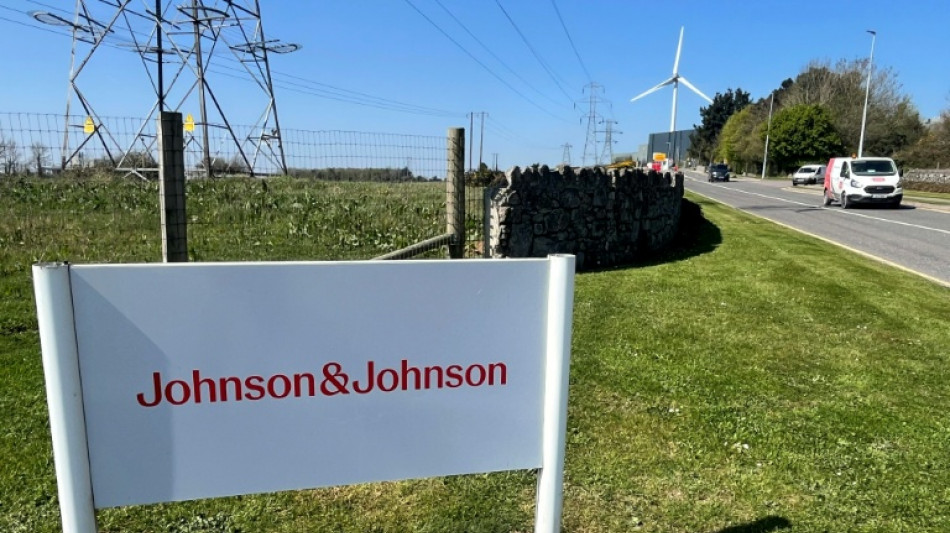
Ireland's 'economic miracle' at risk from tariffs / Photo: Peter MURPHY - AFP

 EU seeks deportation powers for beefed up border agency
 Two charged with UK security offences over airbase plot: police

 Maresca defends Donnarumma, Guehi after Man City defeat

 Nordic leaders call Putin as local truce begins in Ukraine
 Osaka unveils crane outfit in Tokyo before win over Paolini
 Ronaldo in line for Portugal return after fallout with coach

 Norway media take legal action to block Meta from using content
 Bayern praise 'humble' Kane after Ballon d'Or win

 Colts retain Daniel Jones as starter despite continued offensive struggles
 Madushanka wrecks Pakistan as Sri Lanka press for final slot
 Destructive Abhishek 113 leads India to series win over New Zealand

 Norway, Finland leaders hold 'frank and substantive' talk with Putin
 Wall Street faces earnings and Fed tests after turbulent technology-led week

 Ukraine, Russia say US-brokered truce holding in ravaged city

 Police form SIT after vehicles in Rahul Gandhi convoy collide on expressway

 Delhi grants minimum monthly pay and DA to about 4,000 MCD health workers
 Ather Energy shares climb 14% after quarterly profit and expansion plan
 Gold ETF flows turn negative after 13 weeks as bullion loses 4%

 Pakistan's last antique restorers give old treasures new life
 India braces for Cyclone Arnab with evacuations

 Steel Strips Wheels gains 36% in two sessions on growth outlook

 Cavs edge T'Wolves in overtime despite superb Edwards

 Prescott fires Cowboys to 38-21 win over plummeting Eagles

 Kuwait padel chief hails national showing at Premier Padel Major

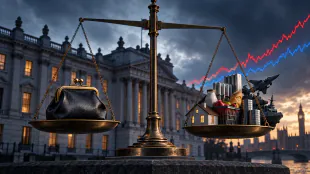 Britain prepares constrained budget as debt and defence pressures mount

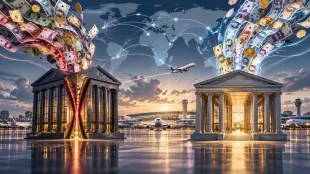
The deal between the United States and the European Union may have averted a transatlantic trade war, but worries persist in Ireland where crucial sectors are dependent on US multinationals.
Attracted primarily by low corporate taxes, huge pharmaceutical firms like Pfizer, Eli Lilly, and Johnson & Johnson, and tech giants like Apple, Google, and Meta have based their European headquarters there.
The US investor influx has boosted Irish tax coffers and fuelled record budget surpluses in recent years.
But Trump's tariffs -- a baseline rate of 15 percent on EU exports will apply across the board -- present a stress test for the Irish economic model.
Once one of western Europe's economic laggards, Ireland became known as the "Celtic Tiger" thanks to a remarkable turnaround in the 1990s.
A model built on low corporate tax and an English-speaking workforce in an EU country proved seductive to foreign investors, particularly from the US.
Their presence drove rampant economic growth and would later help Ireland rebound from the financial crash of 2008.
The transition was an "Irish economic miracle," said Louis Brennan, professor of business studies at Trinity College Dublin.
"Ireland has advanced in a matter of decades from being one of the poorest countries of northwestern Europe to being one of the most prosperous," he told AFP.
Last year Ireland hiked its corporate tax rate from 12.5 to 15 percent after pressure from the Organisation for Economic Co-operation and Development (OECD), but still anticipates a budget surplus of 9.7 billion euros for 2025.
Ireland's "spectacular" transformation "may have been too successful because we are very dependent in many ways on American companies," says Dan O'Brien, director of the IIEA think tank in Dublin.
- Pharma in frontline -
Spared from the first round of Trump's tariffs, pharmaceutical companies are now being targeted by the American administration, keen to repatriate production to home soil.
Earlier this month the US president threatened a 200 percent levy on the sector.
Irish Prime Minister Micheal Martin expressed mixed feelings at Sunday's 15 percent deal, welcoming that "punitively high tariffs" were avoided.
But "higher tariffs than there have been" will make transatlantic trade "more expensive and more challenging," he added.
The new 15 percent levy sealed will be "particularly unwelcome in Ireland," O'Brien told AFP.
"The pharmaceutical industry is very large relative to the size of the economy, and in recent times around half of its exports have gone to the United States," he said.
Pharma employs about 50,000 people and accounted for nearly half of Irish exports last year, reaching 100 billion euros, up by 30 percent year-on-year.
"Ireland's problem is that it is uniquely integrated into the United States economy," said O'Brien.
"There's no other European country like this. So Ireland is caught in the middle," he said.
Large pharmaceutical companies, particularly American ones, also host certain patents in the country to reduce their tax burden, which then boosts the Irish tax take.
Tariffs "risk strongly discouraging American companies from setting up their future factories in Ireland," said Brennan.
The US could still decide to impose further tariffs on the sector following an ongoing probe into whether pharmaceutical imports pose a national security problem, he said.
Tech firms with EU bases in Dublin who have also transferred part of their intellectual property rights will not be directly impacted by the imposition of tariffs on physical goods.
The sector is also a "significant area of investment and employment for Ireland, but at least from a US perspective, it seems outside the scope of the tariffs," said Seamus Coffey, an economics professor at University College Cork.
Beyond tariffs, tech could be affected if the United States decides to modify its tax regime to make it less attractive to set up in low-tax countries, said Andrew Kenningham, from Capital Economics.
A.Moore--AT