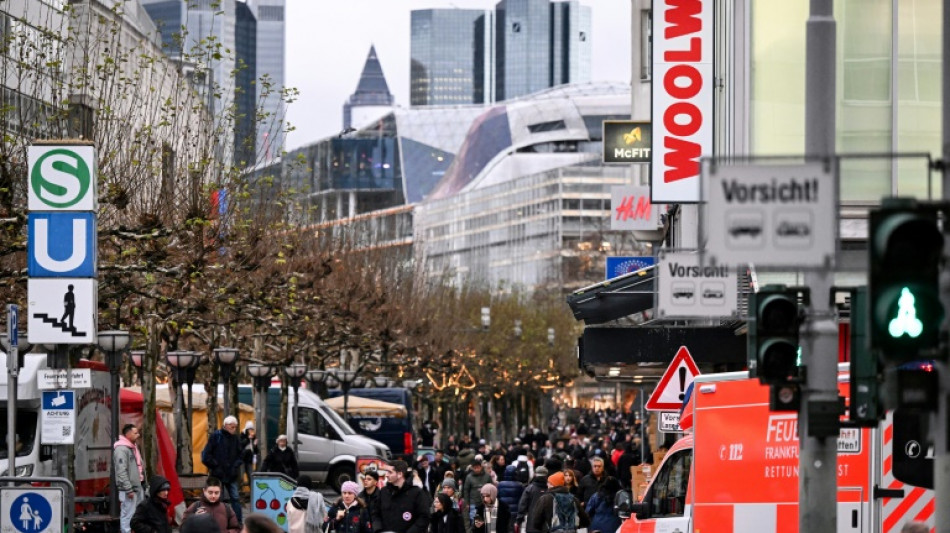
Germans reluctant to open wallets despite easing inflation / Photo: Kirill KUDRYAVTSEV - AFP

 Flight data, satellite images reveal growing US role at Ecuador base
 McInnes feels 'guilt' ahead of Hearts return with Rangers

 Brazil's Lula turns 81, vows to work '24 hours a day'
 Boeing releases cautious growth plan as shares fall sharply

 Exiled Russian dissident Navalnaya warns dictators becoming 'more cunning'

 Bayern 'risk' reaps huge reward for Ballon d'Or winner Kane
 Record turnout as Israeli voters deliver verdict on Netanyahu
 Iraola says Isak 'feels the trust' after Liverpool scoring streak

 French media protest manhandling of journalists at far-right party rally

 EU seeks deportation powers for beefed up border agency
 Two charged with UK security offences over airbase plot: police
 Maresca defends Donnarumma, Guehi after Man City defeat

 Nordic leaders call Putin as local truce begins in Ukraine

 Osaka unveils crane outfit in Tokyo before win over Paolini

 Ronaldo in line for Portugal return after fallout with coach

 Norway media take legal action to block Meta from using content
 Bayern praise 'humble' Kane after Ballon d'Or win

 Colts retain Daniel Jones as starter despite continued offensive struggles

 Madushanka wrecks Pakistan as Sri Lanka press for final slot
 Destructive Abhishek 113 leads India to series win over New Zealand

 Norway, Finland leaders hold 'frank and substantive' talk with Putin
 Wall Street faces earnings and Fed tests after turbulent technology-led week

 Ukraine, Russia say US-brokered truce holding in ravaged city

 Police form SIT after vehicles in Rahul Gandhi convoy collide on expressway

 Delhi grants minimum monthly pay and DA to about 4,000 MCD health workers

The cost-of-living crisis may be easing in Germany but that has not sparked a shopping frenzy just yet in a country where, as a recent survey suggests, people fear inflation more than war.
Inflation in Europe's biggest economy has fluctuated between 1.6 and 2.6 percent over the past year, far below the 70-year high reached in 2022 after Russia's full-scale invasion of Ukraine triggered an energy crisis.
The European Central Bank looks set to hold interest rates steady Thursday for the first time in almost a year after a lengthy easing cycle, with officials increasingly confident that prices have stabilised.
But with the domestic economy still stuck in the doldrums and the threat of US tariffs looming, Germans are hesitant to start spending again. Here are some questions and answers on the topic.
- Why are Germans still worried about inflation? -
While inflation rates have been steadily easing for months, prices remain around 20 percent over 2020 levels, and consumers complain about elevated costs of everything from electricity to groceries and leisure activities.
Chemistry student Tim Scheider has had to forgo attending his favourite music festival outside Berlin after the price of a three-day pass increased to 220 euros ($260), more than double the cost in 2019.
"It has become incredibly expensive over the last two or three years... It's madness," the 27-year-old told AFP.
"Life has become a bit more difficult with the rising prices," said Alkim, a Turkish aeronautics student in the western city of Osnabrueck, who has had to cut back on his diving hobby and only buys the cheapest pasta.
Persistent inflation has also fuelled calls for some unusual measures.
During a heatwave earlier this month, Greens party MPs in Berlin urged an "ice cream price cap" limiting the cost of a scoop to 50 cents so children from poorer families could still enjoy the treat.
- How do we know people are not spending? -
According to a regular survey published by pollsters GfK and Nuremberg Institute for Market Decisions (NIM) in May, saving rates are on the increase.
Consumer sentiment "remains extremely low," according to the survey, blaming US President Donald Trump's unpredictable trade policy and worries about the weak domestic economy, which has been in recession for the past two years.
There is also little sign of shoppers starting to hit the streets in greater numbers -- German retail sales fell in May, April and March, according to official statistics.
- Why is there such caution? -
As well as worries about Trump's tariff blitz and the crisis-wracked domestic economy, experts say many consumers are still scarred from the 2022 inflation shock.
"It can take one to five years for consumer perception to align with reality," said Matthias Diermeier from the IW economic research institute.
On average, 3,000 people surveyed in December by the Cologne-based institute estimated 2024 inflation at 15.3 percent -- in reality, it was only 2.2 percent.
The gap is even more pronounced among supporters of radical parties, such as the far-right AfD and far-left BSW.
Historical experience has also left Germans with a deep aversion to rising prices -- a bout of destabilising hyperinflation in the 1920s paved the way for the rise of the Nazis.
A recent survey by an army research centre showed German consumers fear rising prices more than a war between the West and Russia.
- Why should consumers spend more? -
A pick-up in consumer spending is crucial to help revive the eurozone's traditional powerhouse economy and offset prolonged weakness in the manufacturing sector, which has historically been a key source of growth.
But with memories of the inflation surge still raw, consumers seem unlikely to come to the rescue any time soon.
"People may well suspect that -- since the news has constantly been repeating in recent years that everything is more expensive -- it is indeed still getting more expensive," said Lisa Voelkel, from the Federation of German Consumer Organisations.
A.Ruiz--AT