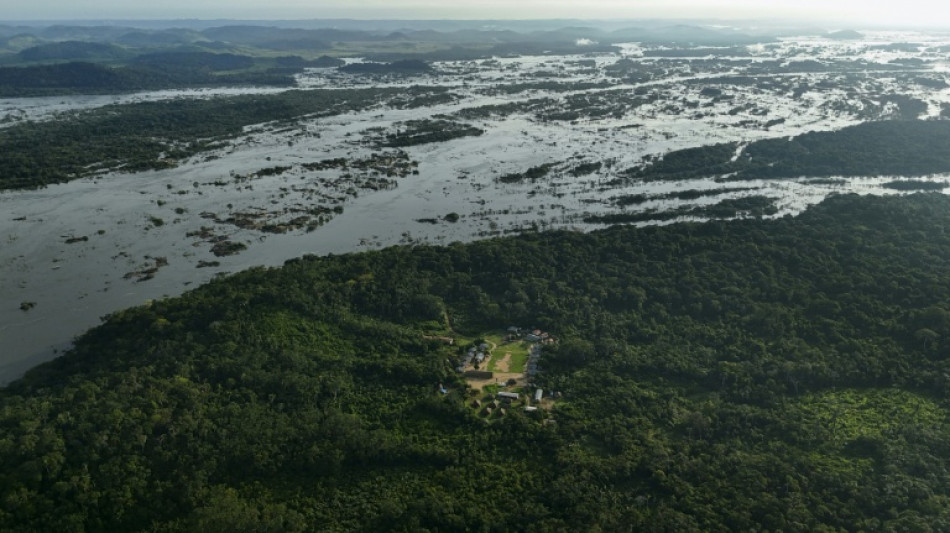
Proof of life: tracking elusive Amazon group to save their land / Photo: Carlos FABAL - AFP

 Flight data, satellite images reveal growing US role at Ecuador base

 McInnes feels 'guilt' ahead of Hearts return with Rangers

 Brazil's Lula turns 81, vows to work '24 hours a day'

 Boeing releases cautious growth plan as shares fall sharply
 Exiled Russian dissident Navalnaya warns dictators becoming 'more cunning'
 Bayern 'risk' reaps huge reward for Ballon d'Or winner Kane

 Record turnout as Israeli voters deliver verdict on Netanyahu
 Iraola says Isak 'feels the trust' after Liverpool scoring streak

 French media protest manhandling of journalists at far-right party rally

 EU seeks deportation powers for beefed up border agency
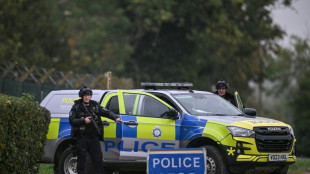 Two charged with UK security offences over airbase plot: police

 Maresca defends Donnarumma, Guehi after Man City defeat
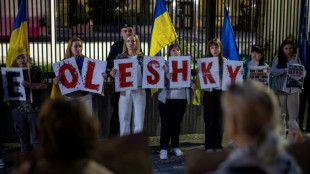 Nordic leaders call Putin as local truce begins in Ukraine

 Osaka unveils crane outfit in Tokyo before win over Paolini

 Ronaldo in line for Portugal return after fallout with coach

 Norway media take legal action to block Meta from using content

 Bayern praise 'humble' Kane after Ballon d'Or win

 Colts retain Daniel Jones as starter despite continued offensive struggles

 Madushanka wrecks Pakistan as Sri Lanka press for final slot
 Destructive Abhishek 113 leads India to series win over New Zealand

 Norway, Finland leaders hold 'frank and substantive' talk with Putin

 Wall Street faces earnings and Fed tests after turbulent technology-led week

 Ukraine, Russia say US-brokered truce holding in ravaged city
 Police form SIT after vehicles in Rahul Gandhi convoy collide on expressway

 Delhi grants minimum monthly pay and DA to about 4,000 MCD health workers
A ceramic pot and the shell of a turtle, once hunted for its meat, are the most recent traces of an Indigenous community thought to live deep in the north Brazilian Amazon.
Archaeological finds like these keep turning up, and date back to at least 2009, with members of a neighboring clan claiming to have caught glimpses of individuals who live in the Ituna/Itata region in Brazil's northern Para state.
For now, the nameless, elusive people -- perhaps belonging to more than one group -- remain among dozens of so-called "uncontacted" communities believed to roam the world's biggest rainforest.
"My sister-in-law told me: 'Over there! Over there!' And it was a little boy staring at me from up close," recounted Takamyi Asurini, an elder in Ita'aka -- an Indigenous village of about 300, whose accounts of close encounters have fed theories of the existence of uncontacted people in Ituna/Itata.
Asurini showed AFP a scar on his ribs he said was the result of being shot with an arrow by an unknown person in the jungle.
Such testimonies, and the objects found, are not considered proof of the existence of people in Ituna/Itata.
But it is enough for the region to enjoy a provisional protected status meant to prevent invasions by miners, loggers and ranchers -- preserving both the forest and the people thought to live there.
The area covers tens of thousands of hectares and is similar in size to Sao Paolo -- the biggest city in Latin America.
It became one of the most overrun Indigenous territories in Brazil under former president Jair Bolsonaro, a backer of agro-industry on whose watch Amazon deforestation surged.
Now, lobby groups want the Ituna/Itata region's protection to be made permanent, which would mean stricter land use rules and enforcement.
- 'Historical neglect' -
For this to happen, the government's National Foundation of Indigenous Peoples (Funai) would have to send expeditions to look for undeniable proof of the group's existence.
Part of the challenge is the dense Amazon jungle is home to rich, varied ecosystems that support migratory agriculture for Indigenous peoples, who may travel to hunt, fish and gather food seasonally.
Under law, any searchers cannot make contact with them -- potentially putting them at risk of diseases they have no immunity to -- but are to look instead for footprints of their life in the forest.
Brazil recognizes 114 "uncontacted" Indigenous groups who live with no or minimal interaction with others.
About a quarter are "confirmed," while for the rest -- like in Ituna/Itata -- there is "strong evidence" that they exist.
For Luiz Fernandes, a member of umbrella group Coordination of the Indigenous Organizations of the Brazilian Amazon (COIAB), there has been "historial neglect" of the issue by the state, which he says "recognizes the possibility of the existence of these peoples but does not guarantee effective measures to protect the territory."
Added Mita Xipaya, an Indigenous activist: "the state needs qualified records" to prove that an area hosts uncontacted people, "but for us it is different: we perceive them in nature, in the sounds we hear, their presences, sometimes their smells."
- 'Taking care of the forest' -
The Brazilian Amazon has lost nearly a third of its native vegetation since records began in 1988, according to environmental NGO Instituto Socioambiental -- except in Indigenous territories where the figure is less than two percent.
From 2019 to 2022, the Bolsonaro government suspended the provisional protection measures decreed for Ituna/Itata, prompting an invasion by land grabbers, turning it into the most deforested Indigenous area in Brazil.
Though the protection was reinstated under his leftist successor Luiz Inacio Lula da Silva, the consequences persist, and miles-wide patches of devastated soil intersperse areas of green rainforest, AFP observed during a recent flyover.
Brazil will in November host the COP30 UN climate conference in the Amazonian city of Belem under Lula, who has sought to position himself as a leader in forest preservation and the fight against global warming.
"It's not just about taking care of the forest but also of the people who inhabit it, because it's through them that the forest remains standing," COIAB coordinator Toya Manchineri told AFP.
Th.Gonzalez--AT