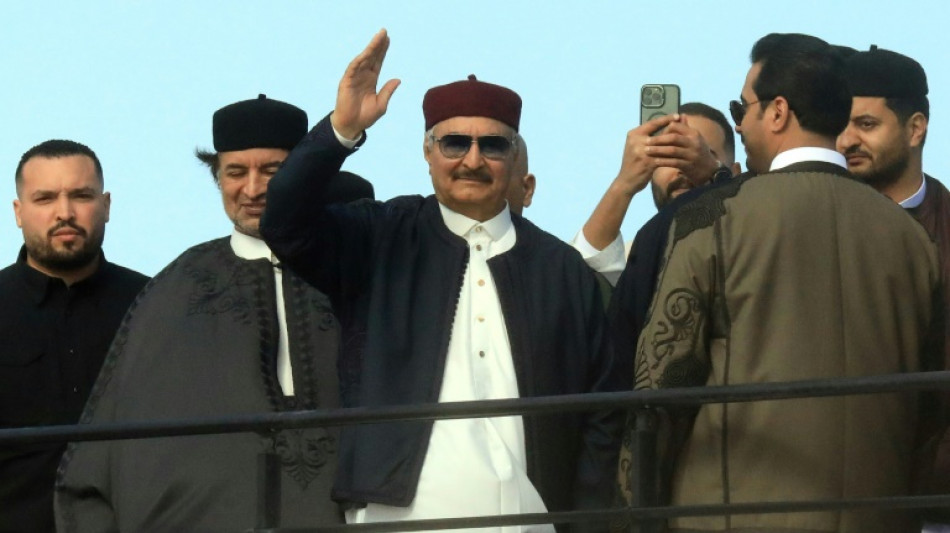
Libya commander Haftar seeks to force international engagement / Photo: Abdullah DOMA - AFP/File

 American woman convicted of getting military training from Islamic State

 Israel opposition holds narrow edge over Netanyahu in first projections

 Floriani hits maiden goal as Lazio go top
 Trump set to drastically loosen oil and gas sector's methane rules

 Storied Paris department store seeks bankruptcy protection
 Xhaka, Embolo can return to Swiss squad after fake Covid docs affair
 Allegri suspended for two Serie A games after red card
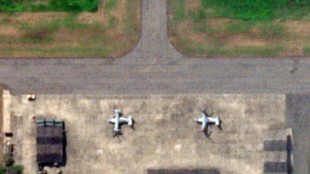 Flight data, satellite images reveal growing US role at Ecuador base
 McInnes feels 'guilt' ahead of Hearts return with Rangers

 Brazil's Lula turns 81, vows to work '24 hours a day'
 Boeing releases cautious growth plan as shares fall sharply

 Exiled Russian dissident Navalnaya warns dictators becoming 'more cunning'

 Bayern 'risk' reaps huge reward for Ballon d'Or winner Kane

 Record turnout as Israeli voters deliver verdict on Netanyahu
 Iraola says Isak 'feels the trust' after Liverpool scoring streak

 French media protest manhandling of journalists at far-right party rally

 EU seeks deportation powers for beefed up border agency
 Two charged with UK security offences over airbase plot: police
 Maresca defends Donnarumma, Guehi after Man City defeat

 Nordic leaders call Putin as local truce begins in Ukraine

 Osaka unveils crane outfit in Tokyo before win over Paolini

 Ronaldo in line for Portugal return after fallout with coach

 Norway media take legal action to block Meta from using content

 Bayern praise 'humble' Kane after Ballon d'Or win

 Colts retain Daniel Jones as starter despite continued offensive struggles

Libya's eastern authorities recently expelled a senior European delegation in a move analysts say was meant to send a message: the unrecognised administration backed by military leader Khalifa Haftar cannot be ignored.
On July 8, an EU commissioner and ministers from Greece, Italy and Malta were in Libya to discuss irregular migration from the North African country.
Their visit was divided in two, as is Libya, which is still grappling with the aftermath of the armed conflict and political chaos that followed the 2011 NATO-backed uprising that toppled longtime dictator Moamer Kadhafi.
The delegation first visited the capital Tripoli, seat of the internationally recognised Libyan government of Prime Minister Abdelhamid Dbeibah.
They then travelled to Benghazi, in the east, where a rival administration backed by Haftar and his clan is based, and with whom the EU has generally avoided direct contact.
Almost immediately, a reported disagreement prompted the eastern authorities to accuse the European delegation of a "flagrant breach of diplomatic norms", ordering the visiting dignitaries to leave.
In Brussels, the European Commission admitted a "protocol issue".
Tarek Megerisi, a senior policy fellow at the European Council on Foreign Relations think tank, said the scene at the airport "was a calculated move".
Haftar was playing to EU fears of irregular migration in order "to generate de facto European recognition", and thus "broaden relations with Europe away from just engagement with him as a local military leader".
Turning the delegation away showed that declining to engage with the eastern civilian administration was no longer an option.
- 'Punish Athens' -
The complex situation in Libya has required unusual diplomacy.
European governments recognise and work with the Tripoli-based government and not the eastern administration, but still hold contact with Haftar's military forces.
In their visit earlier this month, the European commissioner and ministers were meant to meet with eastern military officials.
But once at the Benghazi airport, they saw "there were people there that we had not agreed to meet", a European official in Brussels told journalists on condition of anonymity.
"We had to fly back," the official said, adding that "of course" it was linked to recognition of the eastern government.
Claudia Gazzini, a Libya expert at the International Crisis Group, said she did not believe "it was a premeditated incident".
But "the question does present itself as to why" ministers from the eastern government were at the airport in the first place, and why Haftar would let it play out the way it did, she said.
"We can't completely rule out that there was some particular issue or bilateral disagreement with one of the countries represented in the delegation," Gazzini added.
Libya expert Jalel Harchaoui suggested Greece may have been the target.
On July 6, two days before the axed visit, "the Greek foreign minister had come to demand concessions on migration and maritime (issues) without offering any tangible incentives", Harchaoui said.
Despite Haftar's personal involvement, the July 6 visit "had yielded nothing", added the expert.
Then, on July 8, "a Greek representative -- this time as part of an EU delegation -- wanted to negotiate on the same day with the rival Tripoli government, placing the two governments on an equal footing", he said.
This was "an affront in Benghazi's view", Harchaoui said, and the administration wanted to "punish Athens".
- Legitimacy -
To Harchaoui, the diplomatic flap was a sign not to "underestimate" the Haftars' foreign policy.
"The Haftar family is an absolutely essential actor" in tackling the influx of migrants or, for example, advancing energy projects, due to its key role in securing Libya's eastern coast, said Harchaoui.
The message delivered at the Benghazi airport "is clear: take the eastern faction seriously", he added.
Harchaoui said that the Haftars, already "rich in cash and strong" in terms of strategic assets, have recently increased efforts to "consolidate their legitimacy".
Haftar himself was hosted in February by French President Emmanuel Macron, and in May by Russia's Vladimir Putin.
And Haftar's son, Saddam, recently visited the United States, Turkey, Italy and Niger.
Even Ankara, which has provided support for the Tripoli-based government in repelling attacks from the east, "is now seeking to further profit off the Haftars through things like construction projects", said Megerisi.
He added that Turkey also has wider geopolitical ambitions, hoping to see the Haftars endorse a maritime border agreement in the eastern Mediterranean, which Tripoli had already signed but Athens regards as illegal.
E.Rodriguez--AT