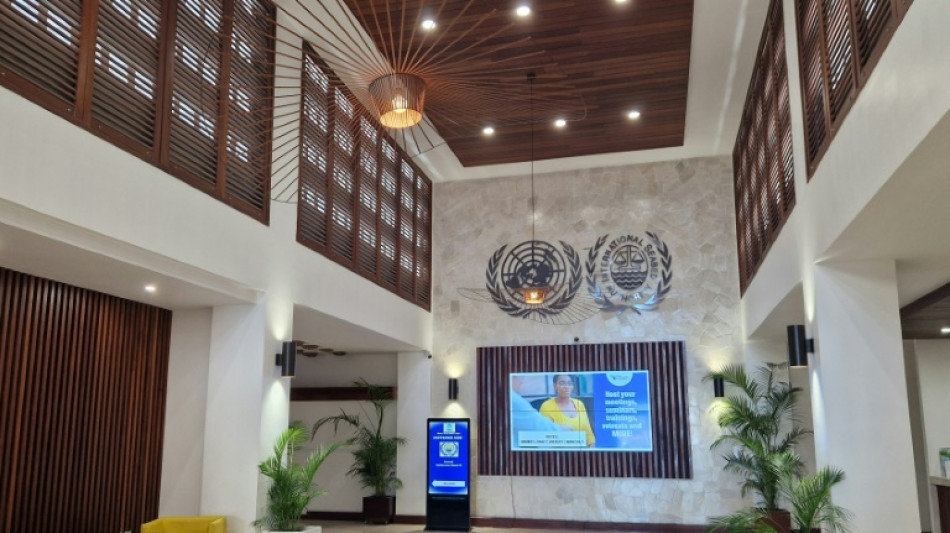
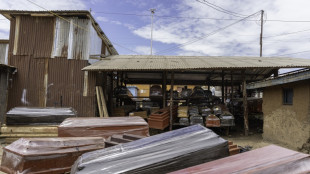
Restoring sea floor after mining may not be possible, researchers warn / Photo: Amélie BOTTOLLIER-DEPOIS - AFP/File

 American woman convicted of getting military training from Islamic State

 Israel opposition holds narrow edge over Netanyahu in first projections

 Floriani hits maiden goal as Lazio go top
 Trump set to drastically loosen oil and gas sector's methane rules

 Storied Paris department store seeks bankruptcy protection

 Xhaka, Embolo can return to Swiss squad after fake Covid docs affair

 Allegri suspended for two Serie A games after red card

 Flight data, satellite images reveal growing US role at Ecuador base

 McInnes feels 'guilt' ahead of Hearts return with Rangers

 Brazil's Lula turns 81, vows to work '24 hours a day'

 Boeing releases cautious growth plan as shares fall sharply

 Exiled Russian dissident Navalnaya warns dictators becoming 'more cunning'
 Bayern 'risk' reaps huge reward for Ballon d'Or winner Kane

 Record turnout as Israeli voters deliver verdict on Netanyahu

 Iraola says Isak 'feels the trust' after Liverpool scoring streak

 French media protest manhandling of journalists at far-right party rally

 EU seeks deportation powers for beefed up border agency

 Two charged with UK security offences over airbase plot: police

 Maresca defends Donnarumma, Guehi after Man City defeat
 Nordic leaders call Putin as local truce begins in Ukraine

 Osaka unveils crane outfit in Tokyo before win over Paolini

 Ronaldo in line for Portugal return after fallout with coach

 Norway media take legal action to block Meta from using content

 Bayern praise 'humble' Kane after Ballon d'Or win

 Colts retain Daniel Jones as starter despite continued offensive struggles

Scientists present at the latest effort to hash out international rules for deep-sea mining say it's unclear if it's possible to restore damaged sea floor ecosystems -- or how long it would take.
One of the last wild zones on the planet, the sea floor is a coveted frontier for companies and countries eager to access minerals that are in high demand for emerging technologies such as electric cars.
Particularly coveted are potato-sized nodules containing cobalt, nickel, copper and manganese, that are found in abundance on the seabed in the central Pacific Ocean.
Companies eager to vacuum up these polymetallic nodules say they can do it with minimal risk to the deep-sea environment.
But ocean defenders have battled against what they see as the advent of an industry that will threaten isolated ecosystems that are not yet well understood.
That threat was underscored by European scientists who presented findings this week on the sidelines of a meeting in Kingston, Jamaica of the International Seabed Authority, which is trying to finalize future rules for seabed mining.
"If we remove nodules from the seabed, we do not know what we lose, only that it's lost forever," was one of the conclusions of DEEP REST, a sea floor conservation research project.
The DEEP REST study cautioned against using seabed restoration "as a management action for impacted habitats."
"So far, all the restoration operations we have attempted within our DEEP REST project have been short-term. And what we observed, is that in the given time, that is to say a few years, the ecosystems do not recover," said Jozee Sarrazin, a researcher at the French Institute for Ocean Science, or Ifremer.
"If restoration is possible, it will take a very long time, and at the moment we don't have the data to be able to say if that will be 100 years or 1000 years," the DEEP REST coordinator told AFP.
Despite the pressure, the cold, the total darkness, and the lack of nutrition sources at the bottom of the ocean, it is teeming with life.
The number of species who live on the deep seabed is not yet known but estimated to be in the millions.
- Soft corals, sea anemone -
Broad swathes of the Pacific Ocean where polymetallic nodules are found shelter fauna such as sponges, soft corals or sea anemones.
The fauna "only exists in these areas because they need the hard substrate of the nodule to attach," said Matthias Haeckel of the German research center GEOMAR, which presented results of the MiningImpact project in Kingston this week.
Vacuuming up these nodules and spreading sediment over the impacted areas reduces population densities, biodiversity and the functioning of ecosystems, MiningImpact's study found.
"To make the story short, in the end, we're talking about recovery times of thousands of years," Haeckel said. The nodules themselves form over millions of years.
Some research on restoration efforts is underway but the results are not yet in.
"We designed artificial nodules made of deep-sea clay and we placed them at different sites" at depths of about 4,500 meters (14,700 feet), Sabine Gollner, a biologist at the Royal Netherlands Institute for Sea Research, told AFP.
"But when you take into account the slow growth rates in the deep sea, the slow processes, it will take quite some more years to find out if restoration is effective and to what degree," she said.
Massive deposits of sulfide -- a type of mineral deposit found in underwater vents that spit out seawater heated by magma -- should be off-limits, the researchers suggest.
These types of underwater geysers are teeming with astonishing and unique biodiversity.
"If we extract massive sulfides near active vents, we know what we lose, and we must prevent loss," the DEEP REST study says.
But according to Gollner, it would be good to incorporate restoration goals into the mining code being negotiated by the International Seabed Authority's member states.
"It's good to include it but with a clear statement that at this moment in time, it cannot be taken into account to reach agreed environmental goals," she said.
"For example, a contractor shouldn't be allowed to use that argument to mine a larger area."
A.Anderson--AT